Department of Child and Adolescent Psychiatry, Psychotherapy and Psychosomatics, University Hospital Leipzig, Leipzig, Germany.
Department of Child and Adolescent Psychiatry, Psychosomatics and Psychotherapy, Goethe University Frankfurt, Frankfurt, Germany.
PLoS One. 2019 Apr 3;14(4):e0214936. doi: 10.1371/journal.pone.0214936. eCollection 2019.
Prisoners have a higher risk of suicide compared to non-incarcerated individuals. One aim of suicide prevention for prisoners is to identify risk factors in order to put stronger support mechanisms in place for the more vulnerable detainees. This study investigates the suicide risk (SR) in offence-related sub-populations in a representative German sample and differentiates between SR for adolescent and adult prisoners.
Conducting a national study with data from public German records on the entire prison population from 2000 to 2016 and suicide numbers in German prisons in the same period, SR was calculated for the total male prison population as well as for both subgroups, adolescent and adult male prisoners.
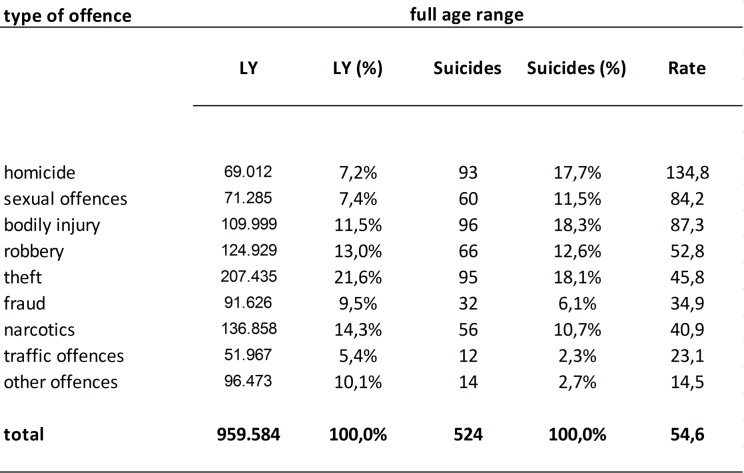
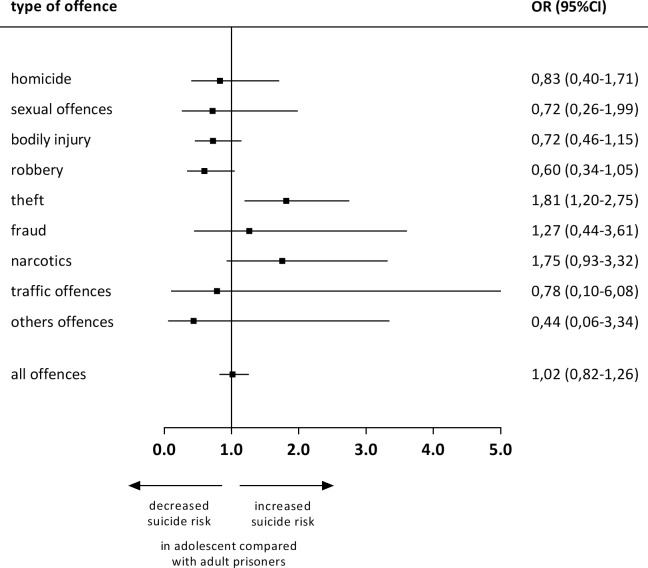
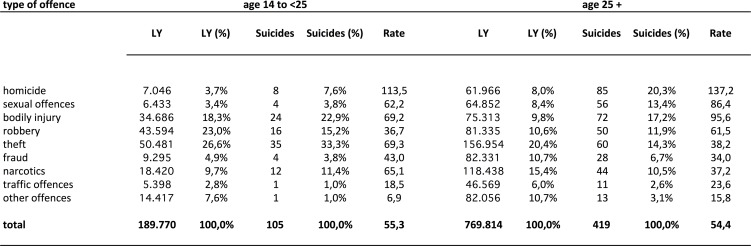
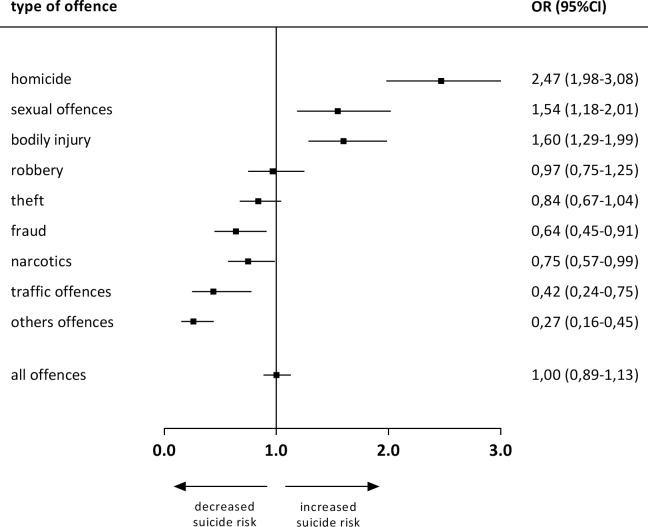
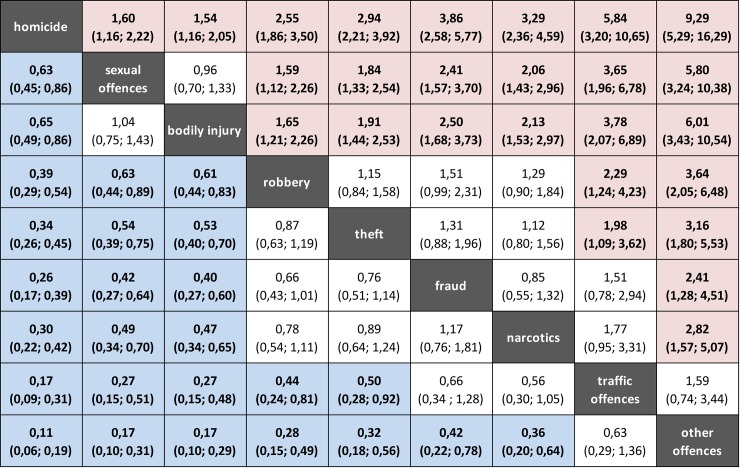
In the study period, male prisoners spent 959.584 life years (LY) in German criminal detention. Among those, 524 prisoners died of suicide. SR was higher for detainees imprisoned for an offence resulting in extensive physical harm for another person, e.g. homicide (suicide rate = 134,8 suicides per 100.000 LY; OR = 2,47; CI95%: 1,98-3,08), bodily injury (suicide rate = 87,3; OR = 1,60; CI95%: 1,29-1,99), and sexual offences (suicide rate = 84,2; OR = 1,54; CI95%: 1,18-2,01) compared with the SR of the total prison population (suicide rate = 54.6). Age differences between offence-related SR were found for theft, with adolescents (suicide rate = 69,3; OR = 1,25; CI95%: 0,85-1,84) showing higher SR than adults (suicide rate = 38,2; OR = 0,7; CI95%: 0,54-0,92).
The index offence of detainees is associated with SR and age-related differences exist. Suicide prevention in prisons should take both into account to determine populations at risk.
囚犯的自杀风险高于非监禁个体。预防囚犯自杀的一个目标是确定风险因素,以便为更脆弱的被拘留者建立更强有力的支持机制。本研究调查了德国代表性样本中与犯罪相关的亚人群的自杀风险(SR),并区分了青少年和成年囚犯的 SR。
对 2000 年至 2016 年期间德国公共记录中的整个监狱人口数据和同期德国监狱中的自杀人数进行全国性研究,计算了男性总监狱人口以及青少年和成年男性囚犯两个亚组的 SR。
在研究期间,男性囚犯在德国刑事拘留中度过了 959.584 个生命年(LY)。其中,有 524 名囚犯死于自杀。因犯罪导致对他人造成广泛身体伤害的囚犯(例如杀人罪,自杀率=134,每 100.000 LY 有 87.3 例自杀;OR=2.47;95%CI:1.98-3.08)、人身伤害罪(自杀率=87.3;OR=1.60;95%CI:1.29-1.99)和性犯罪(自杀率=84.2;OR=1.54;95%CI:1.18-2.01)的囚犯的 SR 高于总监狱人口的 SR(自杀率=54.6)。在与犯罪相关的 SR 中,还发现了盗窃行为的年龄差异,青少年(自杀率=69.3;OR=1.25;95%CI:0.85-1.84)的 SR 高于成年人(自杀率=38.2;OR=0.7;95%CI:0.54-0.92)。
被拘留者的犯罪指数与 SR 相关,并且存在与年龄相关的差异。监狱中的自杀预防应同时考虑这两个因素,以确定风险人群。