Department of Epidemiology and Biostatistics, School of Public Health, Imperial College London, London, UK.
MRC-PHE Centre for Environment and Health, Imperial College London, London, UK.
J Epidemiol Community Health. 2019 Aug;73(8):693-702. doi: 10.1136/jech-2018-212010. Epub 2019 Apr 3.
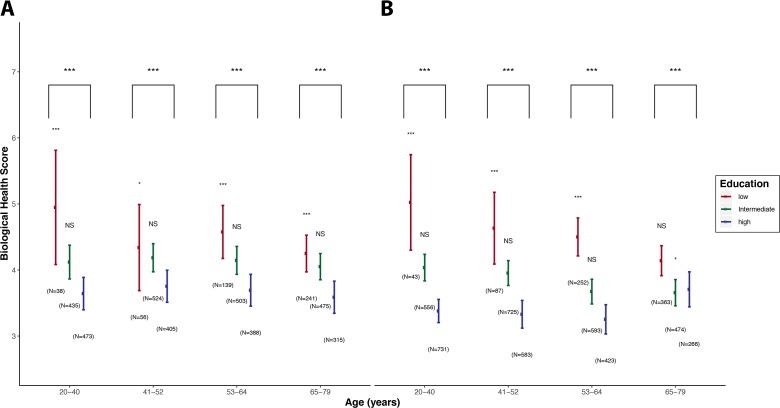
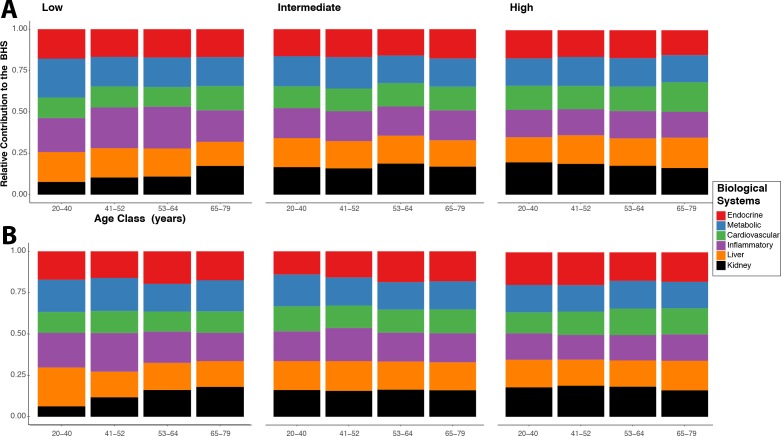
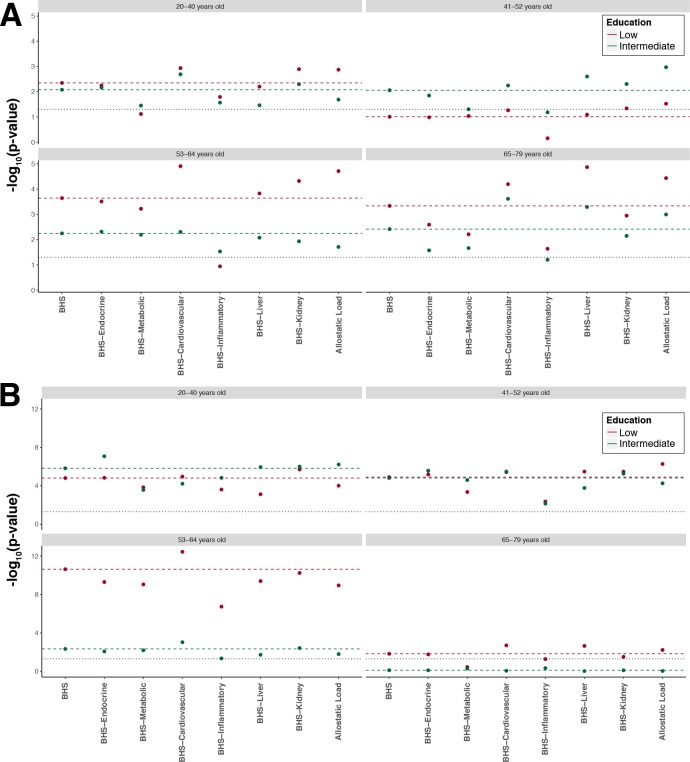
Social position is known to play a role in the quality of ageing, notably through the stimulation/dysregulation of key physiological systems in response to external stresses. Using data from one wave of including 9088 participants, we defined, as an extension of the allostatic load, a synthetic Biological Health Score (BHS) capturing the wear-and-tear of four physiological systems (endocrine, inflammatory, cardiovascular and metabolic systems) and two organs (liver and kidney). We used 16 established blood-derived biomarkers of these systems to calculate the BHS and explored the relative contribution of socioeconomic position to the BHS and its main components across age groups. We identified a systematic decreasing education-related gradient of the BHS (p<0.001) leading to lower biological risk in participants with longer education. Education-related differences in the BHS were detected early in life, and were not attributable to lifestyle and behavioural factors. We found a consistent contribution of the inflammatory and metabolic systems to the overall score throughout from early adulthood onwards, while the contribution of the other four systems seems to vary across age groups and gender. Our findings highlight the social-to-biological processes ultimately leading to health inequalities, and suggest that such disparities can already be detected in the 20-40 years old age group and cannot be fully explained by lifestyle and behavioural factors. This may define early adulthood social condition as a precursor to accelerated biological ageing and as an important target for public health policies.
社会地位已知在衰老质量中起作用,特别是通过响应外部压力调节关键生理系统。利用来自包括 9088 名参与者的一波数据,我们将一种综合的生物健康评分(BHS)定义为适应负荷的扩展,该评分反映了四个生理系统(内分泌、炎症、心血管和代谢系统)和两个器官(肝脏和肾脏)的磨损情况。我们使用这些系统的 16 种已建立的血液衍生生物标志物来计算 BHS,并探索了社会经济地位对 BHS 及其主要组成部分在不同年龄组中的相对贡献。我们发现,BHS 与教育程度呈系统性负相关(p<0.001),即教育程度较高的参与者生物风险较低。BHS 中的教育相关差异在生命早期就已经存在,并且不能归因于生活方式和行为因素。我们发现,从成年早期开始,炎症和代谢系统对整体评分的贡献是一致的,而其他四个系统的贡献似乎因年龄组和性别而异。我们的研究结果强调了导致健康不平等的社会到生物学过程,并表明这种差异在 20-40 岁年龄组就可以检测到,并且不能完全用生活方式和行为因素来解释。这可能将成年早期的社会状况定义为加速生物学衰老的前兆,并成为公共卫生政策的重要目标。