Mahin Samadi Pariya, Gerami Parmida, Elmi Ali, Khanaki Korosh, Faezi Sobhan
Department of Microbiology, Pharmaceutical Sciences Branch, Islamic Azad University, Tehran, Iran.
Department of Microbiology, Biology Research Center, Zanjan Branch, Islamic Azad University, Zanjan, Iran.
Iran J Basic Med Sci. 2019 Jan;22(1):58-64. doi: 10.22038/ijbms.2018.31499.7643.
infections such as keratitis are considered among the major health problems worldwide due to the complexity of pathogenesis and antibiotic resistance crisis, thus, finding new effective approaches for prevention and treatment of the infections seem to be still vital. In this report, we aimed to investigate the therapeutic effects of topical administration of the antibodies against type a and b-flagellin (FLA and FLB) in keratitis model of infection in mice.
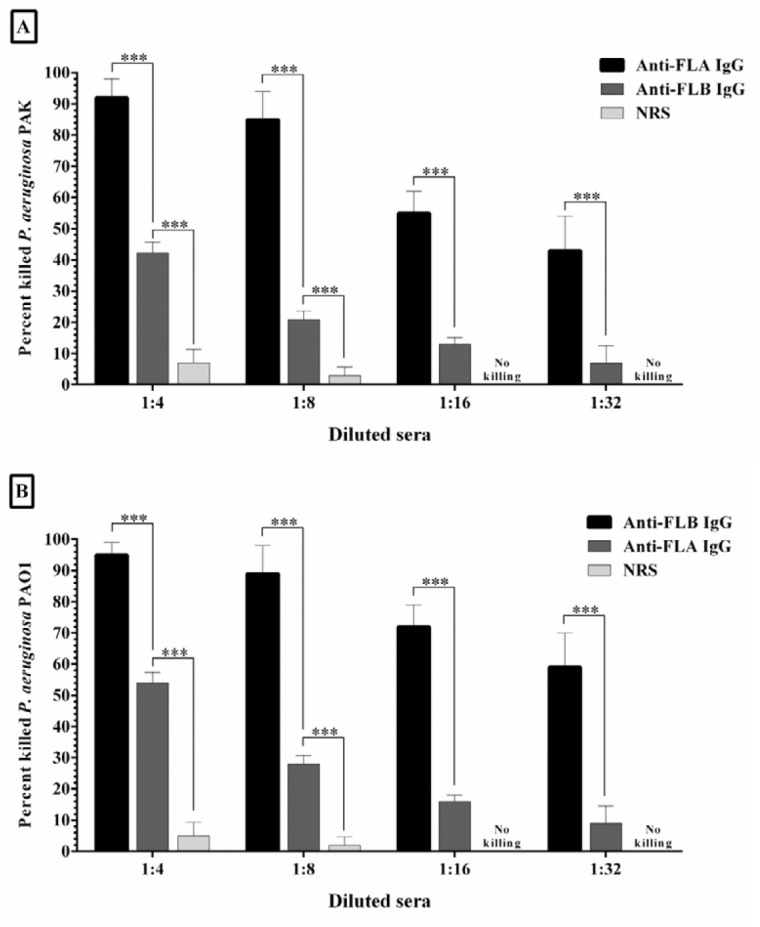
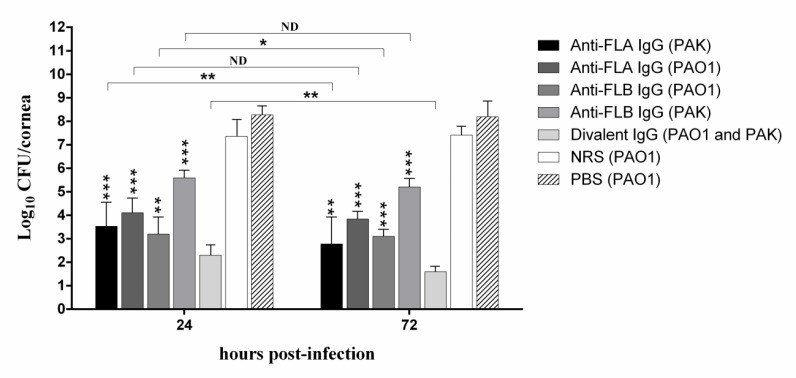
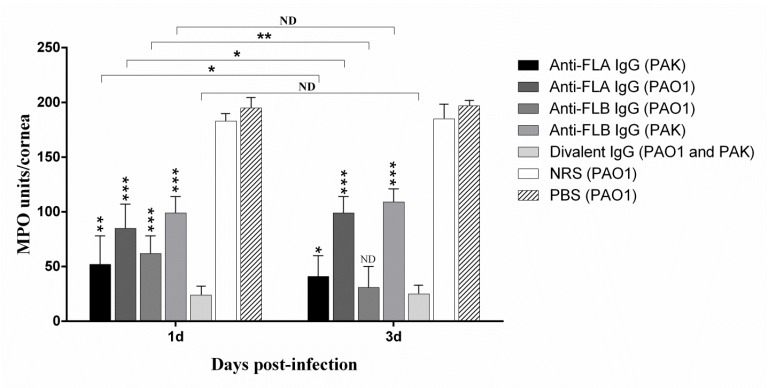
Scratched corneas of mice were treated with approximately 10 CFUs/eye of PAK and/or PAO1 strains of . Specific IgG to FLA, FLB or divalent flagellin were topically applied to the infected corneas for 20 min, 24, and 36 hr post-infection. The bacterial burden and myeloperoxidase activity (as a marker for polymorphonuclears (PMNs) infiltration) were determined in the corneas. The biological activity of the anti-FLA and FLB IgG was evaluated by opsonophagocytosis test.
Compared to other treated corneas, divalent anti-flagellin IgG treatment showed a significant decrease in the bacterial CFUs and myeloperoxidase activity in the infected corneas (<0.05). Results of opsonophagocytosis revealed that the specific antibodies raised against FLA and FLB had more potent opsonic killing activity on their homologous strains as compared with control group (<0.05).
It appears that in keratitis, topical administration of the combined antibodies likely via decreasing the bacterial load, and PMNs infiltration as well as increasing opsonophagocytosis could lead to dramatic improvement of the infected corneas.
由于发病机制复杂和抗生素耐药危机,角膜炎等感染被认为是全球主要的健康问题之一,因此,寻找预防和治疗这些感染的新有效方法似乎仍然至关重要。在本报告中,我们旨在研究局部给予抗a型和b型鞭毛蛋白(FLA和FLB)抗体对小鼠感染性角膜炎模型的治疗效果。
用约10 CFU/眼的PAK和/或PAO1菌株处理小鼠的划痕角膜。在感染后20分钟、24小时和36小时,将针对FLA、FLB或二价鞭毛蛋白的特异性IgG局部应用于感染的角膜。测定角膜中的细菌载量和髓过氧化物酶活性(作为多形核白细胞(PMN)浸润的标志物)。通过调理吞噬试验评估抗FLA和FLB IgG的生物活性。
与其他处理的角膜相比,二价抗鞭毛蛋白IgG处理使感染角膜中的细菌CFU和髓过氧化物酶活性显著降低(<0.05)。调理吞噬试验结果显示,与对照组相比,针对FLA和FLB产生的特异性抗体对其同源菌株具有更强的调理杀伤活性(<0.05)。
在角膜炎中,局部给予联合抗体可能通过降低细菌载量和PMN浸润以及增强调理吞噬作用,从而显著改善感染的角膜。