Department of Immunology, Mudanjiang Medical College, Mudanjiang, Heilongjiang, People's Republic of China.
Department of Pathophysiology, Mudanjiang Medical College, Mudanjiang, Heilongjiang, People's Republic of China.
J Cell Mol Med. 2019 Jun;23(6):3824-3832. doi: 10.1111/jcmm.14210. Epub 2019 Apr 3.
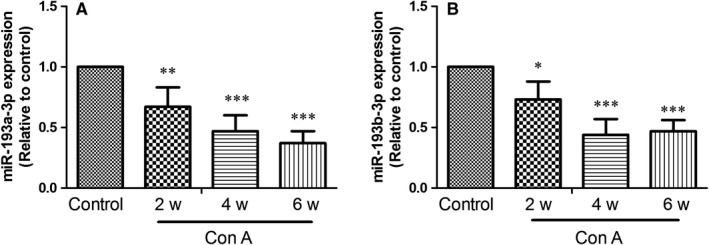
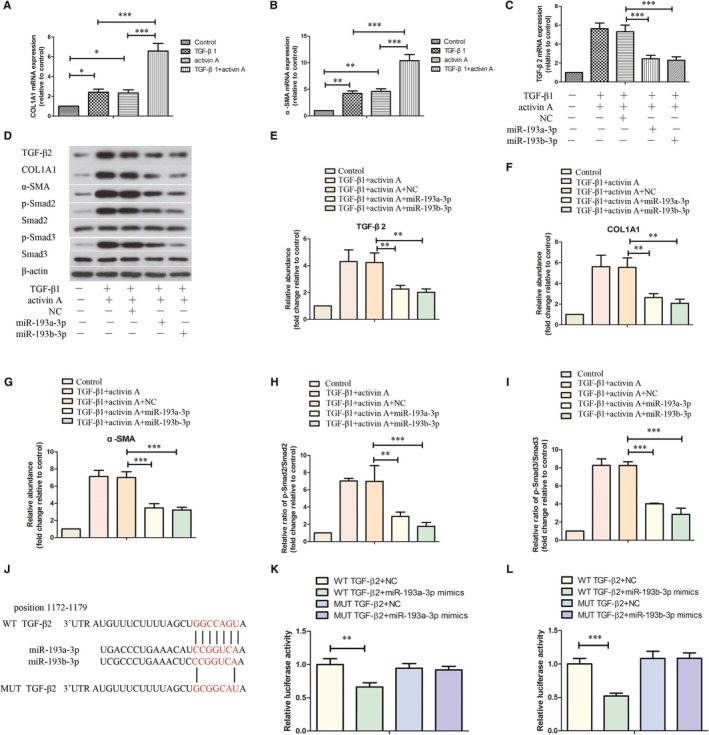
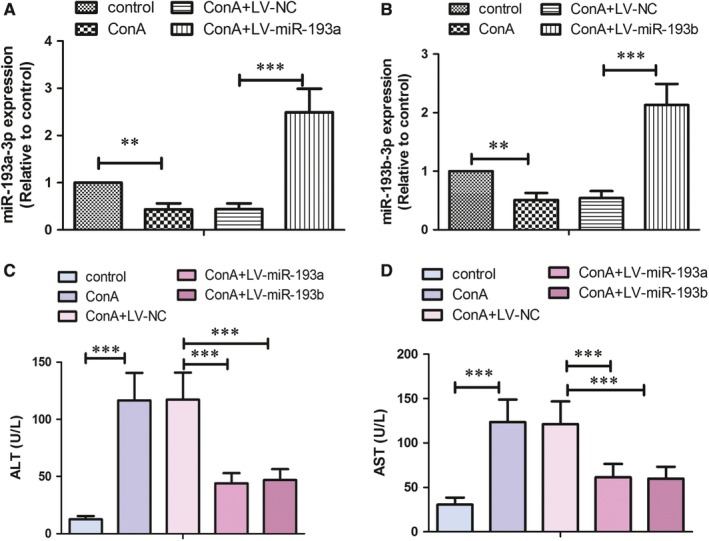
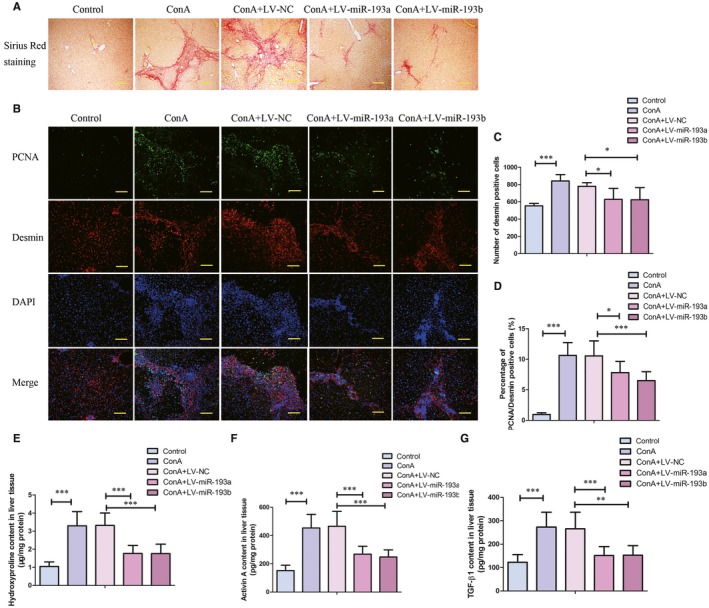
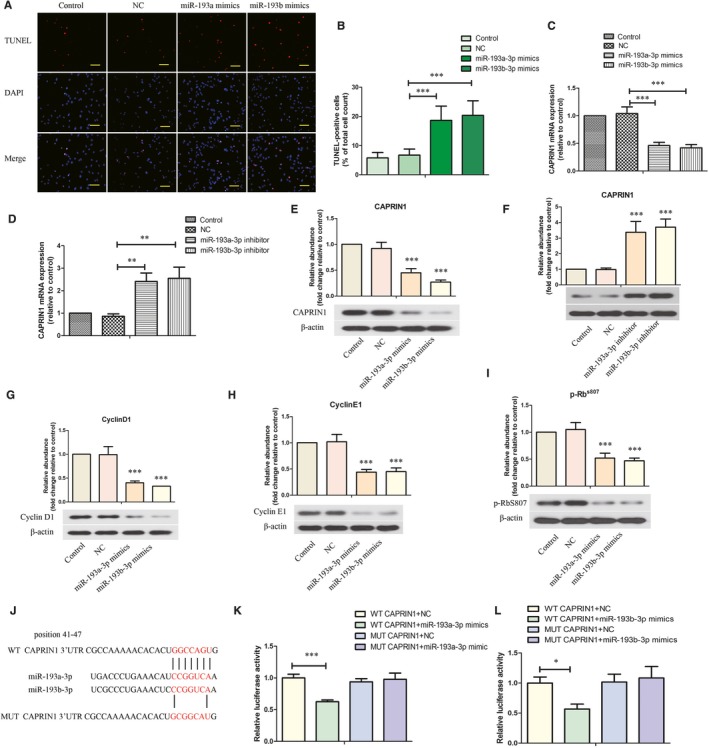
MicroRNAs (miRNAs) have been confirmed to participate in liver fibrosis progression and activation of hepatic stellate cells (HSCs). In this study, the role of miR-193a/b-3p in concanavalin A (ConA)-induced liver fibrosis in mice was evaluated. According to the results, the expression of miR-193a/b-3p was down-regulated in liver tissues after exposure to ConA. Lentivirus-mediated overexpression of miR-193a/b-3p reduced ConA-induced liver injury as demonstrated by decreasing ALT and AST levels. Moreover, ConA-induced liver fibrosis was restrained by the up-regulation of miR-193a/b-3 through inhibiting collagen deposition, decreasing desmin and proliferating cell nuclear antigen (PCNA) expression and lessening the content of hydroxyproline, transforming growth factor-β1 (TGF-β1) and activin A in liver tissues. Furthermore, miR-193a/b-3p mimics suppressed the proliferation of human HSCs LX-2 via inducing the apoptosis of LX-2 cells and lowering the levels of cell cycle-related proteins Cyclin D1, Cyclin E1, p-Rb and CAPRIN1. Finally, TGF-β1 and activin A-mediated activation of LX-2 cells was reversed by miR-193a/b-3p mimics via repressing COL1A1 and α-SMA expression, and restraining the activation of TGF-β/Smad2/3 signalling pathway. CAPRIN1 and TGF-β2 were demonstrated to be the direct target genes of miR-193a/b-3p. We conclude that miR-193a/b-3p overexpression attenuates liver fibrosis through suppressing the proliferation and activation of HSCs. Our data suggest that miR-193a-3p and miR-193b-3p may be new therapeutic targets for liver fibrosis.
微小 RNA(miRNA)已被证实参与肝纤维化的进展和肝星状细胞(HSCs)的激活。在本研究中,评估了 miR-193a/b-3p 在伴刀豆球蛋白 A(ConA)诱导的小鼠肝纤维化中的作用。结果表明,暴露于 ConA 后,肝组织中 miR-193a/b-3p 的表达下调。通过降低 ALT 和 AST 水平,miR-193a/b-3p 的过表达通过抑制胶原沉积、减少结蛋白和增殖细胞核抗原(PCNA)的表达以及降低羟脯氨酸、转化生长因子-β1(TGF-β1)和激活素 A 在肝组织中的含量,抑制 ConA 诱导的肝纤维化。此外,miR-193a/b-3p 模拟物通过诱导 LX-2 细胞凋亡和降低细胞周期相关蛋白 Cyclin D1、Cyclin E1、p-Rb 和 CAPRIN1 的水平,抑制人 HSCs LX-2 的增殖。最后,miR-193a/b-3p 模拟物通过抑制 COL1A1 和 α-SMA 表达以及抑制 TGF-β/Smad2/3 信号通路的激活,逆转了 TGF-β1 和激活素 A 介导的 LX-2 细胞的激活。CAPRIN1 和 TGF-β2 被证明是 miR-193a/b-3p 的直接靶基因。我们得出结论,miR-193a/b-3p 的过表达通过抑制 HSCs 的增殖和激活来减轻肝纤维化。我们的数据表明,miR-193a-3p 和 miR-193b-3p 可能是肝纤维化的新治疗靶点。