Micale Vincenzo, Drago Filippo, Noerregaard Pia K, Elling Christian E, Wotjak Carsten T
Research Group "Neuronal Plasticity", Max Planck Institute of Psychiatry, Munich, Germany.
Department of Biomedical and Biotechnological Sciences, Section of Pharmacology, University of Catania, Catania, Italy.
Front Pharmacol. 2019 Mar 20;10:207. doi: 10.3389/fphar.2019.00207. eCollection 2019.
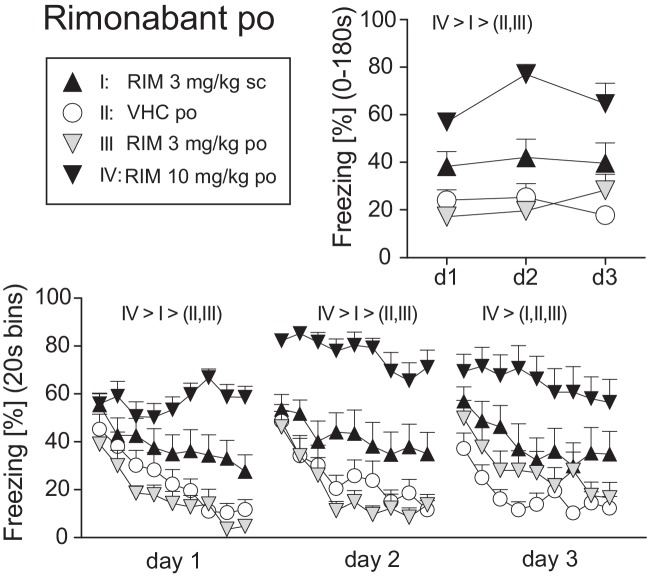
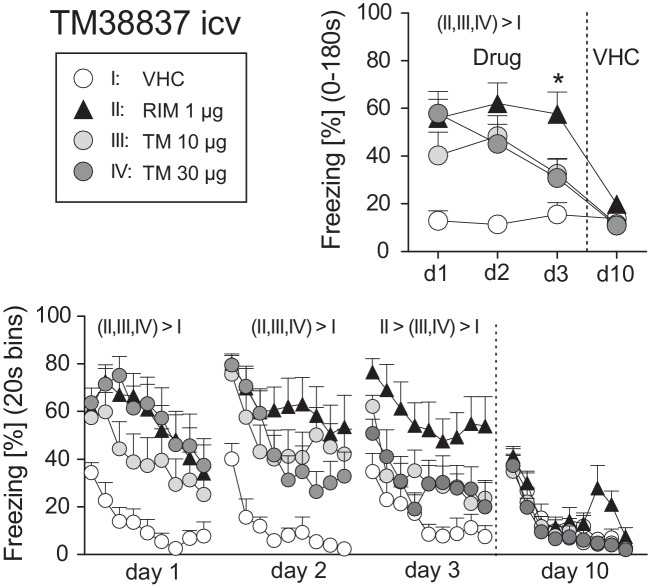
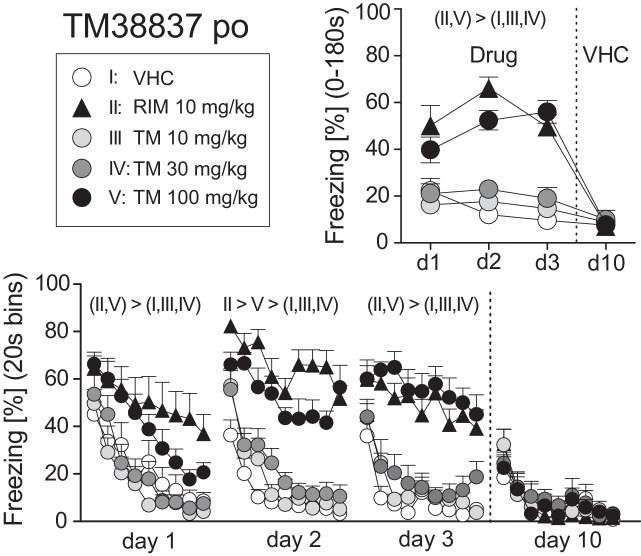
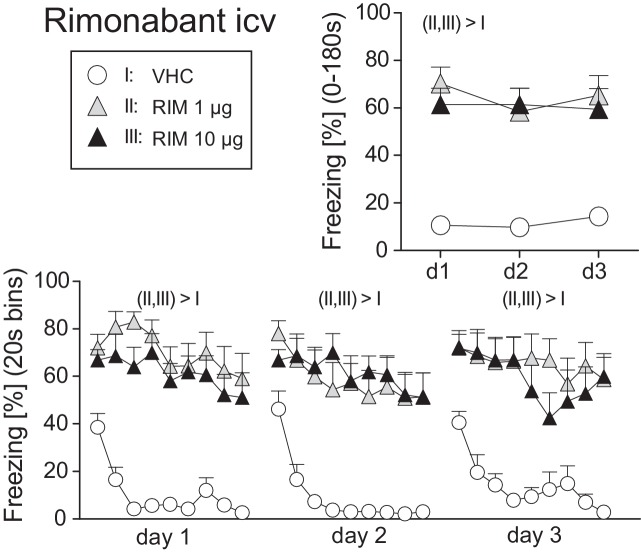
Rimonabant was the first selective CB1 antagonist/inverse agonist introduced into clinical practice to treat obesity and metabolic-related disorders. It was withdrawn from market due to the notably increased rates of psychiatric side effects. We have evaluated TM38837, a novel, largely peripherally restricted CB1 antagonist, in terms of fear-promoting consequences of systemic vs. intracerebral injections. Different groups of male C57BL/6 N mice underwent auditory fear conditioning, followed by re-exposure to the tone. Mice were treated (p.o.) with TM38837 (10, 30, or 100 mg/kg), rimonabant (10 mg/kg; a brain penetrating CB1 antagonist/inverse agonist which served as a positive control), or vehicle, 2 h prior the tone presentation. Only the high dose of TM38837 (100 mg/kg) induced a significant increase in freezing behavior, similar to that induced by rimonabant (10 mg/kg) ( < 0.001). If injected into the brain both TM38837 (10 or 30 μg/mouse) and rimonabant (1 or 10 μg/mouse) caused a sustained fear response to the tone, which was more pronounced after rimonabant treatment. Taken together, TM38837 was at least one order of magnitude less effective in promoting fear responses than rimonabant. Given the equipotency of the two CB1 antagonists with regard to weight loss and metabolic syndrome-like symptoms in rodent obesity models, our results point to a critical dose range in which TM3887 might be beneficial for indications such as obesity and metabolic disorders with limited risk of fear-promoting effects.
利莫那班是首个引入临床实践用于治疗肥胖症及代谢相关疾病的选择性CB1拮抗剂/反向激动剂。因其精神副作用发生率显著增加而退市。我们评估了新型、主要作用于外周的CB1拮抗剂TM38837经全身注射与脑内注射后引发恐惧的后果。不同组的雄性C57BL/6 N小鼠先进行听觉恐惧条件训练,随后再次暴露于该音调下。在音调呈现前2小时,小鼠经口给予TM38837(10、30或100 mg/kg)、利莫那班(10 mg/kg;一种可穿透脑的CB1拮抗剂/反向激动剂,用作阳性对照)或赋形剂。仅高剂量的TM38837(100 mg/kg)引起僵住行为显著增加,类似于利莫那班(10 mg/kg)所诱导的(<0.001);若脑内注射,TM38837(10或30 μg/小鼠)和利莫那班(1或10 μg/小鼠)均引起对该音调的持续恐惧反应,利莫那班治疗后更明显。总体而言,TM38837在促进恐惧反应方面的效力比利莫那班至少低一个数量级。鉴于在啮齿动物肥胖模型中这两种CB1拮抗剂在减肥和代谢综合征样症状方面等效,我们的结果指出了一个关键剂量范围,在此剂量范围内TM3887可能对肥胖症和代谢紊乱等适应症有益,同时引发恐惧效应的风险有限。