Department of Cutaneous Oncology, Moffitt Cancer Center and Research Institute, University of South Florida School of Medicine, 10920 N. McKinley Drive, Room 4123, Tampa, FL, 33612, USA.
Department of Surgery, Rogel Cancer Center University of Michigan, Ann Arbor, MI, USA.
Ann Surg Oncol. 2020 Jan;27(1):196-202. doi: 10.1245/s10434-019-07333-8. Epub 2019 Apr 4.
Robotic pelvic lymphadenectomy (rPLND) has been demonstrated to be a safe and effective minimally invasive approach for patients with metastatic melanoma to the iliac nodes. However, the long-term oncologic benefit of this procedure remains poorly defined.
A single-institutional study comparing perioperative outcomes and survival [recurrence-free (RFS) and overall survival (OS)] between rPLND and open PLND (oPLND) for metastatic melanoma was conducted.
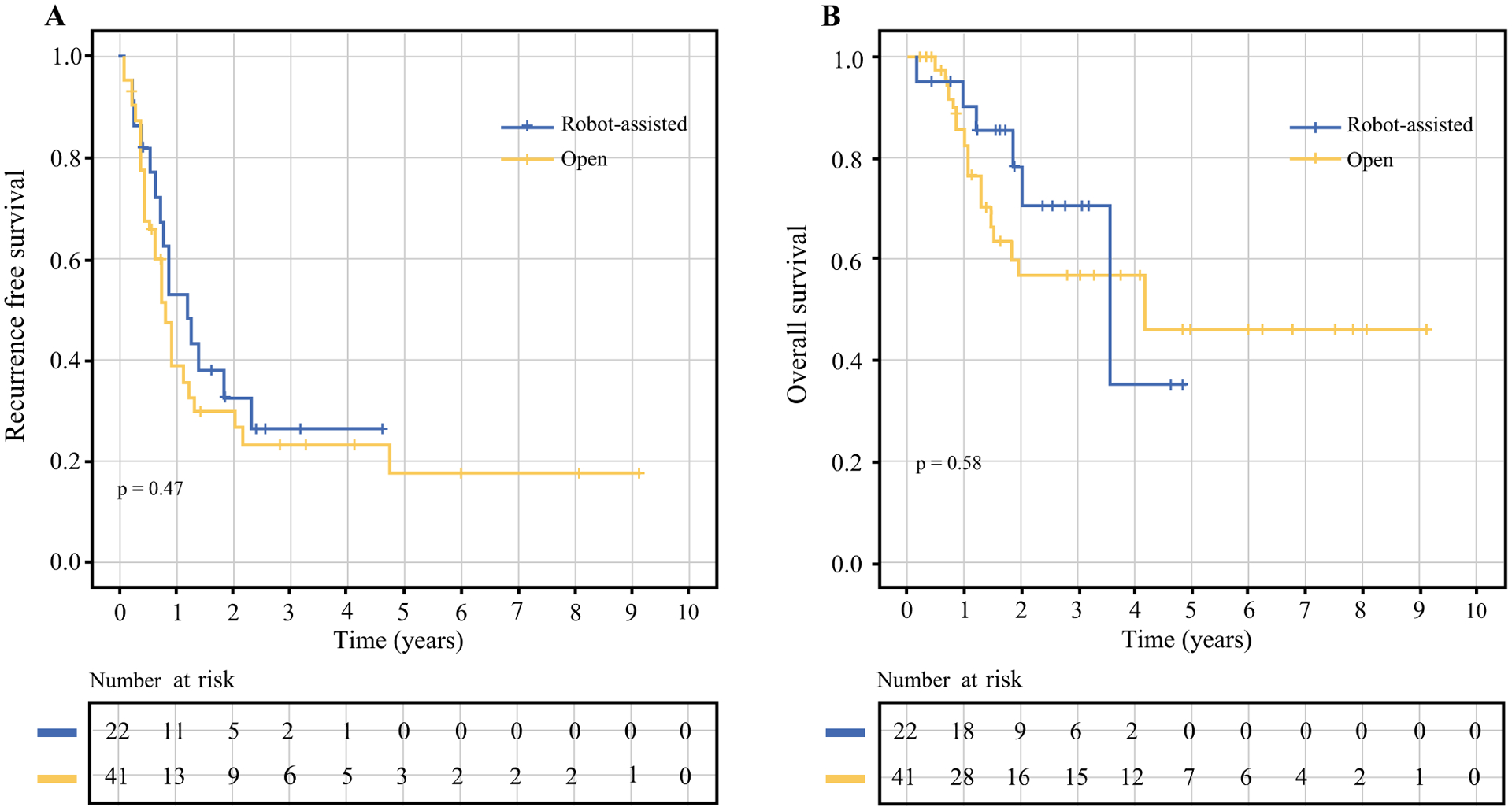
From 2006 to 2018, a total of 63 PLND cases were identified: 22 rPLND and 41 oPLND. Evidence of isolated pelvic metastasis was the most common indication for PLND in both groups (rPLND: 64%, oPLND: 85%). There was no difference in median pelvic lymph node yield (11 vs. 9 nodes, p = 0.65). Neither treatment group experienced a Clavien-Dindo complication ≥ 3. rPLND was associated with a shorter length of stay compared with oPLND (2 vs. 4 days, p < 0.001). With a median follow-up of 37 months, there was no difference in RFS (14.4 vs. 9.6 months, p = 0.47) and OS (43 vs. 50 months, p = 0.58) between rPLND and oPLND, respectively. In basin recurrence was low with 1 (4.5%) and 3 (7.3%) patients in the rPLND and oPLND cohorts, respectively, experiencing an event (p = 0.9).
rPLND for metastatic melanoma is a safe, minimally invasive treatment strategy that appears to result in similar intermediate term recurrence and survival rates as oPLND but shorter hospital stays.
机器人盆腔淋巴结清扫术(rPLND)已被证明是一种安全有效的微创方法,适用于髂淋巴结转移的黑色素瘤患者。然而,该手术的长期肿瘤学获益仍未明确。
本研究进行了一项单机构研究,比较了机器人辅助盆腔淋巴结清扫术(rPLND)与开放盆腔淋巴结清扫术(oPLND)治疗转移性黑色素瘤的围手术期结果和生存情况(无复发生存(RFS)和总生存(OS))。
2006 年至 2018 年,共确定了 63 例 PLND 病例:22 例 rPLND 和 41 例 oPLND。两组中最常见的 PLND 指征均为孤立性盆腔转移(rPLND:64%,oPLND:85%)。盆腔淋巴结清扫的中位淋巴结数目无差异(11 个 vs. 9 个,p=0.65)。两组均无 Clavien-Dindo 并发症≥3 级。与 oPLND 相比,rPLND 的住院时间更短(2 天 vs. 4 天,p<0.001)。中位随访 37 个月时,rPLND 和 oPLND 的 RFS(14.4 个月 vs. 9.6 个月,p=0.47)和 OS(43 个月 vs. 50 个月,p=0.58)无差异。在 rPLND 和 oPLND 队列中,分别有 1 例(4.5%)和 3 例(7.3%)患者出现盆部复发(p=0.9),复发率较低。
rPLND 治疗转移性黑色素瘤是一种安全、微创的治疗策略,其似乎与 oPLND 具有相似的中期复发率和生存率,但住院时间更短。