Department of Human Genetics, Graduate School of Public Health, University of Pittsburgh, Pittsburgh, PA, USA; Department of Epidemiology, Graduate School of Public Health, University of Pittsburgh, Pittsburgh, PA, USA; Department of Psychiatry, School of Medicine, University of Pittsburgh, Pittsburgh, PA, USA.
Department of Human Genetics, Graduate School of Public Health, University of Pittsburgh, Pittsburgh, PA, USA.
Neurobiol Aging. 2019 Dec;84:239.e15-239.e24. doi: 10.1016/j.neurobiolaging.2019.02.024. Epub 2019 Mar 11.
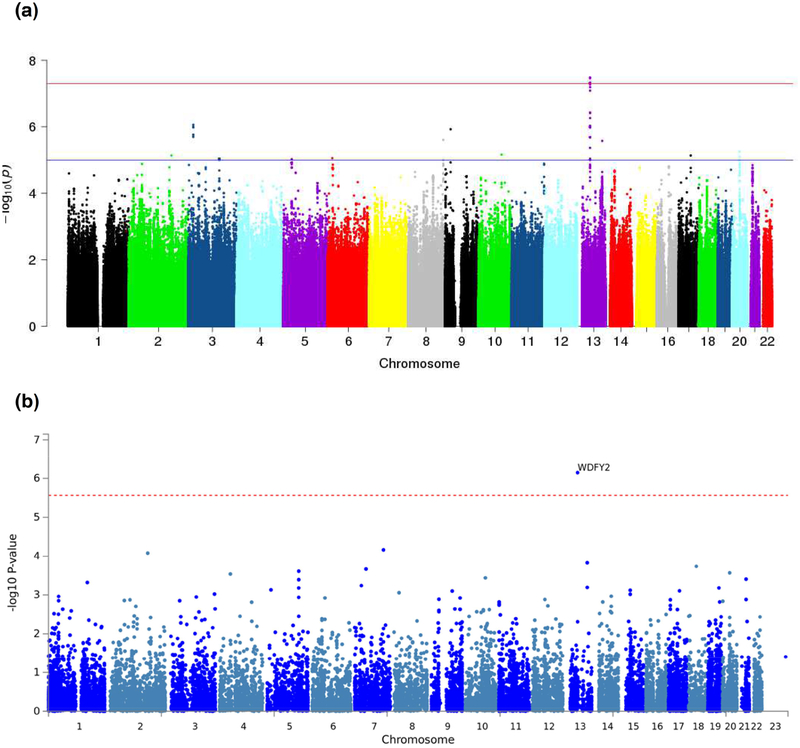
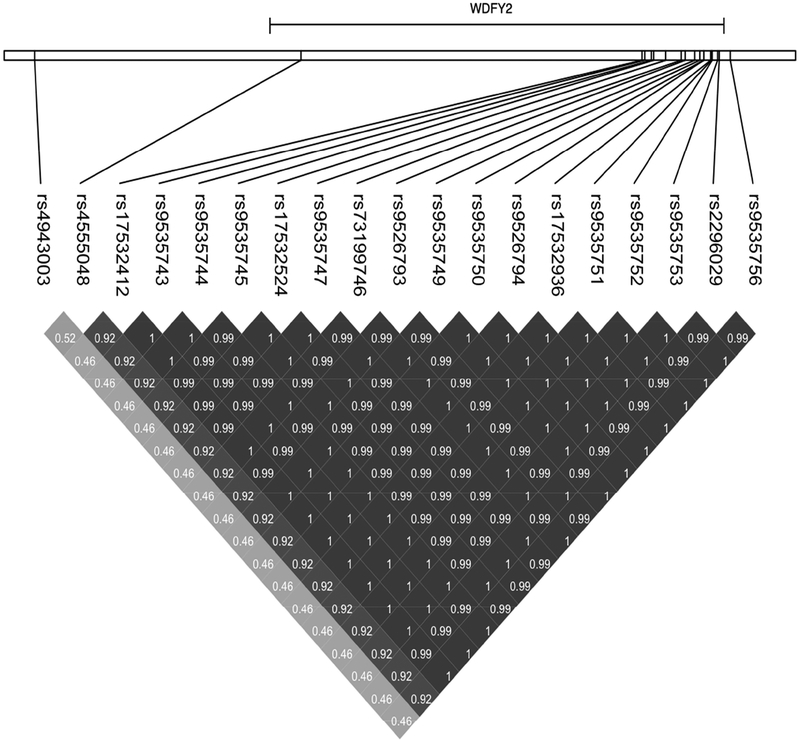
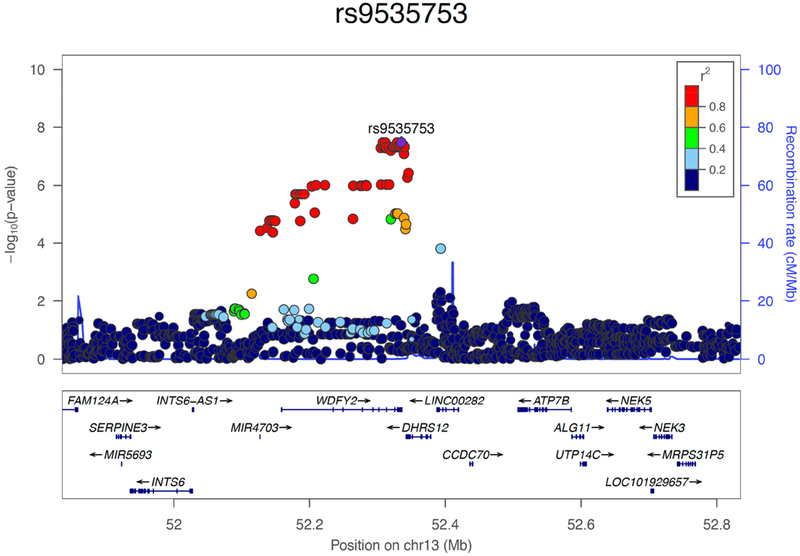
To identify novel loci that affect cognitive decline in older adults free of dementia, we conducted genome-wide and gene-based meta-analyses on longitudinal slopes of 5 cognitive domains (memory, executive function, language, attention/processing speed, and visuospatial ability) derived from 2 population-based cohorts. For decline over time in each cognitive domain, we normalized intraindividual slopes within each cohort, accounting for baseline age, sex, and years of education. Normalized slope for each domain was used in cohort-specific genome-wide analyses after including top principal components as covariates followed by genome-wide and gene-based meta-analyses. Both analyses revealed a novel WDFY2 locus at genome-wide (p = 3.37E-08) and gene-wide (p = 7.10E-07) significance levels for the attention/processing speed domain. In the GTEx eQTL analysis, genome-wide significant single-nucleotide polymorphism was associated with RNA expression levels of WDFY2 in several brain regions: cerebellar hemisphere (p = 1.07E-04), cerebellum (p = 6.92E-04), hippocampus (p = 2.18E-03) and cortex (p = 2.29E-02), and in whole blood (p = 4.41E-05). Our results suggest that WDFY2 genetic variation may affect individual differences in decline over time on tests of attention/processing speed.
为了鉴定在无痴呆的老年人群中影响认知衰退的新基因座,我们对来自两个基于人群的队列的 5 个认知领域(记忆、执行功能、语言、注意力/处理速度和视空间能力)的纵向斜率进行了全基因组和基于基因的荟萃分析。对于每个认知领域随时间的下降,我们在每个队列中对个体内部斜率进行了归一化,考虑了基线年龄、性别和受教育年限。在包括主要成分作为协变量后,对每个领域的归一化斜率进行了特定于队列的全基因组分析,随后进行了全基因组和基于基因的荟萃分析。这两种分析都揭示了一个新的 WDFY2 基因座在注意力/处理速度领域具有全基因组(p=3.37E-08)和基因范围(p=7.10E-07)的显著意义。在 GTEx eQTL 分析中,全基因组显著的单核苷酸多态性与几个大脑区域的 WDFY2 RNA 表达水平相关:小脑半球(p=1.07E-04)、小脑(p=6.92E-04)、海马体(p=2.18E-03)和皮质(p=2.29E-02),以及全血(p=4.41E-05)。我们的研究结果表明,WDFY2 遗传变异可能影响注意力/处理速度测试中个体随时间下降的差异。