Campbell Jeffrey D, Trock Bruce J, Oppenheim Adam R, Anusionwu Ifeanyichukwu, Gor Ronak A, Burnett Arthur L
The James Buchanan Brady Urological Institute and Department of Urology, Johns Hopkins Medical Institutions, 600 N. Wolfe Street, Marburg 405, Baltimore, MD 21287, USA.
The James Buchanan Brady Urological Institute and Department of Urology, The Johns Hopkins University School of Medicine, Baltimore, MD, USA.
Ther Adv Urol. 2019 Mar 29;11:1756287219838364. doi: 10.1177/1756287219838364. eCollection 2019 Jan-Dec.
The aim of this study was to perform a meta-analysis of randomized controlled trials (RCTs) that evaluate the efficacy of low-intensity extracorporeal shock wave therapy (LiESWT) for the treatment of erectile dysfunction (ED).
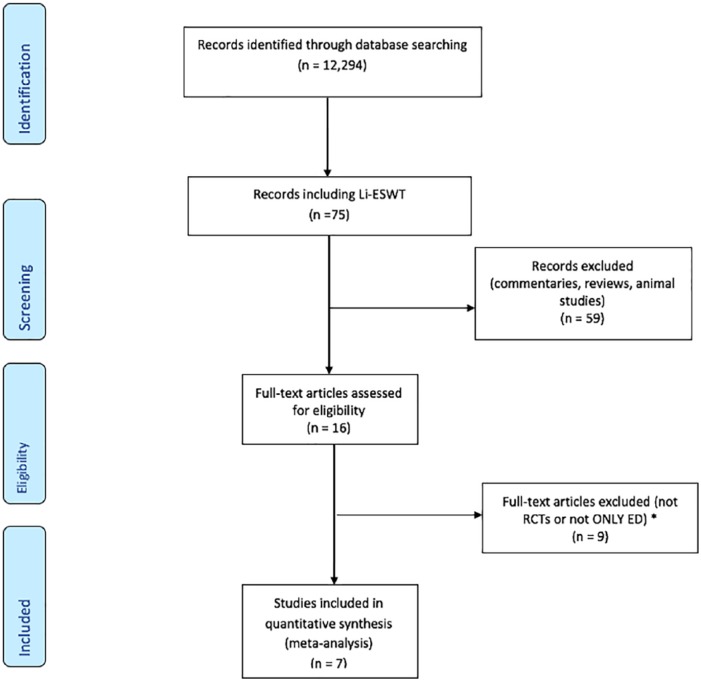
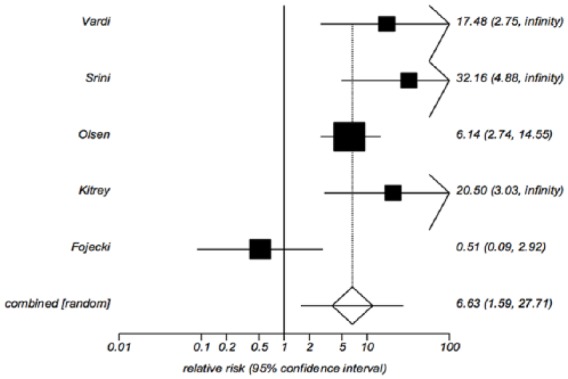
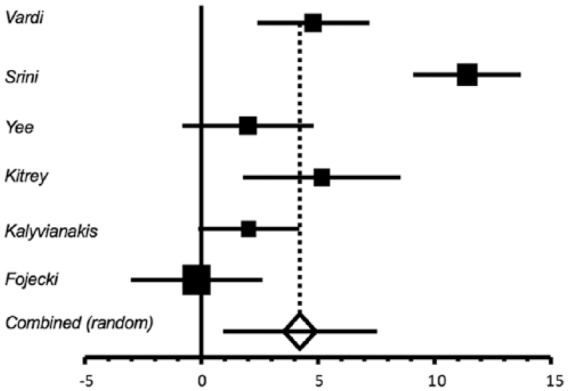
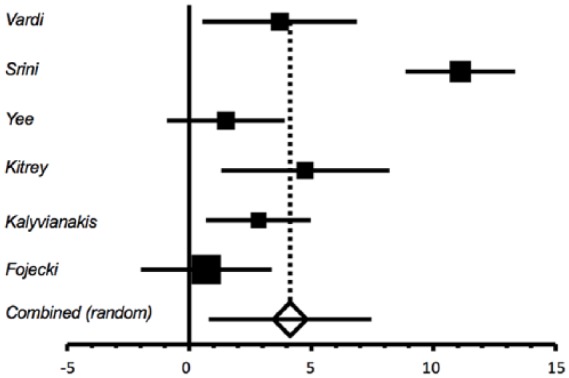
A comprehensive search of , and databases was performed from November 2005 to July 2018. RCTs evaluating efficacy of LiESWT in the treatment of ED were selected. The primary outcomes were the mean difference between treatment and sham patients in the International Index of Erectile Function-Erectile Function (IIEF-EF) domain score 1 month after treatment, and the mean change in IIEF-EF from baseline to 1 month post-treatment. The secondary analysis considered the percentage of men whose erectile hardness score (EHS) changed from <2 at baseline to >3 after treatment. All analyses used a random effects method to pool study-specific results.
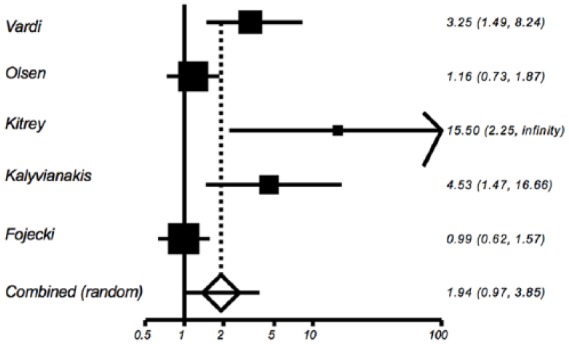
A total of seven RCTs provided data for 607 patients. The mean IIEF-EF 1 month post-treatment ranged from 12.8 to 22.0 in the treatment group 8.17-16.43 in the sham group. The mean difference between the treatment and sham groups at the 1 month follow up was a statistically significant increase in IIEF-EF of 4.23 ( = 0.012). Overall, five of the seven trials provided data on the proportion of patients with baseline EHS <2 who improved to EHS >3 at 1 month post-treatment. The proportions ranged from 3.5 to 90% in the treatment group 0-9% in the sham group and the pooled relative risk of EHS improvement for the treated sham group was 6.63 ( = 0.0095). No significant adverse events were reported.
This is the first meta-analysis that evaluates RCTs exploring LiESWT as a treatment modality strictly for ED. This therapeutic strategy appears to be well tolerated with short-term benefits. However further studies exploring specific treatment regimens and long-term outcomes are needed.
本研究旨在对评估低强度体外冲击波疗法(LiESWT)治疗勃起功能障碍(ED)疗效的随机对照试验(RCT)进行荟萃分析。
于2005年11月至2018年7月对多个数据库进行全面检索。选取评估LiESWT治疗ED疗效的RCT。主要结局为治疗1个月后治疗组与假治疗组患者在国际勃起功能指数-勃起功能(IIEF-EF)领域评分的平均差异,以及从基线到治疗后1个月IIEF-EF的平均变化。次要分析考虑勃起硬度评分(EHS)从基线时<2改善到治疗后>3的男性比例。所有分析均采用随机效应方法汇总各研究的具体结果。
共有7项RCT为607例患者提供了数据。治疗组治疗后1个月的平均IIEF-EF为12.8至22.0,假治疗组为8.17至16.43。随访1个月时,治疗组与假治疗组之间的平均差异为IIEF-EF有统计学意义的增加4.23(P = 0.012)。总体而言,7项试验中的5项提供了关于基线EHS<2的患者在治疗后1个月改善至EHS>3的比例的数据。治疗组的比例为3.5%至90%,假治疗组为0%至9%,治疗组与假治疗组EHS改善的合并相对风险为6.63(P = 0.0095)。未报告显著不良事件。
这是第一项评估将LiESWT作为严格用于ED的治疗方式的RCT的荟萃分析。这种治疗策略似乎耐受性良好且有短期益处。然而,需要进一步研究探索具体治疗方案和长期结局。