van Herpen Carla M L, Agarwala Sanjiv S, Hauschild Axel, Berking Carola, Beck J Thaddeus, Schadendorf Dirk, Jansen Rob, Queirolo Paola, Ascierto Paolo A, Blank Christian U, Heinrich Michael C, Pal Rupam R, Derti Adnan, Antona Victor, Nauwelaerts Heidi, Zubel Angela, Dummer Reinhard
Department of Medical Oncology, Radboud University Medical Center, Nijmegen, The Netherlands.
Department of Medical Oncology and Hematology, St. Luke's University Health Network, Bethlehem, PA, USA.
Oncotarget. 2019 Mar 5;10(19):1850-1859. doi: 10.18632/oncotarget.26753.
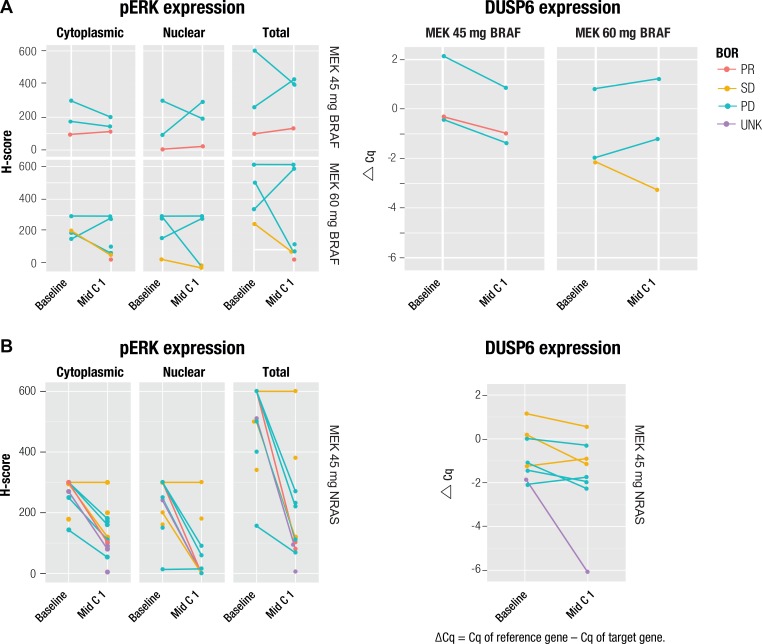
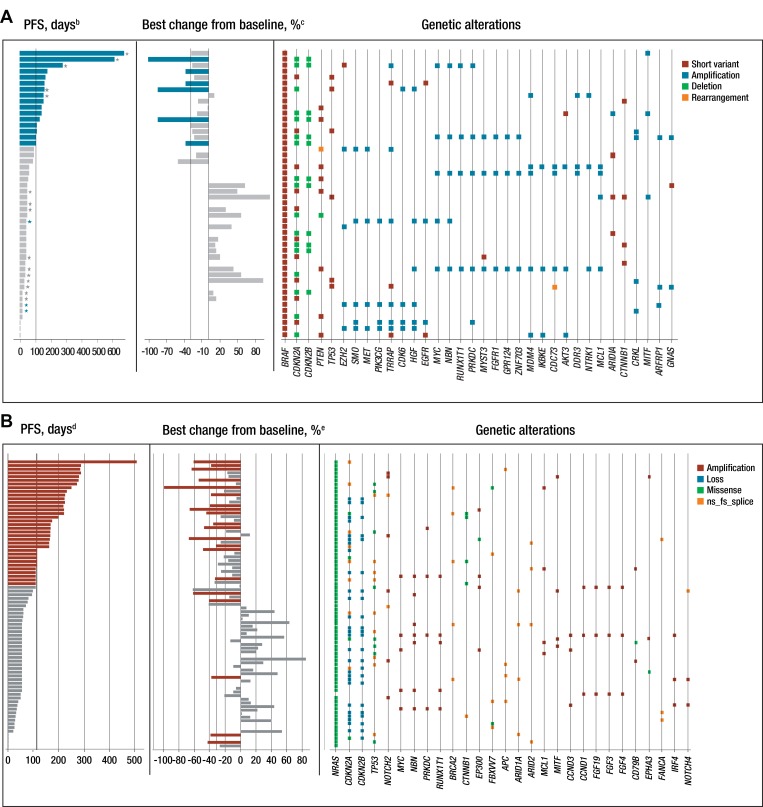
and are the most frequently mutated mitogen-activated protein kinase (MAPK) genes in melanoma. Binimetinib is a highly selective MAPK kinase (MEK) 1/2 inhibitor with clinical antitumor activity in - and -mutant melanoma. We performed a nonrandomized, open-label phase II study, where 183 metastatic melanoma patients received binimetinib 45 mg / 60 mg twice-daily ( arms), or binimetinib 45 mg twice-daily ( arm). Biomarker analyses were prespecified as secondary and exploratory objectives. Here we report the extent of MAPK pathway inhibition by binimetinib, genetic pathway alterations of interest, and potential predictive markers for binimetinib efficacy. Twenty-five fresh pre- and post-dose tumor sample pairs were collected for biomarker analyses, which included assessment of binimetinib on MEK/MAPK signaling by pharmacodynamic analysis of pERK and DUSP6 expression in pre- vs post-dose tumor biopsies; identification of pERK and DUSP6 expression/efficacy correlations; assessment of baseline tumor molecular status; and exploration of potential predictive biomarkers of efficacy of binimetinib. The postbaseline pERK and DUSP6 expression decreased across all arms; no association between reduced pERK or DUSP6 levels with clinical efficacy was observed. Genetic aberrations were similar to previously reported data on clinical melanoma samples. Genetic pathway alterations occurred predominantly within , , and (-mutation) and , , and (-mutation). Several patients with BRAF mutations had amplification of genes on chromosome 7q; these patients tended to have shorter progression-free survival than other patients with -mutant melanoma. Further analysis of genetic alterations, including amplifications of growth factor genes, will determine utility as biomarkers for efficacy.
和是黑色素瘤中最常发生突变的丝裂原活化蛋白激酶(MAPK)基因。比美替尼是一种高度选择性的MAPK激酶(MEK)1/2抑制剂,对和突变的黑色素瘤具有临床抗肿瘤活性。我们进行了一项非随机、开放标签的II期研究,183例转移性黑色素瘤患者接受比美替尼45mg/60mg每日两次(组),或比美替尼45mg每日两次(组)。生物标志物分析预先指定为次要和探索性目标。在此,我们报告比美替尼对MAPK通路的抑制程度、感兴趣的基因通路改变以及比美替尼疗效的潜在预测标志物。收集了25对给药前和给药后的新鲜肿瘤样本用于生物标志物分析,包括通过给药前与给药后肿瘤活检中pERK和DUSP6表达的药效学分析评估比美替尼对MEK/MAPK信号传导的作用;确定pERK和DUSP6表达/疗效的相关性;评估基线肿瘤分子状态;以及探索比美替尼疗效的潜在预测生物标志物。所有组给药后基线水平的pERK和DUSP6表达均下降;未观察到pERK或DUSP6水平降低与临床疗效之间的关联。基因畸变与先前报道的临床黑色素瘤样本数据相似。基因通路改变主要发生在**、和(突变)以及、和(突变)。几名BRAF突变患者在7号染色体上有基因扩增;这些患者的无进展生存期往往比其他突变黑色素瘤患者短。对包括生长因子基因扩增在内的基因改变进行进一步分析,将确定其作为疗效生物标志物的效用。