
未来的气候变化预计将影响形成栖息地的大型褐藻的微生物组和条件。
Future climate change is predicted to affect the microbiome and condition of habitat-forming kelp.
机构信息
1 Centre for Marine Bio-Innovation, School of Biological, Earth and Environmental Sciences, University of New South Wales , Sydney, New South Wales 2052 , Australia.
2 Department of Primary Industries, NSW Fisheries , PO Box 4321, Coffs Harbour, New South Wales 2450 , Australia.
出版信息
Proc Biol Sci. 2019 Feb 13;286(1896):20181887. doi: 10.1098/rspb.2018.1887.
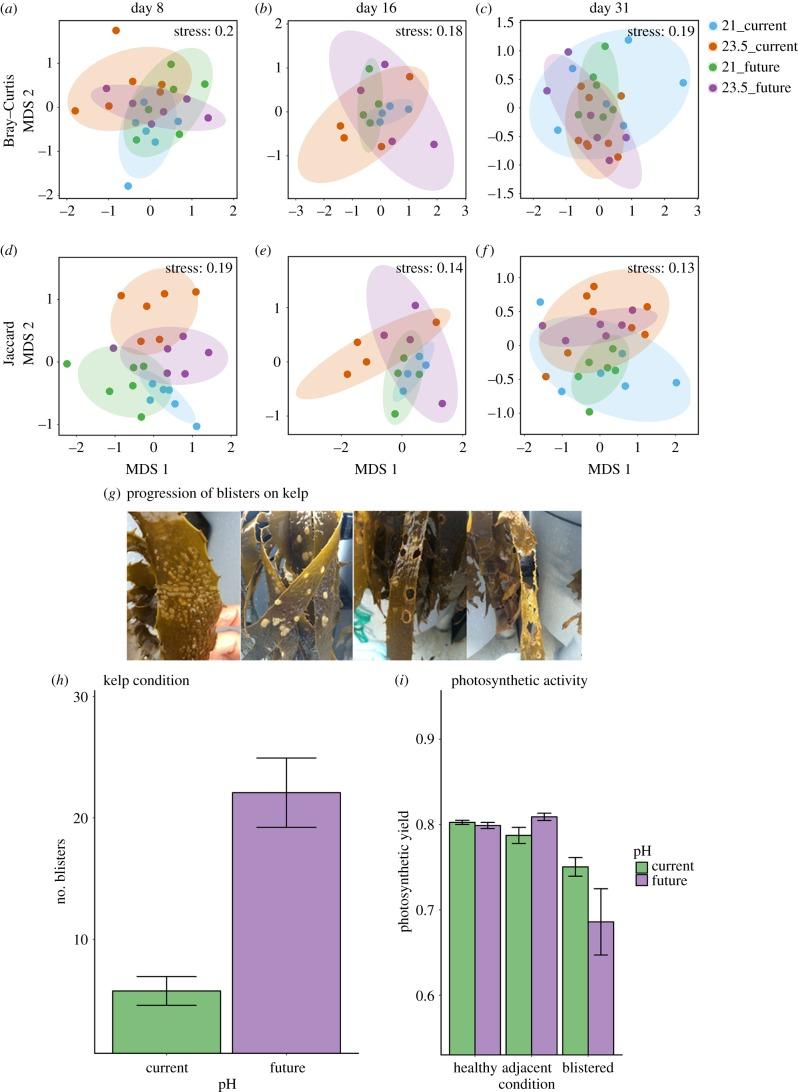
Climate change is driving global declines of marine habitat-forming species through physiological effects and through changes to ecological interactions, with projected trajectories for ocean warming and acidification likely to exacerbate such impacts in coming decades. Interactions between habitat-formers and their microbiomes are fundamental for host functioning and resilience, but how such relationships will change in future conditions is largely unknown. We investigated independent and interactive effects of warming and acidification on a large brown seaweed, the kelp Ecklonia radiata, and its associated microbiome in experimental mesocosms. Microbial communities were affected by warming and, during the first week, by acidification. During the second week, kelp developed disease-like symptoms previously observed in the field. The tissue of some kelp blistered, bleached and eventually degraded, particularly under the acidification treatments, affecting photosynthetic efficiency. Microbial communities differed between blistered and healthy kelp for all treatments, except for those under future conditions of warming and acidification, which after two weeks resembled assemblages associated with healthy hosts. This indicates that changes in the microbiome were not easily predictable as the severity of future climate scenarios increased. Future ocean conditions can change kelp microbiomes and may lead to host disease, with potentially cascading impacts on associated ecosystems.
气候变化通过生理效应和生态相互作用的变化,导致海洋生境形成物种在全球范围内减少,预计未来几十年海洋变暖酸化的轨迹可能会加剧这种影响。生境形成者与其微生物组之间的相互作用对宿主的功能和恢复力至关重要,但在未来条件下这些关系将如何变化在很大程度上是未知的。我们在实验中用中观模型研究了升温和酸化对大型褐藻(Ecklonia radiata)及其相关微生物组的独立和交互影响。微生物群落受到了升温的影响,并且在第一周还受到了酸化的影响。在第二周,一些海带出现了类似疾病的症状,这些症状以前在野外观察到过。一些海带的组织起疱、白化,最终退化,特别是在酸化处理下,这影响了光合作用效率。除了在未来的升温和酸化条件下,所有处理的疱状和健康海带之间的微生物群落都不同,两周后,与健康宿主相关的组合类似于那些处理。这表明,随着未来气候情景的严重程度增加,微生物组的变化不易预测。未来的海洋条件可以改变海带的微生物组,并可能导致宿主疾病,从而对相关生态系统产生潜在的级联影响。

 Zotero 插件