Baena Libia M, Zuleta Ernesto C, Calderón Jorge A
Grupo de Calidad, Metrología y Producción, Instituto Tecnológico Metropolitano ITM, Medellín 050034, Colombia.
Grupo de Procesos Fisicoquímicos Aplicados-PFA, Universidad de Antioquia, Medellín 050034, Colombia.
Polymers (Basel). 2018 May 9;10(5):511. doi: 10.3390/polym10050511.
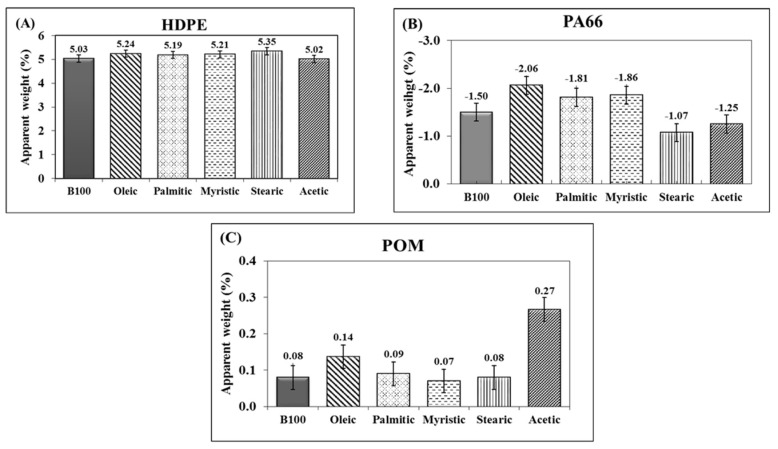
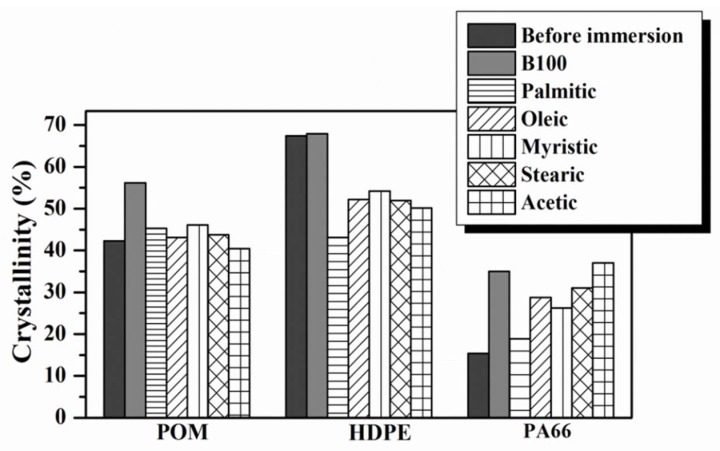
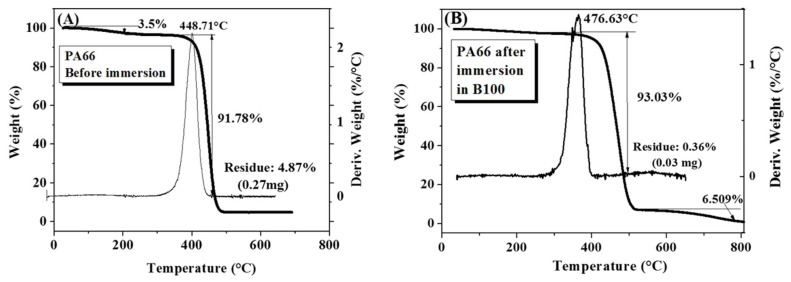
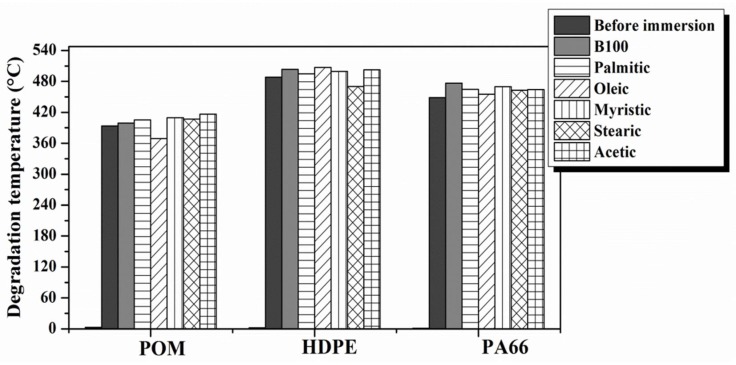
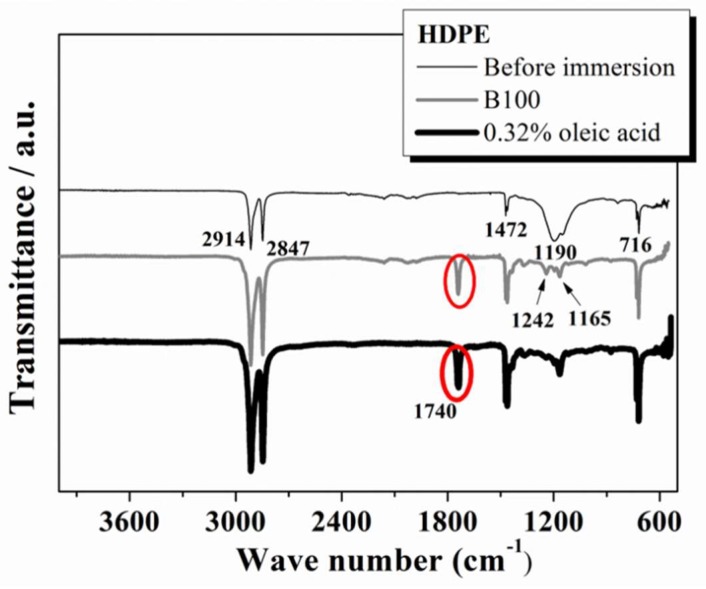
The aim of the present work is to evaluate the impact of pure palm biodiesel fuel (B100) and biodiesel blends with 0.32% oleic, palmitic, acetic, myristic, and stearic acids on the properties of some polymeric materials used commonly in the manufacture of auto parts such as the polyamide 66 (PA66), polyoxymethylene (POM), and high-density polyethylene (HDPE). The effects of the B100 and B100⁻acid blends on polymeric materials were examined by comparing changes in the gain/loss of mass and by measuring the hardness, the impact strength, and the tensile strength of the materials at the end of the exposure. The characterization of the polymers was carried out before and after exposure by using differential scanning calorimetry (DSC), thermogravimetric analysis (TGA), and Fourier transform infrared spectroscopy (FTIR). After the immersion in B100⁻acids blends, the HDPE exhibited an increase in mass of 5%, which was very similar in all blends. The PA66 showed a small decrease in weight (2% approx.) in all mixtures. The POM presented an increase in the percentage of weight in the mixture of B100 with acetic acid of 0.3%. A decrease was observed in the crystallinity of the HDPE when exposed to blends of B100⁻acids. This behavior may be associated with a plasticizing effect in the HDPE exposed to the blends. The mechanical properties of POM and HDPE showed no significant changes after immersion in the fuels. On the other hand, PA66 exhibited a significant decrease in maximum stress value after immersion in B100, B100⁻oleic acid and B100⁻palmitic acid blends. The variation of the mechanical properties of the PA66 after exposure to B100 was potentiated by addition of organic acids. The assessed polymers did not undergo appreciable changes in the chemical structure of the samples after immersion in the fuels, so the variation in the mechanical properties could be explained by physical absorption of the fuel into the polymers.
本工作的目的是评估纯棕榈生物柴油燃料(B100)以及含有0.32%油酸、棕榈酸、乙酸、肉豆蔻酸和硬脂酸的生物柴油混合物对一些常用于制造汽车零部件的聚合材料性能的影响,这些聚合材料包括聚酰胺66(PA66)、聚甲醛(POM)和高密度聚乙烯(HDPE)。通过比较质量增减变化以及在暴露结束时测量材料的硬度、冲击强度和拉伸强度,研究了B100和B100 - 酸混合物对聚合材料的影响。在暴露前后,使用差示扫描量热法(DSC)、热重分析(TGA)和傅里叶变换红外光谱(FTIR)对聚合物进行表征。浸泡在B100 - 酸混合物中后,HDPE的质量增加了5%,在所有混合物中情况非常相似。PA66在所有混合物中的重量略有下降(约2%)。POM在B100与0.3%乙酸的混合物中重量百分比增加。暴露于B100 - 酸混合物时,HDPE的结晶度降低。这种行为可能与暴露于混合物中的HDPE的增塑作用有关。浸泡在燃料中后,POM和HDPE的机械性能没有显著变化。另一方面,PA66浸泡在B100、B100 - 油酸和B100 - 棕榈酸混合物中后,最大应力值显著降低。添加有机酸增强了PA66暴露于B100后机械性能的变化。浸泡在燃料中后,所评估的聚合物样品的化学结构没有发生明显变化,因此机械性能的变化可以用燃料在聚合物中的物理吸收来解释。