Center for Neuroscience and Cell Biology, University of Coimbra, Coimbra, Portugal.
Department of Science and Environment, Roskilde University, Roskilde, Denmark.
Sci Rep. 2019 Apr 9;9(1):5836. doi: 10.1038/s41598-019-42309-4.
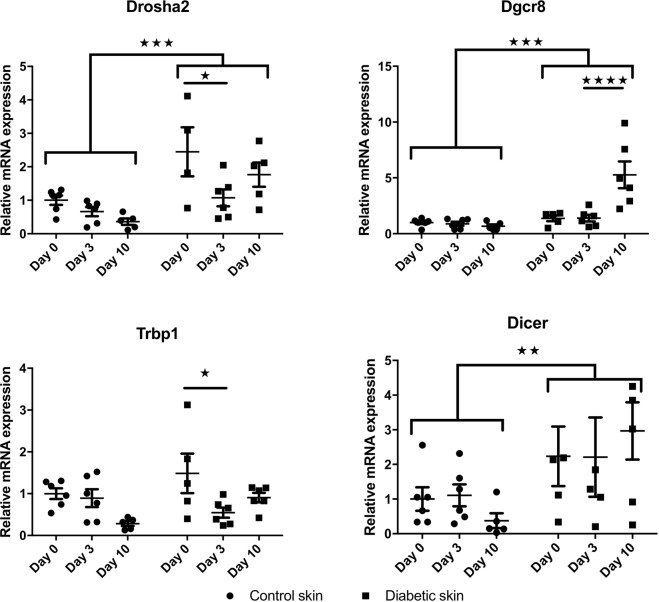
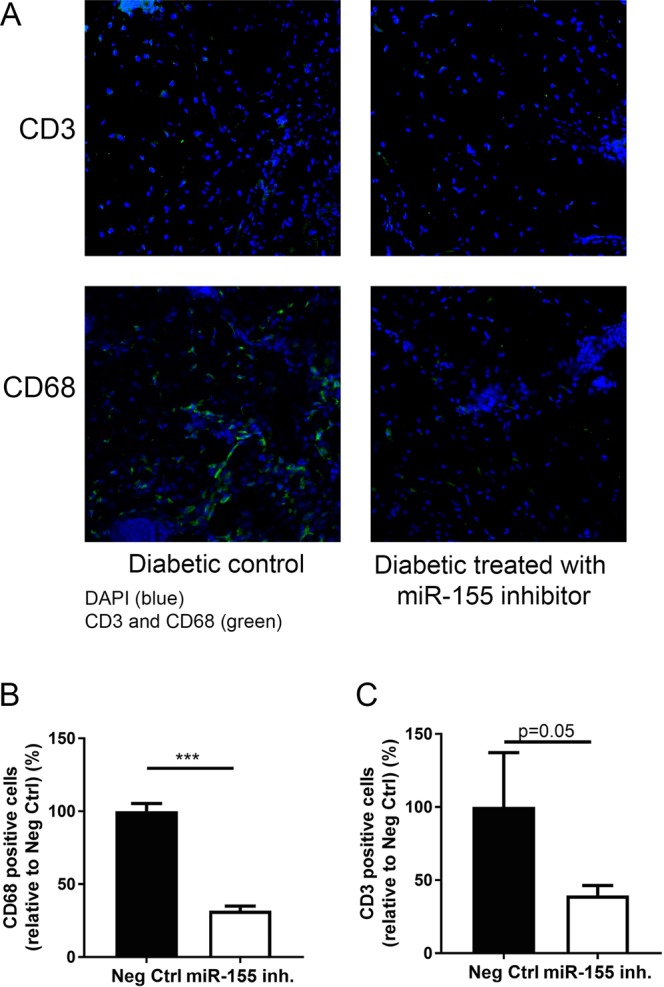
Treatment for chronic diabetic foot ulcers is limited by the inability to simultaneously address the excessive inflammation and impaired re-epithelization and remodeling. Impaired re-epithelization leads to significantly delayed wound closure and excessive inflammation causes tissue destruction, both enhancing wound pathogen colonization. Among many differentially expressed microRNAs, miR-155 is significantly upregulated and fibroblast growth factor 7 (FGF7) mRNA (target of miR-155) and protein are suppressed in diabetic skin, when compared to controls, leading us to hypothesize that topical miR-155 inhibition would improve diabetic wound healing by restoring FGF7 expression. In vitro inhibition of miR-155 increased human keratinocyte scratch closure and topical inhibition of miR-155 in vivo in wounds increased murine FGF7 protein expression and significantly enhanced diabetic wound healing. Moreover, we show that miR-155 inhibition leads to a reduction in wound inflammation, in accordance with known pro-inflammatory actions of miR-155. Our results demonstrate, for the first time, that topical miR-155 inhibition increases diabetic wound fibroblast growth factor 7 expression in diabetic wounds, which, in turn, increases re-epithelization and, consequently, accelerates wound closure. Topical miR-155 inhibition targets both excessive inflammation and impaired re-epithelization and remodeling, being a potentially new and effective treatment for chronic diabetic foot ulcers.
治疗慢性糖尿病足溃疡的方法受到限制,因为无法同时解决过度炎症和受损的再上皮化和重塑问题。再上皮化受损导致伤口愈合明显延迟,而过度炎症导致组织破坏,这两者都会增加伤口病原体定植。在许多差异表达的 microRNAs 中,miR-155 明显上调,与对照相比,糖尿病皮肤中的成纤维细胞生长因子 7 (FGF7) mRNA(miR-155 的靶标)和蛋白受到抑制,这使我们假设局部 miR-155 抑制通过恢复 FGF7 表达来改善糖尿病伤口愈合。体外抑制 miR-155 可增加人角质形成细胞划痕闭合,体内局部抑制 miR-155 可增加小鼠 FGF7 蛋白表达,并显著增强糖尿病伤口愈合。此外,我们表明 miR-155 抑制可减少伤口炎症,这与 miR-155 的已知促炎作用一致。我们的结果首次表明,局部 miR-155 抑制可增加糖尿病伤口中成纤维细胞生长因子 7 的表达,进而增加再上皮化,从而加速伤口闭合。局部 miR-155 抑制靶向过度炎症和受损的再上皮化和重塑,是治疗慢性糖尿病足溃疡的一种有潜力的新方法和有效方法。