Song Jingke, Ma Jinxing, Zhang Changyong, He Calvin, Waite T David
UNSW Water Research Centre, School of Civil and Environmental Engineering, University of New South Wales, Sydney, NSW, Australia.
College of Environmental Science and Engineering, Tongji University, Shanghai, China.
Front Chem. 2019 Mar 22;7:146. doi: 10.3389/fchem.2019.00146. eCollection 2019.
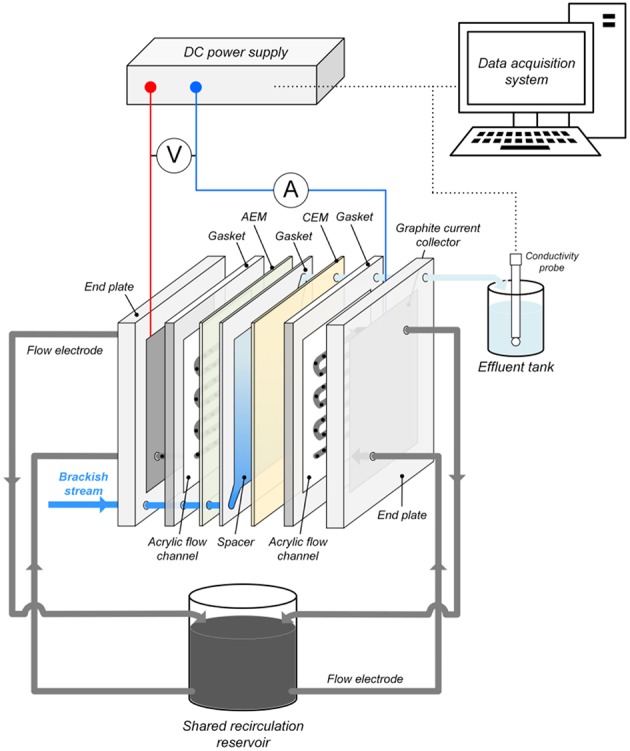
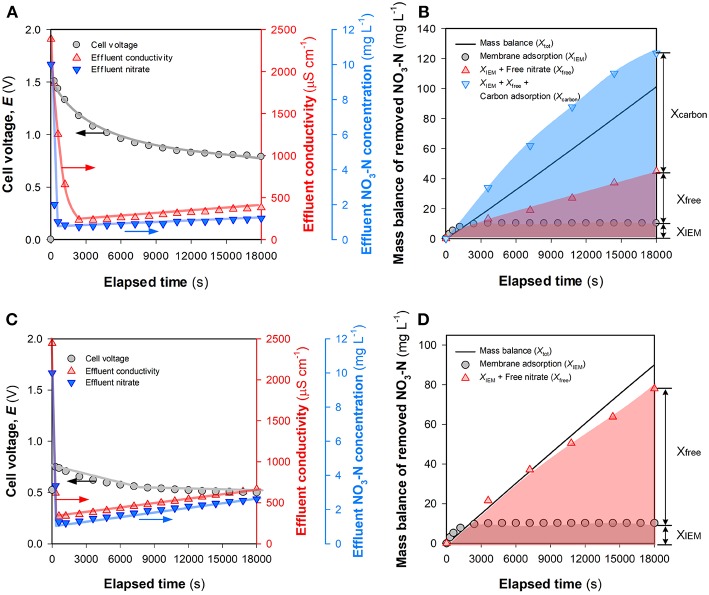
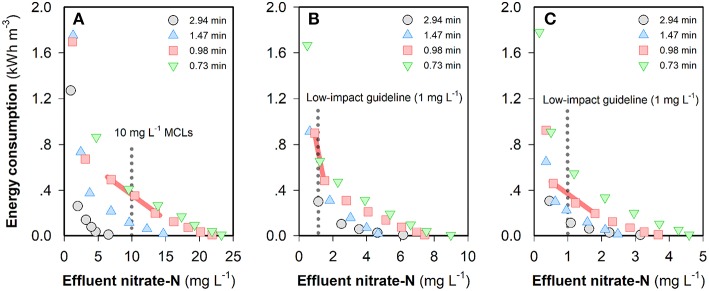
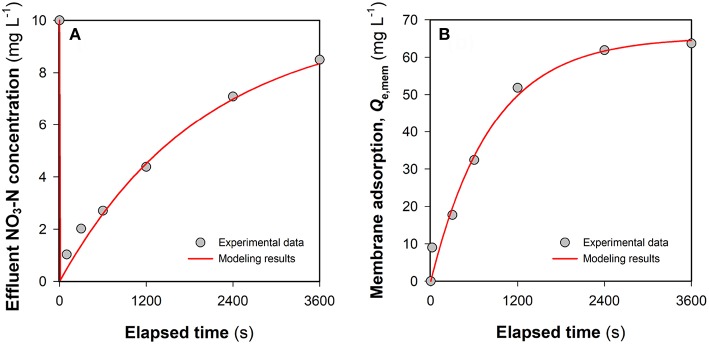
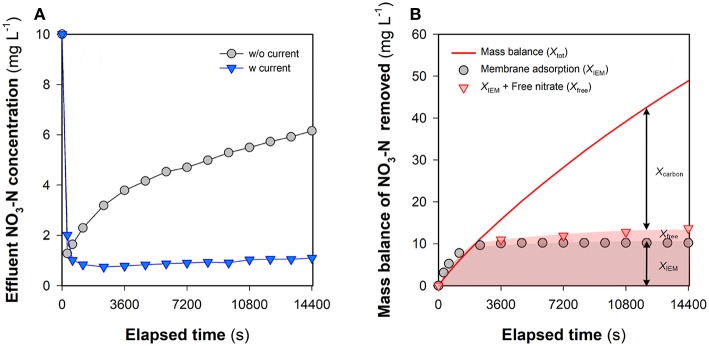
While flow-electrode capacitive deionization (FCDI) operated in short-circuited closed cycle (SCC) mode appears to hold promise for removal of salt from brackish source waters, there has been limited investigation on the removal of other water constituents such as nitrate, fluoride or bromide in combination with salt removal. Of particular concern is the effectiveness of FCDI when ions, such as nitrate, are recognized to non-electrostatically adsorb strongly to activated carbon particles thereby potentially rendering it difficult to regenerate these particles. In this study, SCC FCDI was used to desalt source waters containing nitrate at different concentrations. Results indicate that nitrate can be removed from source waters using FCDI to concentrations <1 mg NO-N L though a lower quality target such as 10 mg L would be more cost-effective, particularly where the influent nitrate concentration is high (50 mg NO-N L). Although studies of the fate of nitrate in the FCDI system show that physico-chemical adsorption of nitrate to the carbon initially plays a vital role in nitrate removal, the ongoing process of nitrate removal is not significantly affected by this phenomenon with this lack of effect most likely due to the continued formation of electrical double layers enabling capacitive nitrate removal. In contrast to conventional CDI systems, constant voltage mode is shown to be more favorable in maintaining stable effluent quality in SCC FCDI because the decrease in electrical potential that occurs in constant current operation leads to a reduction in the extent of salt removal from the brackish source waters. Through periodic replacement of the electrolyte at a water recovery of 91.4%, we show that the FCDI system can achieve a continuous desalting performance with the effluent NO-N concentration below 1 mg NO-N L at low energy consumption (~0.5 kWh m) but high productivity.
虽然以短路闭合循环(SCC)模式运行的流动电极电容去离子化(FCDI)似乎有望从微咸水源水中去除盐分,但对于结合除盐去除其他水中成分(如硝酸盐、氟化物或溴化物)的研究却很有限。特别值得关注的是,当硝酸盐等离子被认为会非静电地强烈吸附到活性炭颗粒上时,FCDI的有效性,这可能会使这些颗粒难以再生。在本研究中,SCC FCDI被用于脱除含有不同浓度硝酸盐的源水盐分。结果表明,使用FCDI可将源水中的硝酸盐浓度降低至<1 mg NO-N/L,但较低的质量目标(如10 mg/L)会更具成本效益,特别是在进水硝酸盐浓度较高(50 mg NO-N/L)的情况下。尽管对FCDI系统中硝酸盐归宿的研究表明,硝酸盐在碳上的物理化学吸附最初在硝酸盐去除中起着至关重要的作用,但硝酸盐去除的持续过程并未受到这一现象的显著影响,这种缺乏影响很可能是由于双电层的持续形成使得电容性硝酸盐去除得以实现。与传统的电容去离子化(CDI)系统相比,恒压模式在SCC FCDI中更有利于维持稳定的出水水质,因为恒流运行中发生的电势降低会导致从微咸水源水中去除盐分的程度降低。通过在水回收率为91.4%时定期更换电解液,我们表明FCDI系统能够实现连续脱盐性能,在低能耗(~0.5 kWh/m³)但高生产率的情况下,出水NO-N浓度低于1 mg NO-N/L。