Gastrointestinal Oncology Service, Department of Medicine, Memorial Sloan Kettering Cancer Center, New York, New York.
Cancer. 2019 Jun 15;125(12):1990-2001. doi: 10.1002/cncr.32066. Epub 2019 Apr 11.
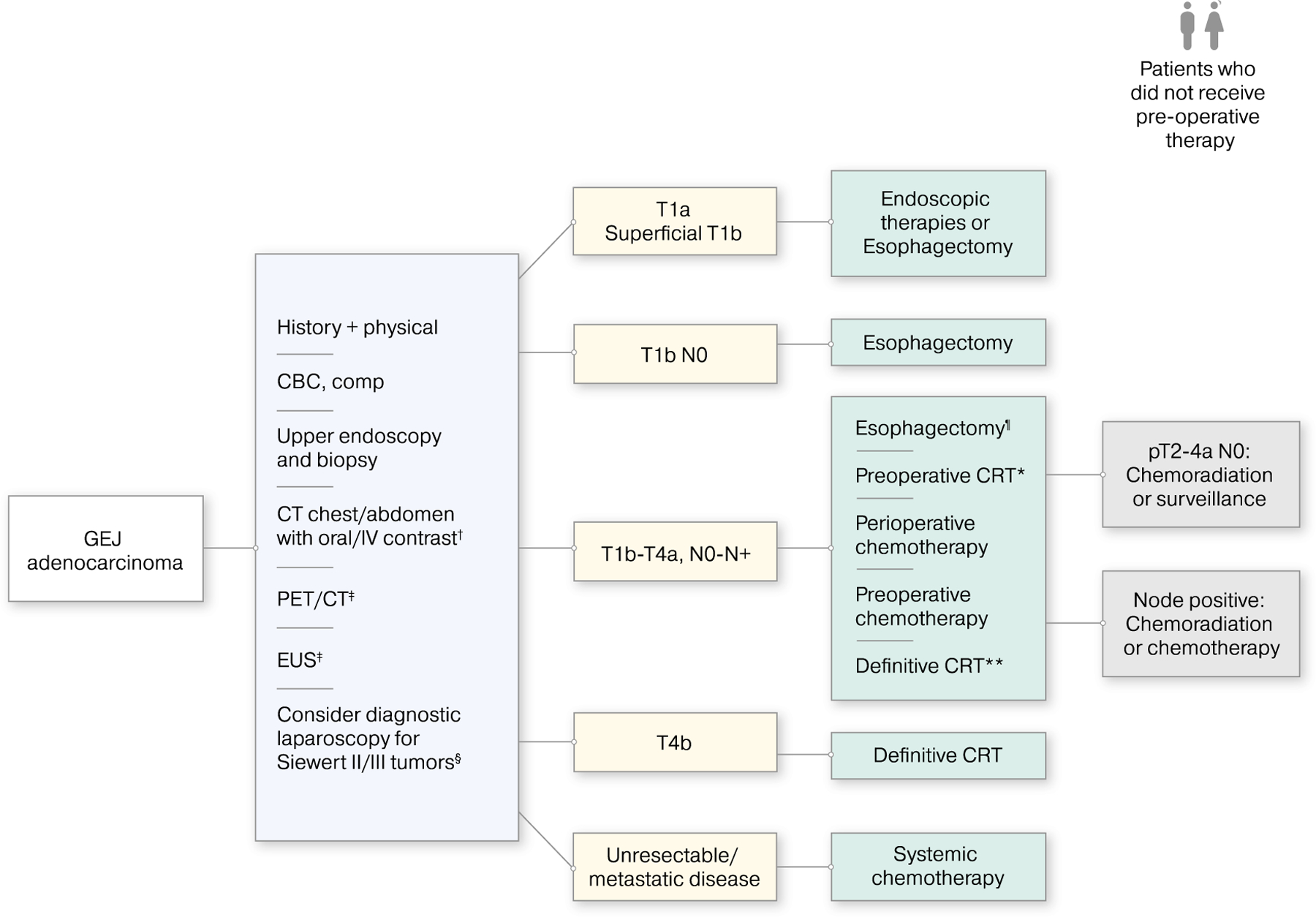
Although recent decades have witnessed incremental improvements in the treatment of gastroesophageal junction (GEJ) carcinoma, outcomes remain modest. For locally advanced esophageal cancer, the addition of chemotherapy and/or radiation to surgery is considered the standard of care. Chemotherapy remains the primary treatment for metastatic disease and improves survival over best supportive care. However, the prognosis for patients with GEJ cancers, which are treated along the same paradigms as esophageal and gastric carcinomas, remain poor because of the emergence of chemoresistance and limited targeted therapeutic approaches, which include agents that target the HER2 and vascular endothelial growth factor pathways. Evaluation of immune checkpoint inhibitors in the chemorefractory setting have confirmed the activity of immunotherapy in esophagogastric cancer. Ongoing immunotherapeutic strategies are being evaluated in both the locally advanced and metastatic settings. This review focuses on the treatment of locally advanced and metastatic GEJ carcinomas, which encompass all tumors that have an epicenter within 5 cm proximal or distal to the anatomical Z-line (Siewert classification). Because the vast majority of GEJ tumors are adenocarcinoma, the management of adenocarcinoma is the focus of this review. Evolving approaches and areas of clinical equipoise are discussed.
尽管近几十年来胃食管交界(GEJ)癌的治疗取得了渐进式的改善,但疗效仍然不尽人意。对于局部晚期食管癌,化疗和/或放疗联合手术被认为是标准治疗。化疗仍然是转移性疾病的主要治疗方法,可改善生存,优于最佳支持治疗。然而,由于化学耐药性的出现和有限的靶向治疗方法,包括针对 HER2 和血管内皮生长因子途径的药物,按照食管和胃癌的相同模式治疗的 GEJ 癌患者的预后仍然较差。在化疗耐药的情况下评估免疫检查点抑制剂证实了免疫疗法在胃食管癌症中的活性。正在局部晚期和转移性环境中评估新的免疫治疗策略。本文重点讨论局部晚期和转移性 GEJ 癌的治疗,包括位于解剖 Z 线(Siewert 分类)近端或远端 5cm 内的所有肿瘤。由于绝大多数 GEJ 肿瘤为腺癌,因此本综述的重点是腺癌的治疗。讨论了不断发展的方法和临床平衡的领域。