Infection Biology Unit, German Primate Center-Leibniz Institute for Primate Research, Göttingen, Germany.
Faculty of Biology and Psychology, University Göttingen, Göttingen, Germany.
PLoS One. 2019 Apr 11;14(4):e0214968. doi: 10.1371/journal.pone.0214968. eCollection 2019.
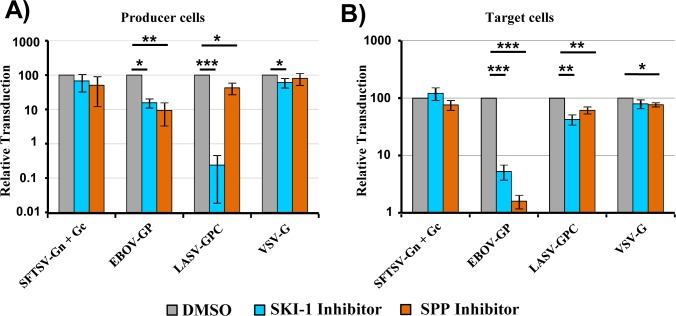
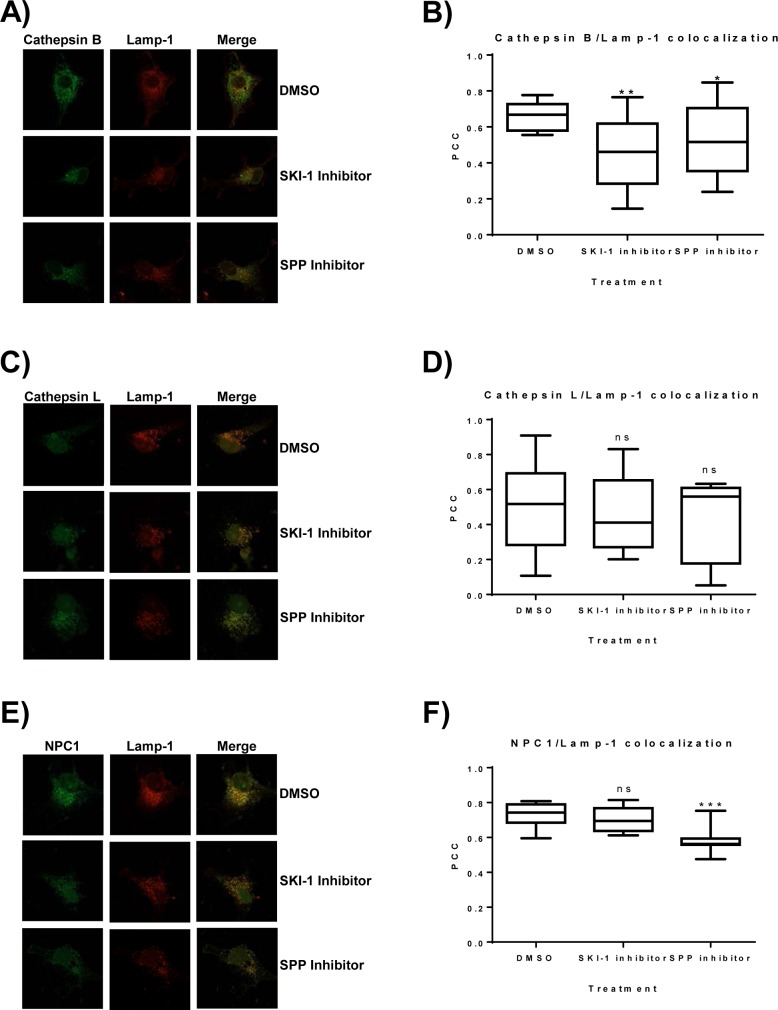
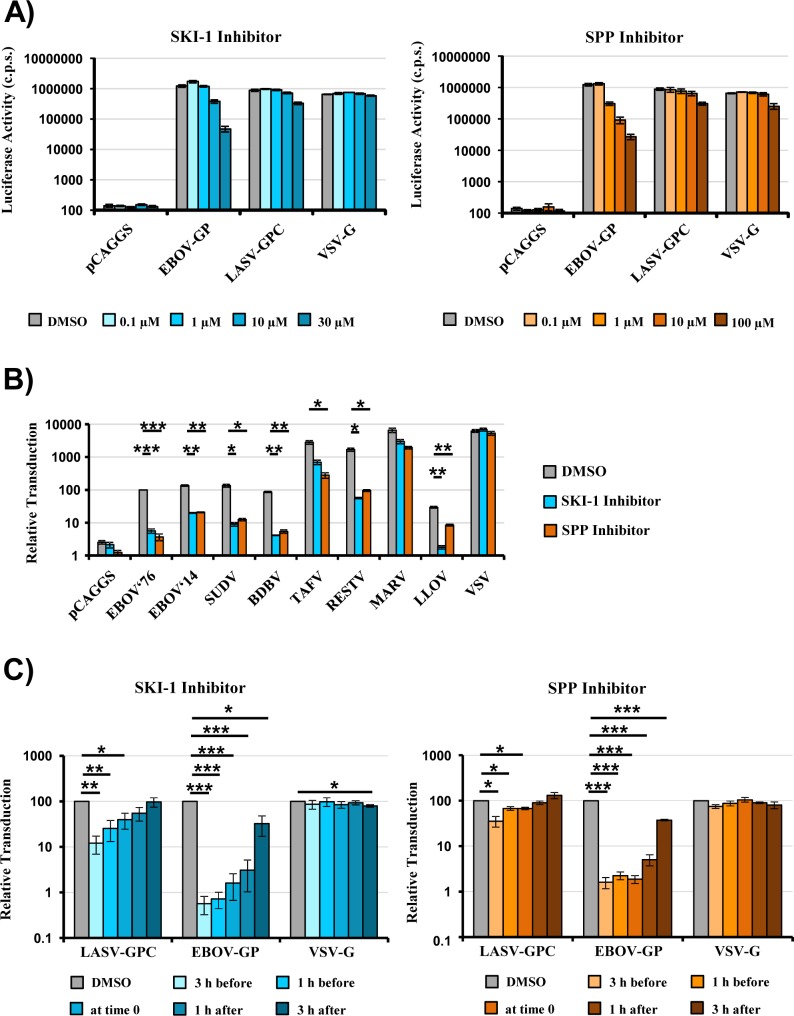
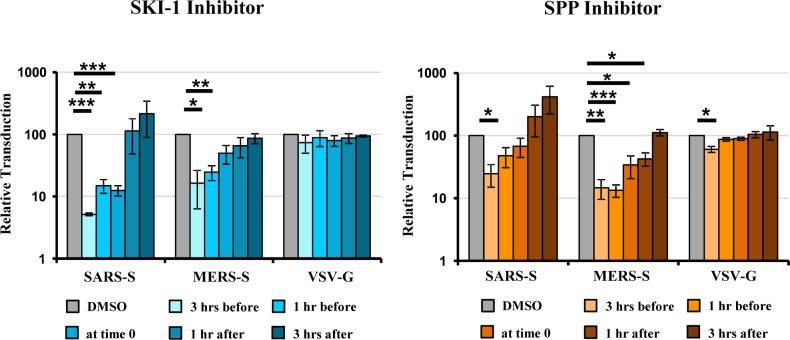
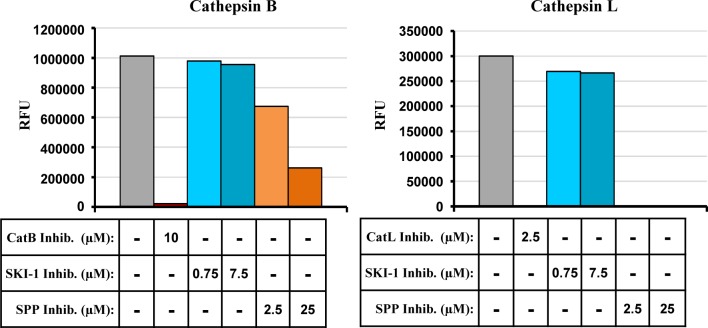
Emerging viruses such as severe fever and thrombocytopenia syndrome virus (SFTSV) and Ebola virus (EBOV) are responsible for significant morbidity and mortality. Host cell proteases that process the glycoproteins of these viruses are potential targets for antiviral intervention. The aspartyl protease signal peptide peptidase (SPP) has recently been shown to be required for processing of the glycoprotein precursor, Gn/Gc, of Bunyamwera virus and for viral infectivity. Here, we investigated whether SPP is also required for infectivity of particles bearing SFTSV-Gn/Gc. Entry driven by the EBOV glycoprotein (GP) and the Lassa virus glycoprotein (LASV-GPC) depends on the cysteine proteases cathepsin B and L (CatB/CatL) and the serine protease subtilisin/kexin-isozyme 1 (SKI-1), respectively, and was examined in parallel for control purposes. We found that inhibition of SPP and SKI-1 did not interfere with SFTSV Gn + Gc-driven entry but, unexpectedly, blocked entry mediated by EBOV-GP. The inhibition occurred at the stage of proteolytic activation and the SPP inhibitor was found to block CatL/CatB activity. In contrast, the SKI-1 inhibitor did not interfere with CatB/CatL activity but disrupted CatB localization in endo/lysosomes, the site of EBOV-GP processing. These results underline the potential of protease inhibitors for antiviral therapy but also show that previously characterized compounds might exert broader specificity than initially appreciated and might block viral entry via diverse mechanisms.
新兴病毒,如严重发热伴血小板减少综合征病毒(SFTSV)和埃博拉病毒(EBOV),会导致严重的发病率和死亡率。这些病毒的糖蛋白加工所涉及的宿主细胞蛋白酶是抗病毒干预的潜在靶点。天冬氨酰蛋白酶信号肽肽酶(SPP)最近被证明是 Bunyamwera 病毒糖蛋白前体 Gn/Gc 加工和病毒感染性所必需的。在这里,我们研究了 SPP 是否也需要 SFTSV-Gn/Gc 颗粒的感染性。EBOV 糖蛋白(GP)和拉萨病毒糖蛋白(LASV-GPC)驱动的进入依赖于半胱氨酸蛋白酶组织蛋白酶 B 和 L(CatB/CatL)和丝氨酸蛋白酶枯草杆菌蛋白酶/激肽酶 1(SKI-1),分别进行了平行检测,作为对照。我们发现,抑制 SPP 和 SKI-1 不会干扰 SFTSV Gn + Gc 驱动的进入,但出人意料的是,它阻断了 EBOV-GP 介导的进入。这种抑制发生在蛋白水解激活阶段,发现 SPP 抑制剂可以阻断 CatL/CatB 活性。相比之下,SKI-1 抑制剂不会干扰 CatB/CatL 活性,但会破坏 CatB 在内体/溶酶体中的定位,即 EBOV-GP 加工的部位。这些结果强调了蛋白酶抑制剂在抗病毒治疗中的潜力,但也表明先前表征的化合物可能具有比最初预期更广泛的特异性,并且可能通过不同的机制阻断病毒进入。