Alongi Jenny, Carosio Federico, Kiekens Paul
Department of Chemistry, University of Milan, Milano 20133, Italy.
Dipartimento di Scienza Applicata e Tecnologia, Politecnico di Torino, Alessandria Campus, Alessandria 15121, Italy.
Polymers (Basel). 2016 Oct 11;8(10):357. doi: 10.3390/polym8100357.
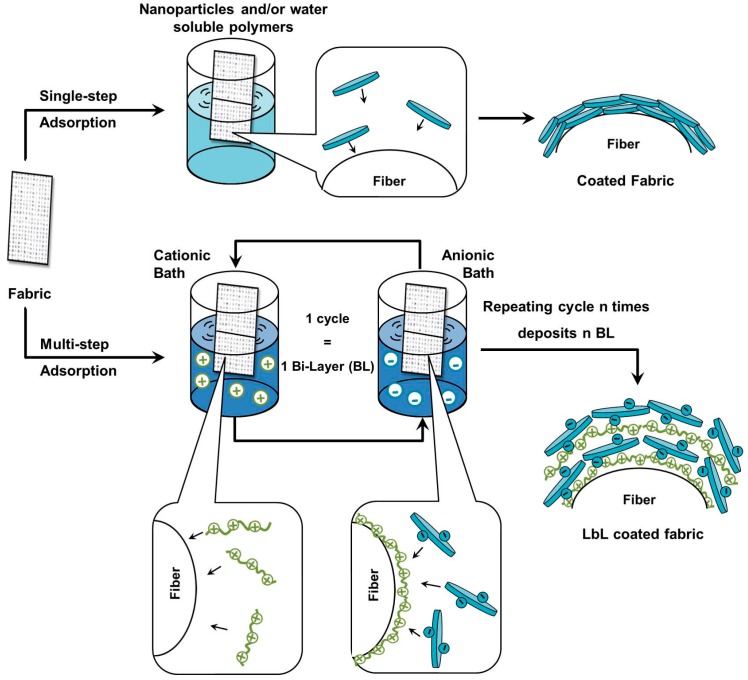
Over the last ten years a new trend of research activities regarding the flame retardancy of polymeric materials has arisen. Indeed, the continuous search for new flame retardant systems able to replace the traditional approaches has encouraged alternative solutions, mainly centred on nanotechnology. In this context, the deposition of nanostructured coatings on fabrics appears to be the most appealing and performance suitable approach. To this aim, different strategies can be exploited: from the deposition of a single monolayer consisting of inorganic nanoparticles (single-step adsorption) to the building-up of more complex architectures derived from layer by layer assembly (multi-step adsorption). The present paper aims to review the application of such systems in the field of polyester and polyester-cotton blend fabrics. The results collated by the authors are discussed and compared with those published in the literature on the basis of the different deposition methods adopted. A critical analysis of the advantages and disadvantages exhibited by these approaches is also presented.
在过去十年中,出现了一种关于聚合物材料阻燃性的新研究趋势。事实上,不断寻求能够替代传统方法的新型阻燃系统促使了替代解决方案的出现,主要集中在纳米技术上。在这种背景下,在织物上沉积纳米结构涂层似乎是最具吸引力且性能合适的方法。为此,可以采用不同的策略:从由无机纳米颗粒组成的单分子层沉积(单步吸附)到通过逐层组装构建更复杂的结构(多步吸附)。本文旨在综述此类系统在聚酯和聚酯 - 棉混纺织物领域的应用。作者整理的结果将根据所采用的不同沉积方法进行讨论,并与文献中发表的结果进行比较。还对这些方法所展现的优缺点进行了批判性分析。