Fan Hongli, Yan Qingyue, Coyte Peter C, Yu Wenguang
1 Shandong University of Finance and Economics, Jinan, China.
2 University of Toronto, ON, Canada.
Inquiry. 2019 Jan-Dec;56:46958019842000. doi: 10.1177/0046958019842000.
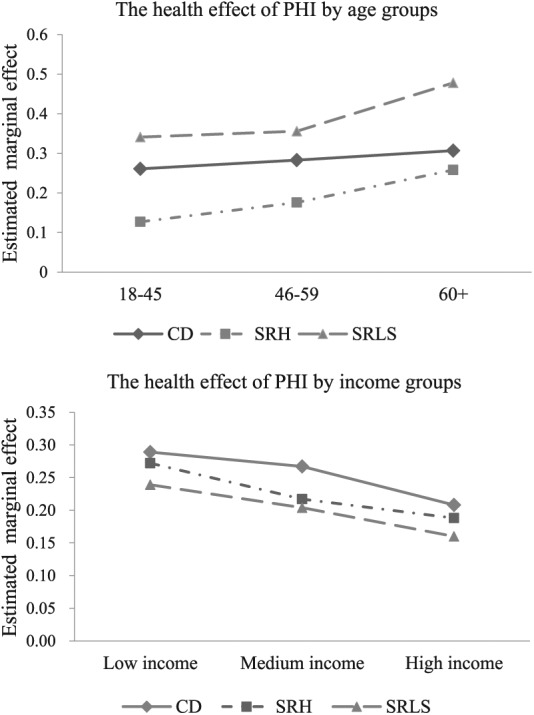
This article examines the impacts of public health insurance on the health of adults through use of data from the China Health and Nutrition Survey. We use the endogenous treatment effects model to infer the causal effects of public health insurance on health. We find that public health insurance significantly improves the physical and mental health status of health insurance beneficiaries after controlling for other covariates. Among the 2 types of voluntary public health insurance, the Urban Resident Basic Medical Insurance has the greater impact in improving health than the New Cooperative Medical Scheme. Moreover, the health effect appears to be stronger for middle-aged individuals, the elderly, and those with lower incomes than for their counterparts. The positive health effects may result from few channels, including the increase of health care utilization, the improvement of health-related behaviors, and the fact that individuals with public health insurance are more likely to use higher level care providers. This study provides implications on reforming China's health care system.
本文通过使用中国健康与营养调查的数据,研究了公共医疗保险对成年人健康的影响。我们使用内生性处理效应模型来推断公共医疗保险对健康的因果效应。我们发现,在控制了其他协变量之后,公共医疗保险显著改善了医疗保险受益人的身心健康状况。在两种自愿性公共医疗保险中,城镇居民基本医疗保险在改善健康方面的影响比新型农村合作医疗更大。此外,中年个体、老年人和低收入者的健康效应似乎比同龄人更强。积极的健康效应可能源于几个渠道,包括医疗保健利用率的提高、健康相关行为的改善,以及拥有公共医疗保险的个体更有可能使用更高水平的医疗服务提供者。本研究为中国医疗体系改革提供了启示。