Sivevski Atanas, Ivanov Emilija, Karadjova Dafina, Slaninka-Miceska Maja, Kikerkov Igor
University Clinic for Gynecology & Obstetrics, Anaesthesia Department, Clinical Center Mother Teresa, Faculty of Medicine, Ss Cyril and Methodius University of Skopje, Skopje, Republic of Macedonia.
Institute of Preclinical and Clinical Pharmacology and Toxicology, Faculty of Medicine, Ss Cyril and Methodius University of Skopje, Skopje, Republic of Macedonia.
Open Access Maced J Med Sci. 2019 Mar 30;7(6):996-1000. doi: 10.3889/oamjms.2019.230.
There is a widespread belief that spinal anaesthesia in patients with preeclampsia might cause severe hypotension and decreased uteroplacental perfusion. This study aimed to evaluate the incidence and severity of spinal induced-hypotension in preeclamptics and healthy parturients.
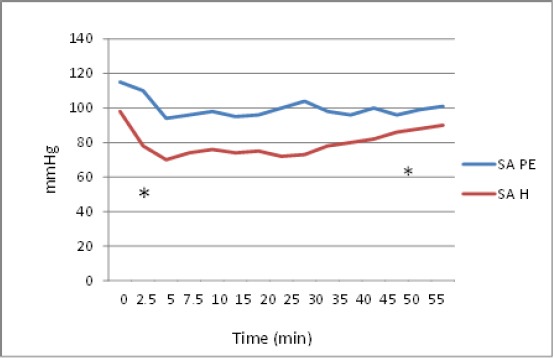
Total of 78 patients (40 healthy and 38 preeclamptic) undergoing a C-Section with spinal anaesthesia were included. Spinal anaesthesia was performed with a mixture of 8-9 mg isobaric 0.5% bupivacaine, 20 mcg fentanyl and 100 mcg morphine (total volume 2.2-2.4 ml). Blood pressures (BP)-SBP, DBP, MAP were recorded non-invasively before performing spinal anaesthesia and at 2.5 minutes after a spinal puncture.
The BP falls (%) from baseline were significantly greater in the healthy parturients compared to those with preeclampsia (25.8% ± 10.1 vs 18.8% ± 17.0 for SBP, 28.5% ± 8.8 vs 22.5% ± 10.4 for DBP, and 31.2% ± 14.2 vs 18.2% ± 12.6% for MAP, p < 0.05). The incidence rate of hypotension in the preeclamptics was 25% compared to 53% in healthy parturients (p < 0.001). Higher doses of vasopressors both ephedrine (16.5 ± 8.6 vs 6.0 ± 2.0 mg) and phenylephrine (105 ± 25 mg) in the healthy women were required. There was no need for phenylephrine treatment in the preeclamptic group.
This study showed that the incidence and severity of spinal-induced hypotension in preeclamptic patients are less than in healthy women. The use of low dose spinal anaesthesia also contributed to this statement.
人们普遍认为,子痫前期患者接受脊髓麻醉可能会导致严重低血压和子宫胎盘灌注减少。本研究旨在评估子痫前期患者和健康产妇脊髓诱导性低血压的发生率和严重程度。
纳入78例行脊髓麻醉下剖宫产的患者(40例健康产妇和38例子痫前期患者)。采用8 - 9毫克等比重0.5%布比卡因、20微克芬太尼和100微克吗啡的混合液进行脊髓麻醉(总体积2.2 - 2.4毫升)。在进行脊髓麻醉前和脊髓穿刺后2.5分钟无创记录血压(BP)——收缩压(SBP)、舒张压(DBP)、平均动脉压(MAP)。
与子痫前期患者相比,健康产妇的血压从基线下降的百分比显著更高(SBP:25.8% ± 10.1对18.8% ± 17.0;DBP:28.5% ± 8.8对22.5% ± 10.4;MAP:31.2% ± 14.2对18.2% ± 12.6%,p < 0.05)。子痫前期患者低血压的发生率为25%,而健康产妇为53%(p < 0.001)。健康女性需要更高剂量的血管升压药,包括麻黄碱(16.5 ± 8.6对6.0 ± 2.0毫克)和去氧肾上腺素(105 ± 25毫克)。子痫前期组无需使用去氧肾上腺素治疗。
本研究表明,子痫前期患者脊髓诱导性低血压的发生率和严重程度低于健康女性。低剂量脊髓麻醉的使用也支持了这一观点。