Genentech, 1 DNA Way, South San Francisco, CA, 94080, USA.
qPharmetra, Hälsovägen 7, 141 57, Huddinge, Sweden.
Cancer Chemother Pharmacol. 2019 Jun;83(6):1147-1158. doi: 10.1007/s00280-019-03826-1. Epub 2019 Apr 11.
To characterize the pharmacokinetics (PK) of, and perform an exploratory exposure-response (E-R) analysis for, pertuzumab in patients with HER2-positive early breast cancer (EBC) within the APHINITY study (NCT01358877, BIG 4-11/BO25126/TOC4939G).
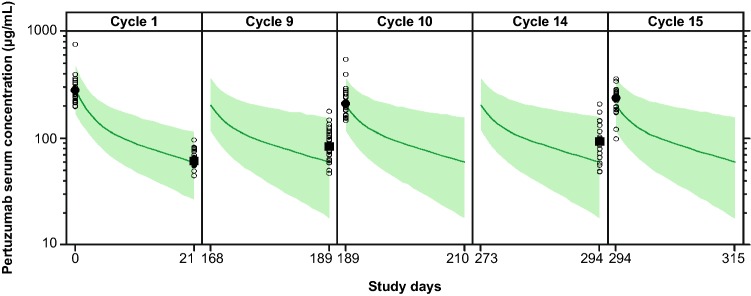
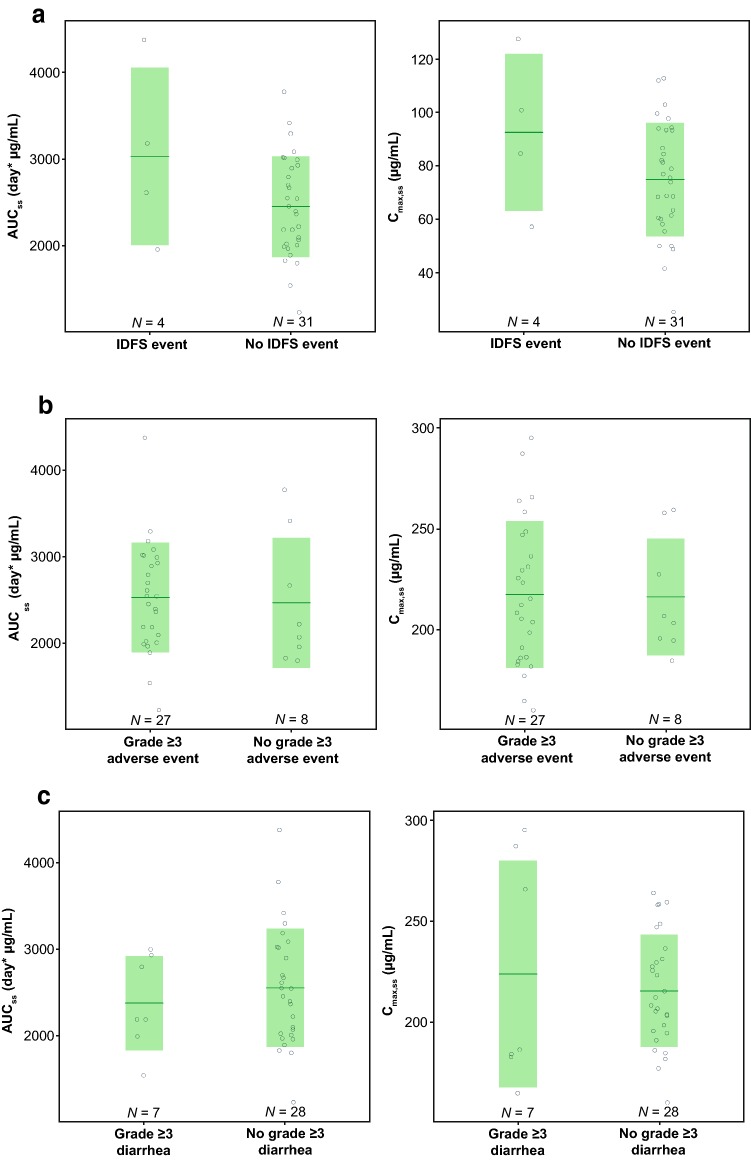
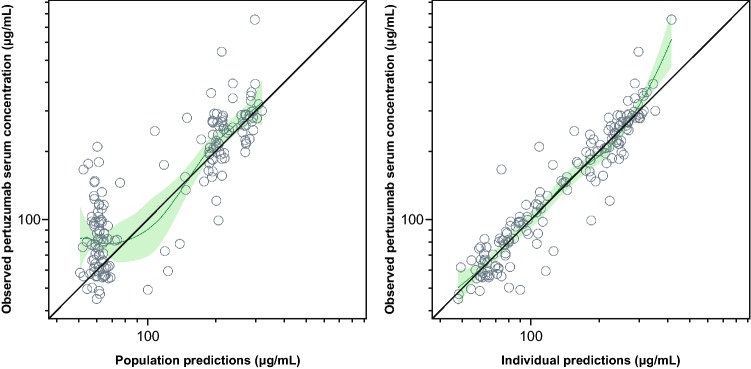
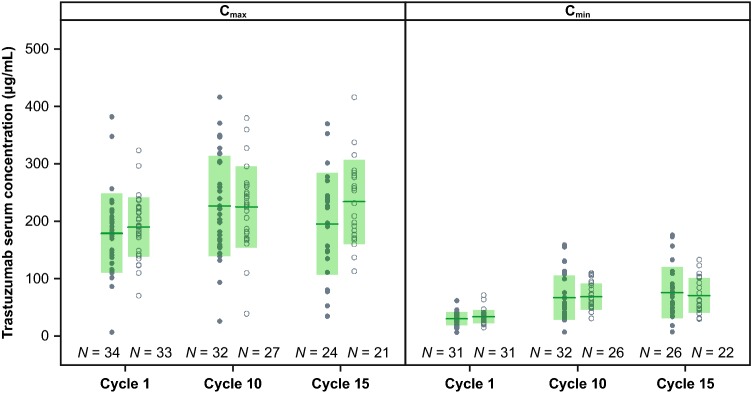
A previously developed pertuzumab two-compartment linear population pharmacokinetic (popPK) model was subjected to external validation to examine appropriateness for describing pertuzumab concentrations from the APHINITY study. Pharmacokinetic drug-drug interactions (DDIs) between pertuzumab, trastuzumab, and chemotherapy were assessed by comparing observed serum or plasma C, C, and AUC geometric mean ratios with 90% CIs. Predictions of pertuzumab C, C, and AUC were derived from individual parameter estimates and used in an exploratory E-R analysis.
Using data from 72 patients, based on goodness-of-fit, the popPK model was deemed appropriate for predictions of individual exposures for subsequent comparisons to historical data, assessment of DDIs, and E-R analyses. No evidence of DDIs for pertuzumab on trastuzumab, trastuzumab on pertuzumab, or pertuzumab on chemotherapy PK was observed. Analyses of differences in exposure between patients with and without invasive disease-free survival events did not indicate improved efficacy with increased exposure. Overall Grade ≥ 3 diarrhea prevalence was higher with pertuzumab versus placebo, but was not greater with increasing pertuzumab exposure. No apparent E-R relationship was suggested with respect to other grade ≥ 3 AEs.
Overall, the limited available data from this exploratory study suggest that no dose adjustments are needed for pertuzumab when administered in combination with trastuzumab and an EBC chemotherapy regimen.
在 APHINITY 研究(NCT01358877、BIG 4-11/BO25126/TOC4939G)中,对人表皮生长因子受体 2(HER2)阳性早期乳腺癌(EBC)患者的帕妥珠单抗药代动力学(PK)进行特征描述,并进行探索性暴露-反应(E-R)分析。
先前建立的帕妥珠单抗两室线性群体 PK 模型(popPK)进行了外部验证,以检查其是否适合描述 APHINITY 研究中的帕妥珠单抗浓度。通过比较观察到的血清或血浆 C、C 和 AUC 几何均数比值与 90%置信区间(CI),评估帕妥珠单抗、曲妥珠单抗和化疗之间的药物-药物相互作用(DDI)。从个体参数估计值推导出帕妥珠单抗 C、C 和 AUC 的预测值,并用于探索性 E-R 分析。
使用 72 例患者的数据,基于拟合优度,popPK 模型被认为适合于预测个体暴露量,以便随后与历史数据进行比较、评估 DDI 和 E-R 分析。未观察到帕妥珠单抗对曲妥珠单抗、曲妥珠单抗对帕妥珠单抗或帕妥珠单抗对化疗 PK 的 DDI 证据。对无侵袭性疾病无复发生存事件和有侵袭性疾病无复发生存事件患者之间暴露差异的分析表明,增加暴露并不能提高疗效。帕妥珠单抗组的总体 3 级及以上腹泻发生率高于安慰剂组,但随着帕妥珠单抗暴露量的增加,发生率并未增加。其他 3 级及以上不良事件与暴露量之间似乎没有明显的 E-R 关系。
总体而言,这项探索性研究中有限的可用数据表明,当帕妥珠单抗与曲妥珠单抗和 EBC 化疗方案联合使用时,无需调整帕妥珠单抗的剂量。