Mathorne Stine Westergaard, Sørensen Kristina, Fagerberg Christina, Bode Matthias, Hertz Jens Michael
Department of Clinical Genetics, Odense University Hospital, J. B. Winsløvs Vej 4, DK-5000, Odense, Denmark.
Department of Neurology, Odense University Hospital, Odense, Denmark.
BMC Neurol. 2019 Apr 12;19(1):60. doi: 10.1186/s12883-019-1292-8.
Primary familial brain calcification is a rare autosomal dominant or recessive neurodegenerative disease, characterized by bilateral brain calcifications in different areas of the brain. It is a clinically heterogeneous disease and patients are reported to exhibit a wide spectrum of neurological and psychiatric symptoms. Mutations in five genes have been identified so far including SLC20A2, PDGFRB, PDGFB, XPR1, and MYORG. PDGFRB encodes the platelet-derived growth factor receptor-beta, and is expressed in neurons, vascular smooth muscle cells and pericytes. Patients with a PDGFRB mutation seem to exhibit a milder phenotype and milder brain calcification on brain imaging than patients with SLC20A2 and PDGFB mutations. However, this is based on a few observations so far.
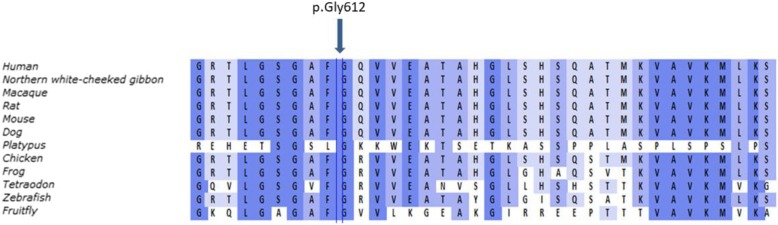
We present a Danish family with bilateral brain calcifications and mild clinical symptoms of primary familial brain calcification, segregating with a novel PDGFRB sequence variant: c.1834G > A; p.(Gly612Arg), detected by whole exome sequencing. The variant results in physiochemical changes at the amino acid level, and affects a highly conserved nucleotide as well as amino acid. It is located in the tyrosine kinase domain of PDGFRβ. Segregation analysis and in silico analyses predicted the missense variant to be disease causing.
Our study confirms that PDGFRB mutation carriers in general have a mild clinical phenotype, and basal ganglia calcifications can be detected by a CT scan, also in asymptomatic mutation carriers.
原发性家族性脑钙化是一种罕见的常染色体显性或隐性神经退行性疾病,其特征为大脑不同区域出现双侧脑钙化。它是一种临床异质性疾病,据报道患者会表现出广泛的神经和精神症状。迄今为止,已鉴定出五个基因的突变,包括SLC20A2、PDGFRB、PDGFB、XPR1和MYORG。PDGFRB编码血小板衍生生长因子受体β,在神经元、血管平滑肌细胞和周细胞中表达。与携带SLC20A2和PDGFB突变的患者相比,携带PDGFRB突变的患者在脑成像上似乎表现出较轻的表型和较轻的脑钙化。然而,这目前仅基于少数观察结果。
我们报告了一个丹麦家族,该家族患有双侧脑钙化及原发性家族性脑钙化的轻度临床症状,通过全外显子组测序检测到一种新的PDGFRB序列变异:c.1834G>A;p.(Gly612Arg)。该变异导致氨基酸水平的理化变化,影响一个高度保守的核苷酸以及氨基酸。它位于PDGFRβ的酪氨酸激酶结构域。分离分析和生物信息学分析预测该错义变异为致病突变。
我们的研究证实,一般而言,PDGFRB突变携带者具有轻度临床表型,并且通过CT扫描可检测到基底节钙化,无症状突变携带者也不例外。