1 Key Laboratory of Acupuncture and Neurology of Zhejiang Province, Department of Neurobiology and Acupuncture Research, The Third Clinical Medical College, Zhejiang Chinese Medical University, Hangzhou, China.
2 Department of Neuroscience, Cell Biology and Anatomy, University of Texas Medical Branch, Galveston, TX, USA.
Mol Pain. 2019 Jan-Dec;15:1744806919847810. doi: 10.1177/1744806919847810.
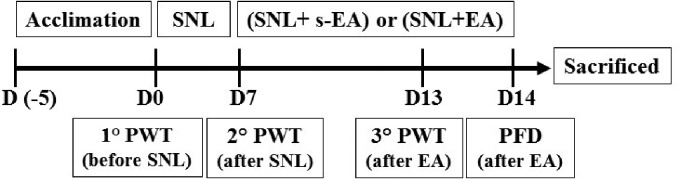
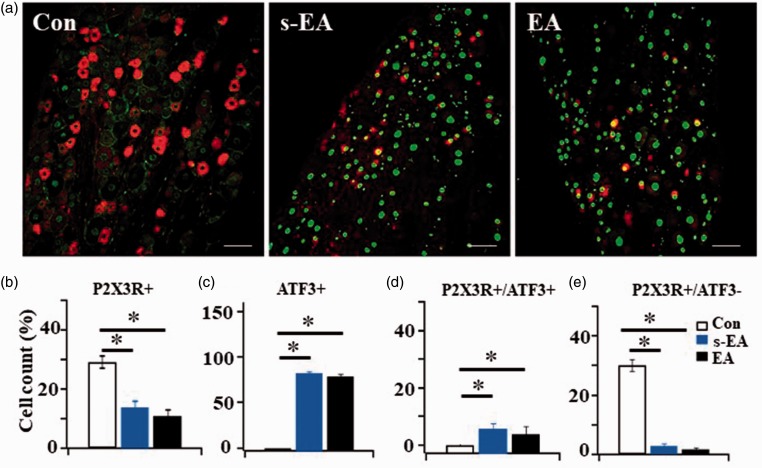
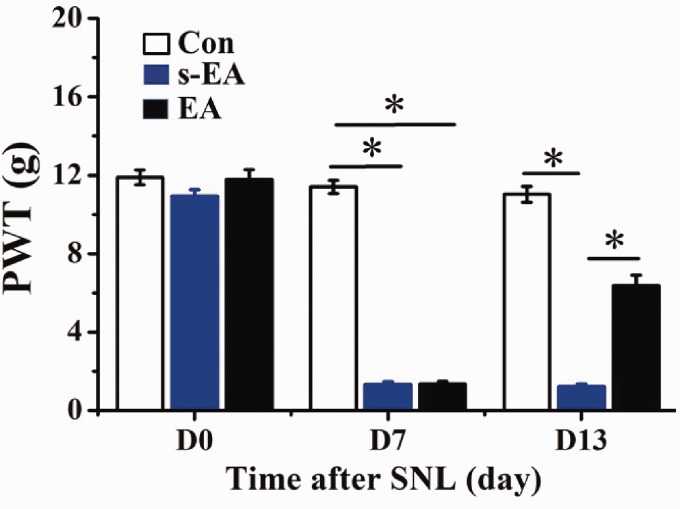
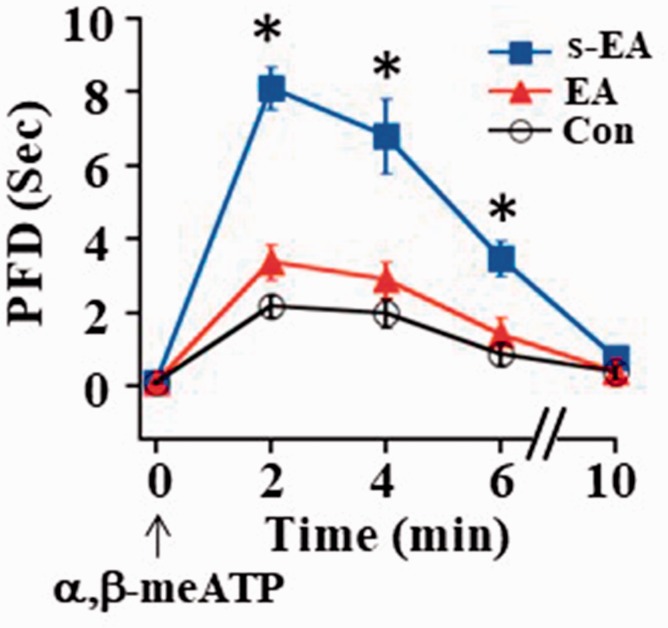
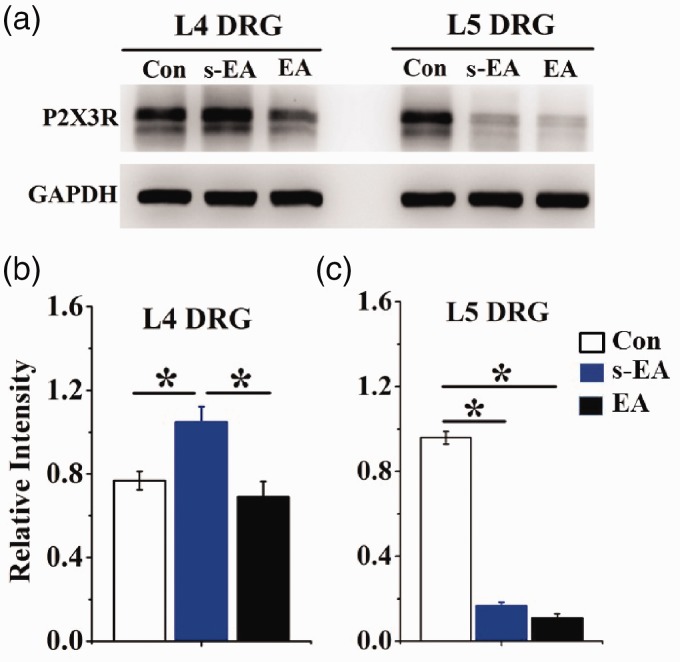
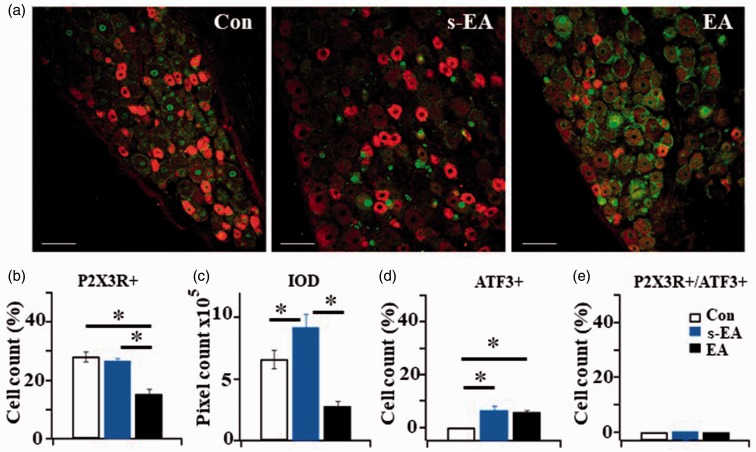
Electroacupuncture has been shown to effectively reduce chronic pain in patients with nerve injury. The underlying mechanisms are not well understood. Accumulated evidence suggests that purinergic P2X3 receptors (P2X3Rs) in dorsal root ganglion neurons play a major role in mediating chronic pain associated with nerve injury. The aim of this study is to determine if electroacupuncture stimulation alters P2X3R activity in dorsal root ganglia to produce analgesia under neuropathic pain condition. Peripheral neuropathy was produced by ligation of the left lumbar 5 (L5) spinal nerve in rats. Low-frequency (2 Hz) electrical stimulation was applied to ipsilateral ST36 and BL60 acupoints in rats. The P2X3R agonist (α,β-meATP)-induced flinch responses were reduced after electroacupuncture treatment. Western analyses showed that P2X3R expression was upregulated in nerve-uninjured lumbar 4 (L4) dorsal root ganglion neurons ipsilateral to the spinal nerve ligation. Electroacupuncture-stimulation reversed the upregulation. In nerve-injured L5 dorsal root ganglia, P2X3R expression was substantially reduced. Electroacupuncture had no effect on the reduction. We also determined the injury state of P2X3R expressing dorsal root ganglion neurons using the neuronal injury marker, activating transcription factor 3 (ATF3). Immunohistochemical assay showed that in L4 dorsal root ganglia, almost all P2X3Rs were expressed in uninjured (ATF3-) neurons. Spinal nerve ligation increased the expression of P2X3Rs. Electroacupuncture reduced the increase in P2X3R expression without affecting the percentage of ATF + neurons. In ipsilateral L5 dorsal root ganglion neurons, spinal nerve ligation reduced the percentage of P2X3R + neurons and markedly increased the percentage of ATF3 + cells. Almost all of P2X3Rs were expressed in damaged (ATF3+) neurons. Electroacupuncture had no effect on spinal nerve ligation-induced changes in the percentage of P2X3R or percentage of ATF3 + cells in L5 dorsal root ganglia. These observations led us to conclude that electroacupuncture effectively reduces injury-induced chronic pain by selectively reducing the expression of P2X3Rs in nerve-uninjured L4 dorsal root ganglion neurons.
电针已被证明可有效减轻神经损伤患者的慢性疼痛。但其潜在机制尚不清楚。越来越多的证据表明,背根神经节神经元中的嘌呤能 P2X3 受体(P2X3R)在介导与神经损伤相关的慢性疼痛中起着主要作用。本研究旨在确定电针刺激是否会改变背根神经节中的 P2X3R 活性,从而在神经病理性疼痛条件下产生镇痛作用。通过结扎大鼠左侧第 5 腰椎(L5)脊神经产生周围神经病变。在大鼠同侧 ST36 和 BL60 穴位施加低频(2 Hz)电刺激。电针治疗后,P2X3R 激动剂(α,β-meATP)诱导的退缩反应减少。Western 分析显示,神经未损伤的 L4 背根神经节神经元中 P2X3R 表达上调,与脊神经结扎同侧。电针刺激逆转了这种上调。在神经损伤的 L5 背根神经节中,P2X3R 表达显著减少。电针刺激对这种减少没有影响。我们还使用神经元损伤标志物激活转录因子 3(ATF3)来确定表达 P2X3R 的背根神经节神经元的损伤状态。免疫组织化学检测显示,在 L4 背根神经节中,几乎所有 P2X3R 均表达在未损伤(ATF3-)神经元中。脊神经结扎增加了 P2X3R 的表达。电针刺激减少了 P2X3R 表达的增加,而不影响 ATF+神经元的百分比。在同侧 L5 背根神经节神经元中,脊神经结扎减少了 P2X3R+神经元的百分比,并显著增加了 ATF3+细胞的百分比。几乎所有 P2X3R 都表达在受损(ATF3+)神经元中。电针刺激对 L5 背根神经节中脊神经结扎诱导的 P2X3R 百分比或 ATF3+细胞百分比的变化没有影响。这些观察结果使我们得出结论,电针通过选择性降低神经未损伤的 L4 背根神经节神经元中 P2X3R 的表达,有效减轻损伤引起的慢性疼痛。