Human Anatomy, Department of Translational Research and New Technologies in Medicine and Surgery, University of Pisa, Pisa, Italy.
I.R.C.C.S Neuromed, Pozzilli, Italy.
Front Immunol. 2019 Mar 29;10:628. doi: 10.3389/fimmu.2019.00628. eCollection 2019.
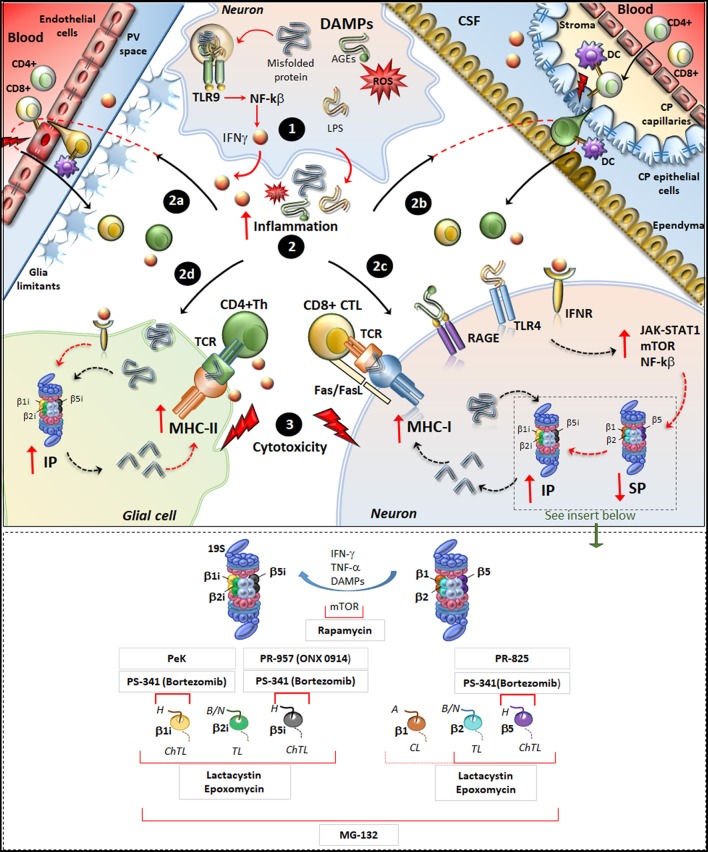
The wealth of recent evidence about a bi-directional communication between nerve- and immune- cells revolutionized the traditional concept about the brain as an "immune-privileged" organ while opening novel avenues in the pathophysiology of CNS disorders. In fact, altered communication between the immune and nervous system is emerging as a common hallmark in neuro-developmental, neurodegenerative, and neuro-immunological diseases. At molecular level, the ubiquitin proteasome machinery operates as a sentinel at the crossroad between the immune system and brain. In fact, the standard proteasome and its alternative/inducible counterpart, the immunoproteasome, operate dynamically and coordinately in both nerve- and immune- cells to modulate neurotransmission, oxidative/inflammatory stress response, and immunity. When dysregulations of the proteasome system occur, altered amounts of standard- vs. immune-proteasome subtypes translate into altered communication between neurons, glia, and immune cells. This contributes to neuro-inflammatory pathology in a variety of neurological disorders encompassing Parkinson's, Alzheimer's, and Huntingtin's diseases, brain trauma, epilepsy, and Multiple Sclerosis. In the present review, we analyze those proteasome-dependent molecular interactions which sustain communication between neurons, glia, and brain circulating T-lymphocytes both in baseline and pathological conditions. The evidence here discussed converges in that upregulation of immunoproteasome to the detriment of the standard proteasome, is commonly implicated in the inflammatory- and immune- biology of neurodegeneration. These concepts may foster additional studies investigating the role of immunoproteasome as a potential target in neurodegenerative and neuro-immunological disorders.
近年来,关于神经细胞和免疫细胞之间双向通讯的丰富证据彻底改变了传统观念,即大脑是一个“免疫特权”器官,同时为中枢神经系统疾病的病理生理学开辟了新途径。事实上,免疫系统和神经系统之间改变的通讯正在成为神经发育、神经退行性和神经免疫性疾病的共同标志。在分子水平上,泛素蛋白酶体机制作为免疫系统和大脑交汇点的哨兵发挥作用。事实上,标准蛋白酶体及其替代/诱导型对应物免疫蛋白酶体在神经细胞和免疫细胞中动态且协调地运作,以调节神经传递、氧化/炎症应激反应和免疫。当蛋白酶体系统失调时,标准型与免疫型蛋白酶体亚型的数量改变会导致神经元、神经胶质和免疫细胞之间通讯改变。这导致各种神经病变中的神经炎症病理学,包括帕金森病、阿尔茨海默病和亨廷顿病、脑创伤、癫痫和多发性硬化症。在本综述中,我们分析了那些在基础和病理条件下维持神经元、神经胶质和大脑循环 T 淋巴细胞之间通讯的蛋白酶体依赖性分子相互作用。这里讨论的证据表明,免疫蛋白酶体的上调以牺牲标准蛋白酶体为代价,通常与神经退行性变的炎症和免疫生物学有关。这些概念可能会促进更多的研究,以调查免疫蛋白酶体作为神经退行性和神经免疫性疾病潜在靶点的作用。