
基于无人机的表型分析结合形态测量和光谱分析能够量化野生番茄植株对盐胁迫的响应。
Unmanned Aerial Vehicle-Based Phenotyping Using Morphometric and Spectral Analysis Can Quantify Responses of Wild Tomato Plants to Salinity Stress.
作者信息
Johansen Kasper, Morton Mitchell J L, Malbeteau Yoann M, Aragon Bruno, Al-Mashharawi Samir K, Ziliani Matteo G, Angel Yoseline, Fiene Gabriele M, Negrão Sónia S C, Mousa Magdi A A, Tester Mark A, McCabe Matthew F
机构信息
Hydrology, Agriculture and Land Observation, Water Desalination and Reuse Center, King Abdullah University of Science and Technology, Thuwal, Saudi Arabia.
Center for Desert Agriculture, The Salt Lab, King Abdullah University of Science and Technology, Thuwal, Saudi Arabia.
出版信息
Front Plant Sci. 2019 Mar 29;10:370. doi: 10.3389/fpls.2019.00370. eCollection 2019.
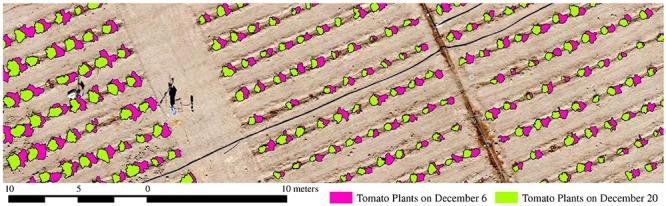
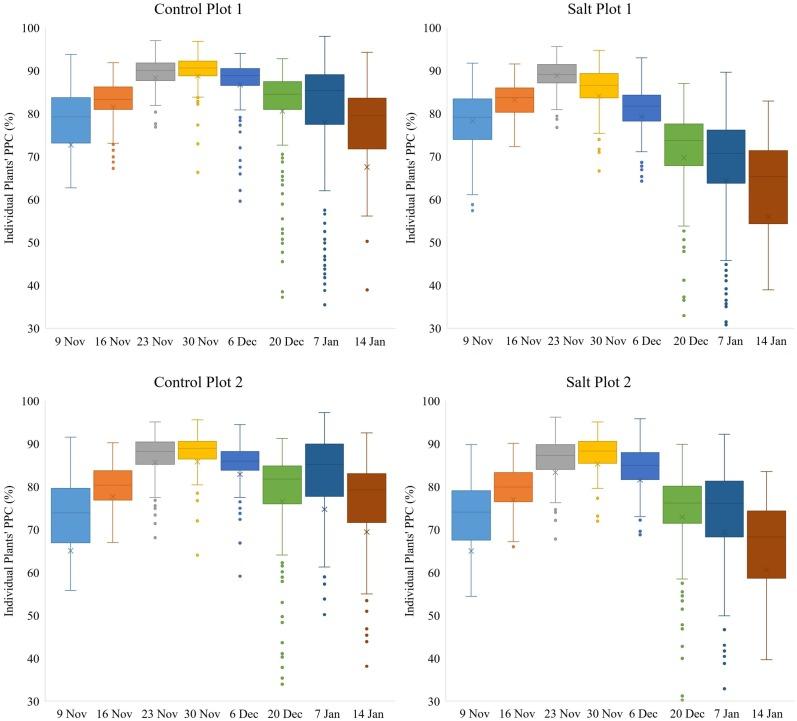
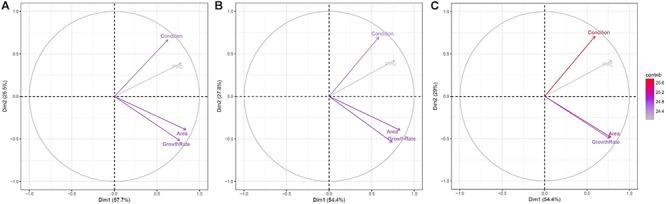
With salt stress presenting a major threat to global food production, attention has turned to the identification and breeding of crop cultivars with improved salt tolerance. For instance, some accessions of wild species with higher salt tolerance than commercial varieties are being investigated for their potential to expand food production into marginal areas or to use brackish waters for irrigation. However, assessment of individual plant responses to salt stress in field trials is time-consuming, limiting, for example, longitudinal assessment of large numbers of plants. Developments in Unmanned Aerial Vehicle (UAV) sensing technologies provide a means for extensive, repeated and consistent phenotyping and have significant advantages over standard approaches. In this study, 199 accessions of the wild tomato species, , were evaluated through a field assessment of 600 control and 600 salt-treated plants. UAV imagery was used to: (1) delineate tomato plants from a time-series of eight RGB and two multi-spectral datasets, using an automated object-based image analysis approach; (2) assess four traits, i.e., plant area, growth rates, condition and Plant Projective Cover (PPC) over the growing season; and (3) use the mapped traits to identify the best-performing accessions in terms of yield and salt tolerance. For the first five campaigns, >99% of all tomato plants were automatically detected. The omission rate increased to 2-5% for the last three campaigns because of the presence of dead and senescent plants. Salt-treated plants exhibited a significantly smaller plant area (average control and salt-treated plant areas of 0.55 and 0.29 m, respectively), maximum growth rate (daily maximum growth rate of control and salt-treated plant of 0.034 and 0.013 m, respectively) and PPC (5-16% difference) relative to control plants. Using mapped plant condition, area, growth rate and PPC, we show that it was possible to identify eight out of the top 10 highest yielding accessions and that only five accessions produced high yield under both treatments. Apart from showcasing multi-temporal UAV-based phenotyping capabilities for the assessment of plant performance, this research has implications for agronomic studies of plant salt tolerance and for optimizing agricultural production under saline conditions.
盐胁迫对全球粮食生产构成重大威胁,人们的注意力已转向鉴定和培育耐盐性更强的作物品种。例如,一些耐盐性高于商业品种的野生种材料正在接受研究,以评估其将粮食生产扩展到边缘地区或利用微咸水进行灌溉的潜力。然而,在田间试验中评估单株植物对盐胁迫的反应非常耗时,例如限制了对大量植物的纵向评估。无人机(UAV)传感技术的发展提供了一种进行广泛、重复和一致的表型分析的方法,与标准方法相比具有显著优势。在本研究中,通过对600株对照植物和600株盐处理植物进行田间评估,对199份野生番茄物种材料进行了评价。无人机图像被用于:(1)使用基于对象的自动图像分析方法,从包含8个RGB和2个多光谱数据集的时间序列中勾勒出番茄植株;(2)评估生长季节内的四个性状,即植株面积、生长速率、状况和植物投影覆盖度(PPC);(3)利用映射的性状来鉴定在产量和耐盐性方面表现最佳的材料。在前五次监测中,所有番茄植株的自动检测率>99%。由于存在死亡和衰老的植株,后三次监测的遗漏率增加到2-5%。与对照植株相比,盐处理植株的植株面积显著更小(对照和盐处理植株的平均面积分别为0.55和0.29平方米)、最大生长速率(对照和盐处理植株的日最大生长速率分别为0.034和0.013平方米)和PPC(相差5-16%)。利用映射的植株状况、面积、生长速率和PPC,我们发现能够从产量最高的前10份材料中鉴定出8份,并且只有5份材料在两种处理下均能高产。除了展示基于无人机的多时间点表型分析能力以评估植物性能外,本研究还对植物耐盐性的农艺学研究以及在盐渍条件下优化农业生产具有启示意义。





 Zotero 插件