Watanabe Kakeru, Guo Wei, Arai Keigo, Takanashi Hideki, Kajiya-Kanegae Hiromi, Kobayashi Masaaki, Yano Kentaro, Tokunaga Tsuyoshi, Fujiwara Toru, Tsutsumi Nobuhiro, Iwata Hiroyoshi
Laboratory of Biometry and Bioinformatics, Department of Agricultural and Environmental Biology, Graduate School of Agricultural and Life Sciences, The University of Tokyo Tokyo, Japan.
Institute for Sustainable Agro-ecosystem Services, Graduate School of Agricultural and Life Sciences, The University of Tokyo Tokyo, Japan.
Front Plant Sci. 2017 Mar 28;8:421. doi: 10.3389/fpls.2017.00421. eCollection 2017.
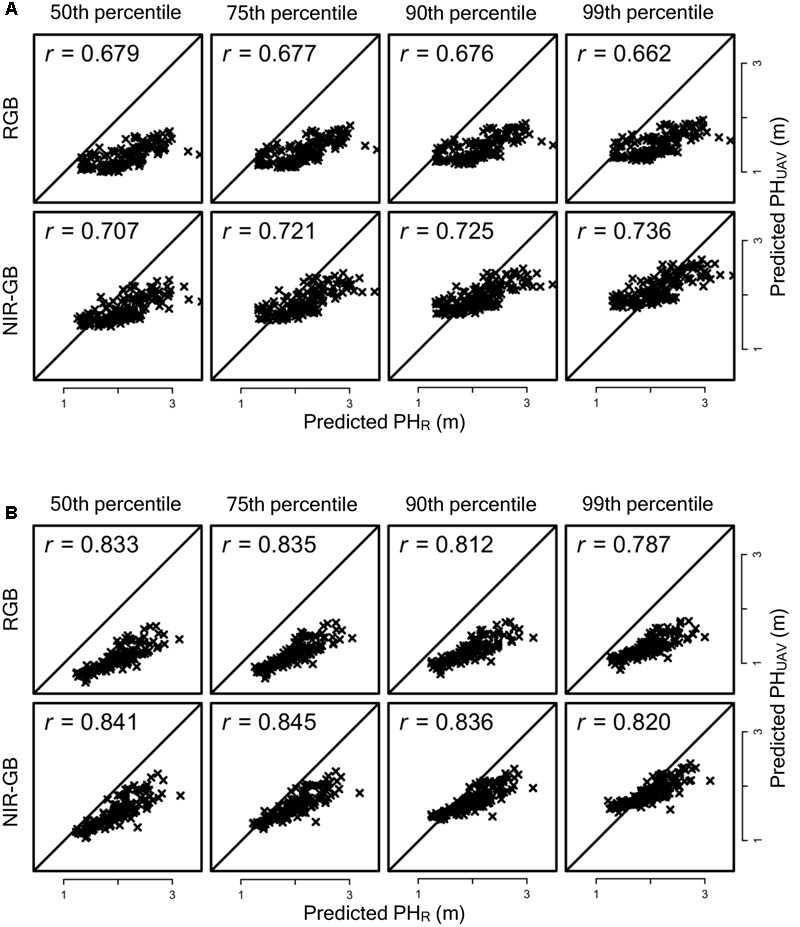
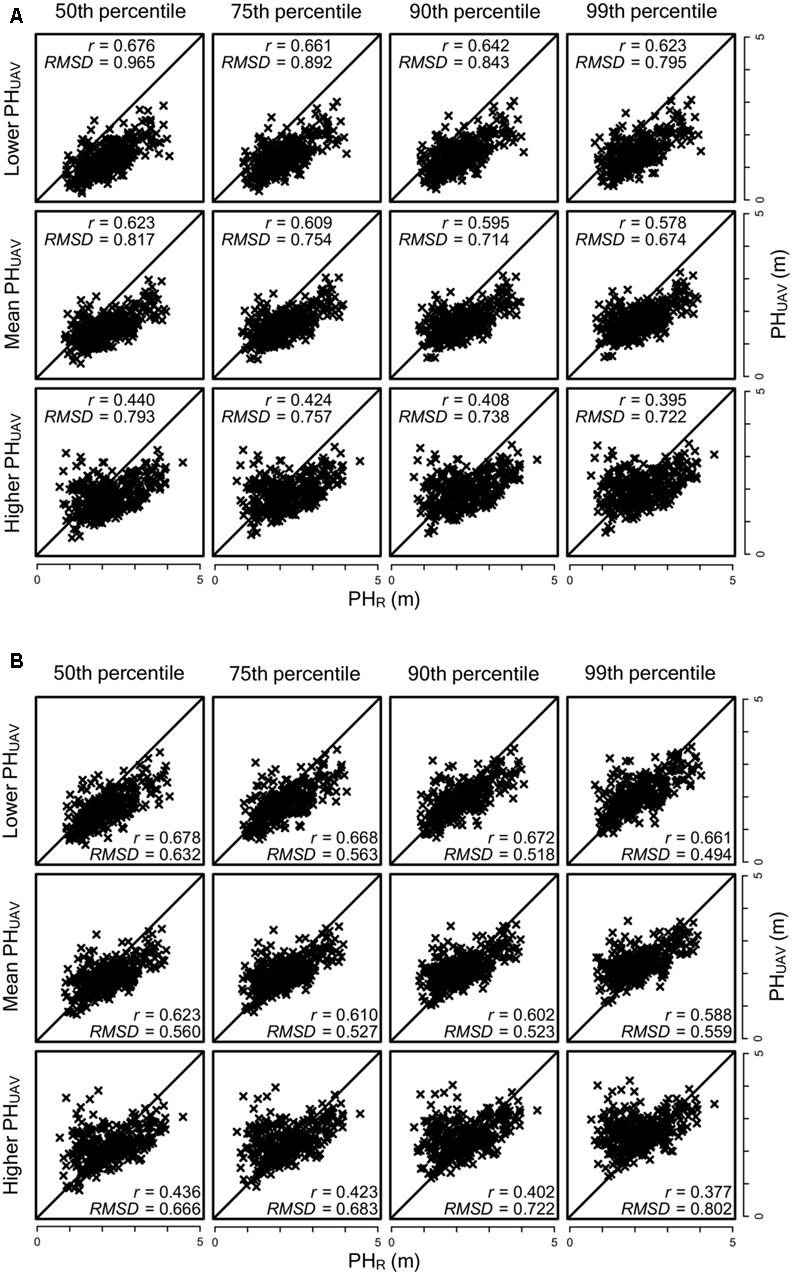
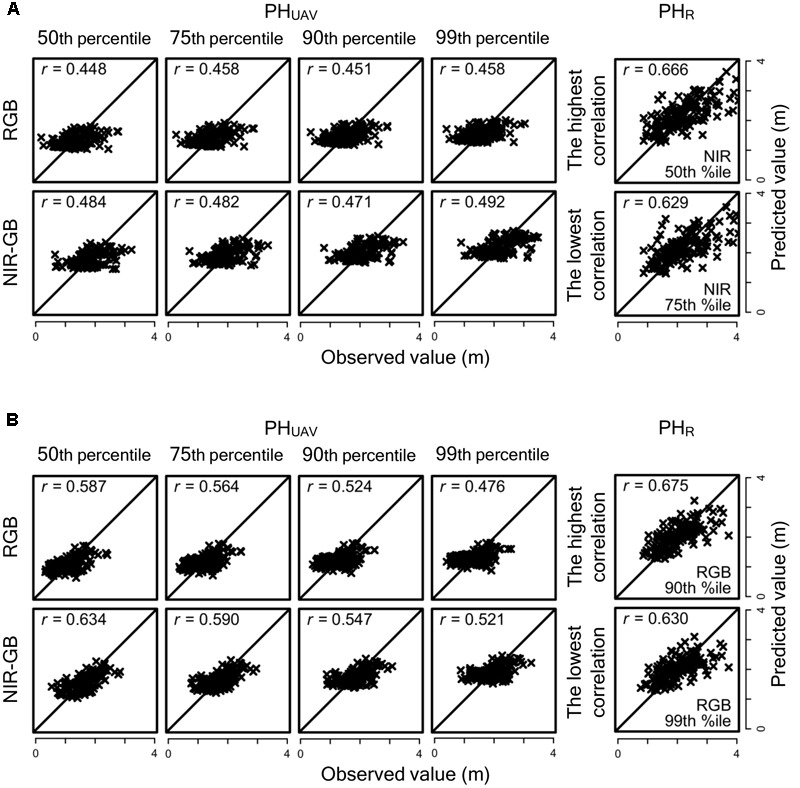
Genomics-assisted breeding methods have been rapidly developed with novel technologies such as next-generation sequencing, genomic selection and genome-wide association study. However, phenotyping is still time consuming and is a serious bottleneck in genomics-assisted breeding. In this study, we established a high-throughput phenotyping system for sorghum plant height and its response to nitrogen availability; this system relies on the use of unmanned aerial vehicle (UAV) remote sensing with either an RGB or near-infrared, green and blue (NIR-GB) camera. We evaluated the potential of remote sensing to provide phenotype training data in a genomic prediction model. UAV remote sensing with the NIR-GB camera and the 50th percentile of digital surface model, which is an indicator of height, performed well. The correlation coefficient between plant height measured by UAV remote sensing (PH) and plant height measured with a ruler (PH) was 0.523. Because PH was overestimated (probably because of the presence of taller plants on adjacent plots), the correlation coefficient between PH and PH was increased to 0.678 by using one of the two replications (that with the lower PH value). Genomic prediction modeling performed well under the low-fertilization condition, probably because PH overestimation was smaller under this condition due to a lower plant height. The predicted values of PH and PH were highly correlated with each other ( = 0.842). This result suggests that the genomic prediction models generated with PH were almost identical and that the performance of UAV remote sensing was similar to that of traditional measurements in genomic prediction modeling. UAV remote sensing has a high potential to increase the throughput of phenotyping and decrease its cost. UAV remote sensing will be an important and indispensable tool for high-throughput genomics-assisted plant breeding.
随着新一代测序、基因组选择和全基因组关联研究等新技术的出现,基因组辅助育种方法得到了迅速发展。然而,表型分析仍然耗时,是基因组辅助育种中的一个严重瓶颈。在本研究中,我们建立了一个用于高粱株高及其对氮素有效性响应的高通量表型分析系统;该系统依赖于使用配备RGB或近红外、绿色和蓝色(NIR-GB)相机的无人机遥感技术。我们评估了遥感技术在基因组预测模型中提供表型训练数据的潜力。使用NIR-GB相机和作为高度指标的数字表面模型第50百分位数的无人机遥感表现良好。无人机遥感测量的株高(PH)与用尺子测量的株高(PH)之间的相关系数为0.523。由于PH被高估(可能是因为相邻地块上存在较高的植株),通过使用两个重复样本之一(PH值较低的那个),PH与PH之间的相关系数提高到了0.678。在低施肥条件下,基因组预测建模表现良好,可能是因为在此条件下由于株高较低,PH高估较小。PH和PH的预测值彼此高度相关(=0.842)。这一结果表明,用PH生成的基因组预测模型几乎相同,并且在基因组预测建模中,无人机遥感的性能与传统测量方法相似。无人机遥感具有提高表型分析通量并降低其成本的巨大潜力。无人机遥感将成为高通量基因组辅助植物育种的重要且不可或缺的工具。