Adams Gemma M, Ryan David E, Beattie Nicholas A, McKay Alasdair I, Lloyd-Jones Guy C, Weller Andrew S
Chemistry Research Laboratories, Mansfield Road, University of Oxford, Oxford OX1 3TA, United Kingdom.
Institute of Chemical Sciences, Heriot Watt University, Edinburgh EH14 4AS, United Kingdom.
ACS Catal. 2019 Apr 5;9(4):3657-3666. doi: 10.1021/acscatal.9b00081. Epub 2019 Mar 11.
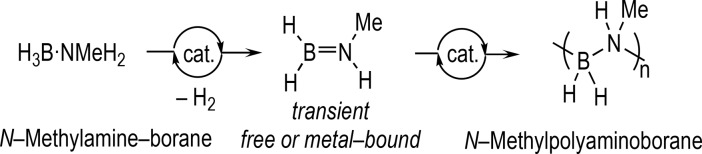
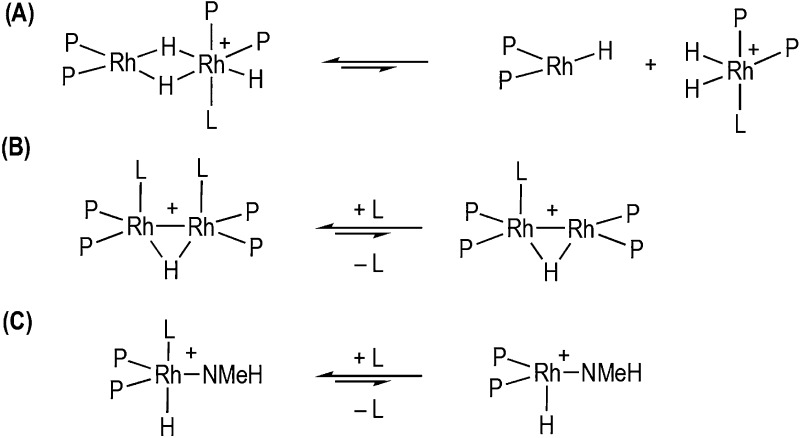
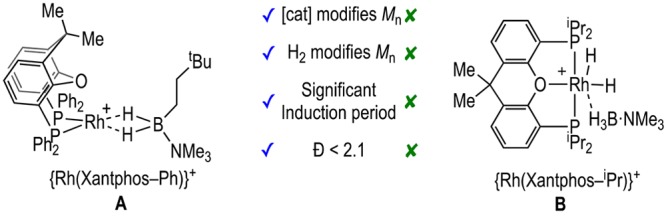
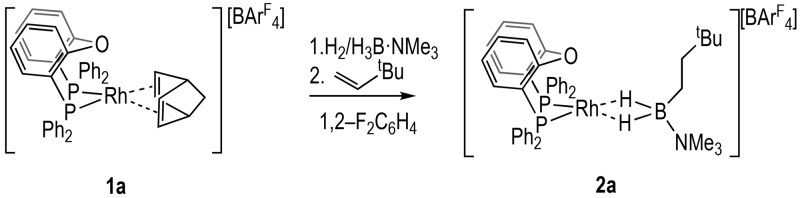
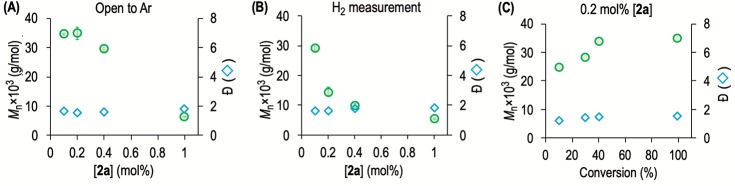
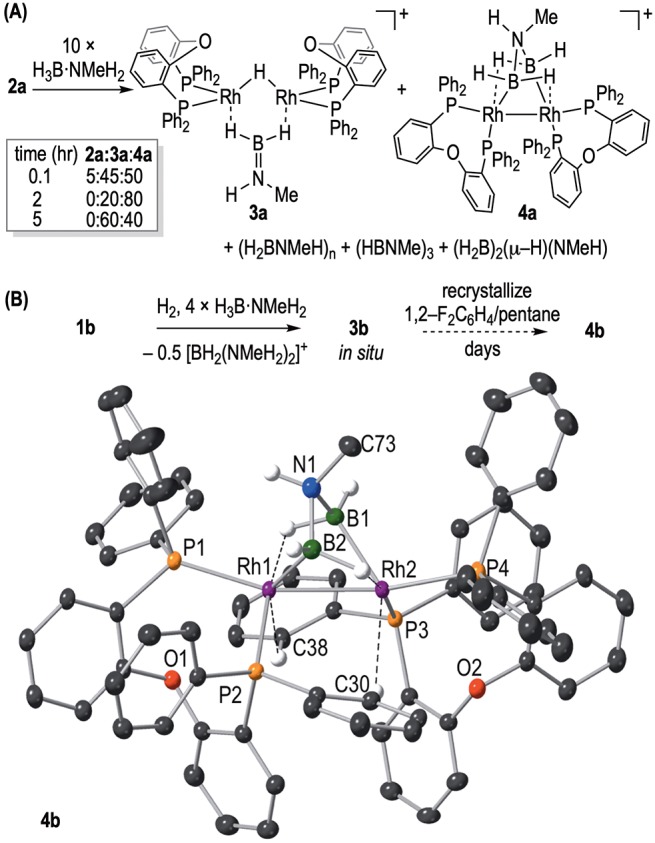
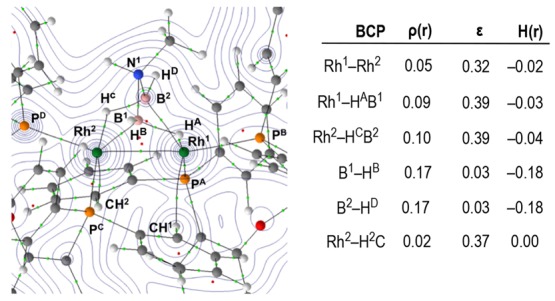
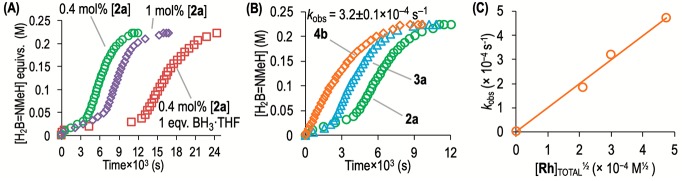
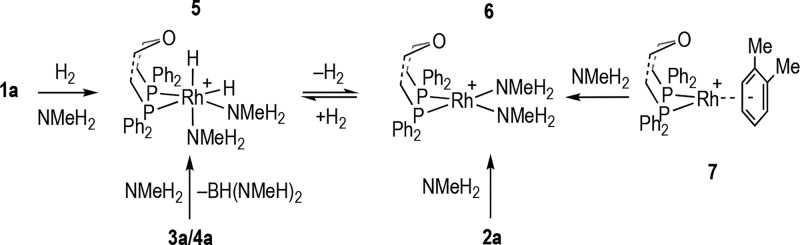
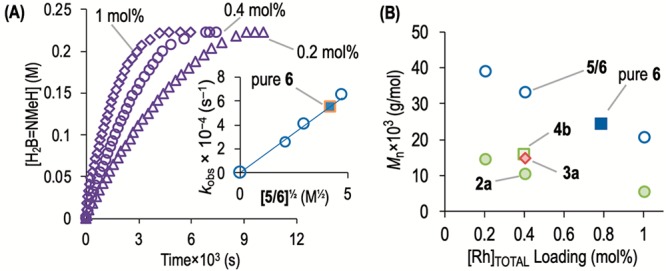
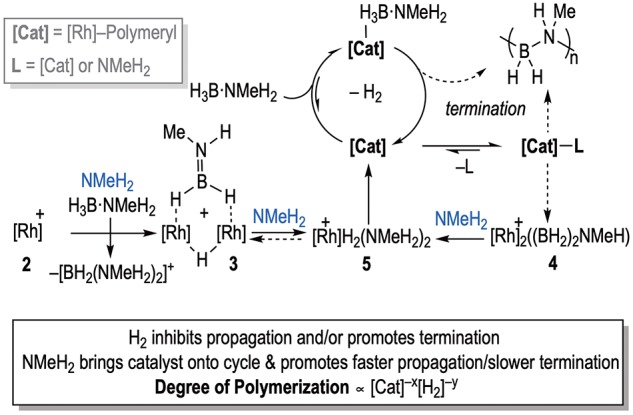
[Rh(κ-PP-DPEphos){ηη-HB(NMe)(CH) Bu}][BAr ] acts as an effective precatalyst for the dehydropolymerization of HB·NMeH to form -methylpolyaminoborane (HBNMeH) . Control of polymer molecular weight is achieved by variation of precatalyst loading (0.1-1 mol %, an inverse relationship) and use of the chain-modifying agent H: with ranging between 5 500 and 34 900 g/mol and between 1.5 and 1.8. H evolution studies (1,2-FCH solvent) reveal an induction period that gets longer with higher precatalyst loading and complex kinetics with a noninteger order in [Rh]. Speciation studies at 10 mol % indicate the initial formation of the amino-borane bridged dimer, [Rh(κ-PP-DPEphos)(μ-H)(μ-HBN=HMe)][BAr ], followed by the crystallographically characterized amidodiboryl complex [Rh(-κ-PP-DPEphos)(σ,μ-(HB)NHMe)][BAr ]. Adding ∼2 equiv of NMeH in tetrahydrofuran (THF) solution to the precatalyst removes this induction period, pseudo-first-order kinetics are observed, a half-order relationship to [Rh] is revealed with regard to dehydrogenation, and polymer molecular weights are increased (e.g., = 40 000 g/mol). Speciation studies suggest that NMeH acts to form the precatalysts [Rh(κ-DPEphos)(NMeH)][BAr ] and [Rh(κ-DPEphos)(H)(NMeH)][BAr ], which were independently synthesized and shown to follow very similar dehydrogenation kinetics, and produce polymers of molecular weight comparable with [Rh(κ-PP-DPEphos){η-HB(NMe)(CH) Bu}][BAr ], which has been doped with amine. This promoting effect of added amine in situ is shown to be general in other cationic Rh-based systems, and possible mechanistic scenarios are discussed.
[Rh(κ-PP-DPEphos){ηη-HB(NMe)(CH)Bu}][BAr]作为将HB·NMeH脱氢聚合形成聚甲基氨基硼烷(HBNMeH)的有效预催化剂。通过改变预催化剂负载量(0.1 - 1 mol%,呈反比关系)以及使用链改性剂H来控制聚合物分子量,数均分子量在5500至34900 g/mol之间,分散度在1.5至1.8之间。氢气析出研究(1,2-FCH溶剂)表明,随着预催化剂负载量增加,诱导期变长,并且在[Rh]方面呈现非整数级的复杂动力学。在10 mol%下的物种形成研究表明,最初形成氨基硼烷桥联二聚体[Rh(κ-PP-DPEphos)(μ-H)(μ-HBN=HMe)][BAr],随后是经晶体学表征的脒基二硼基配合物[Rh(-κ-PP-DPEphos)(σ,μ-(HB)NHMe)][BAr]。在四氢呋喃(THF)溶液中向预催化剂中加入约2当量的NMeH可消除该诱导期,观察到准一级动力学,在脱氢方面揭示了与[Rh]的半级关系,并且聚合物分子量增加(例如,数均分子量 = 40000 g/mol)。物种形成研究表明,NMeH作用形成预催化剂[Rh(κ-DPEphos)(NMeH)][BAr]和[Rh(κ-DPEphos)(H)(NMeH)][BAr],它们已独立合成并显示出非常相似的脱氢动力学,并且产生的聚合物分子量与掺杂有胺的[Rh(κ-PP-DPEphos){η-HB(NMe)(CH)Bu}][BAr]相当。已表明添加胺的这种原位促进作用在其他阳离子Rh基体系中普遍存在,并讨论了可能的机理情况。