Kerekes Daniel, Goodwin C Rory, Ahmed A Karim, Verlaan Jorrit-Jan, Bettegowda Chetan, Abu-Bonsrah Nancy, Sciubba Daniel M
The Johns Hopkins University, Baltimore, MD, USA.
These authors contributed equally to this work.
Global Spine J. 2019 Apr;9(2):191-201. doi: 10.1177/2192568217741114. Epub 2018 May 30.
Systematic review.
Sacral chordomas are rare, primary tumors of the spine, best treated with en bloc resection. The purpose of this study was to assess the literature for resected sacral chordoma and to quantify the prevalence of, risk factors for, and treatment outcomes of local and distant recurrence therein.
We searched 5 online databases from January 1980 to May 2016 to find articles that report survival, recurrence outcomes, and/or prognostic factors for the resected sacral chordoma patient population. Characteristics and clinical outcomes of the pooled cohort are reported. Fisher exact tests, unpaired tests, and one-way analysis of variance were used to investigate patient- and treatment-associated prognostic factors for local and distant recurrence. Survival analyses were performed for time to local recurrence and death. The protocol's PROSPERO ID is CRD42015024384.
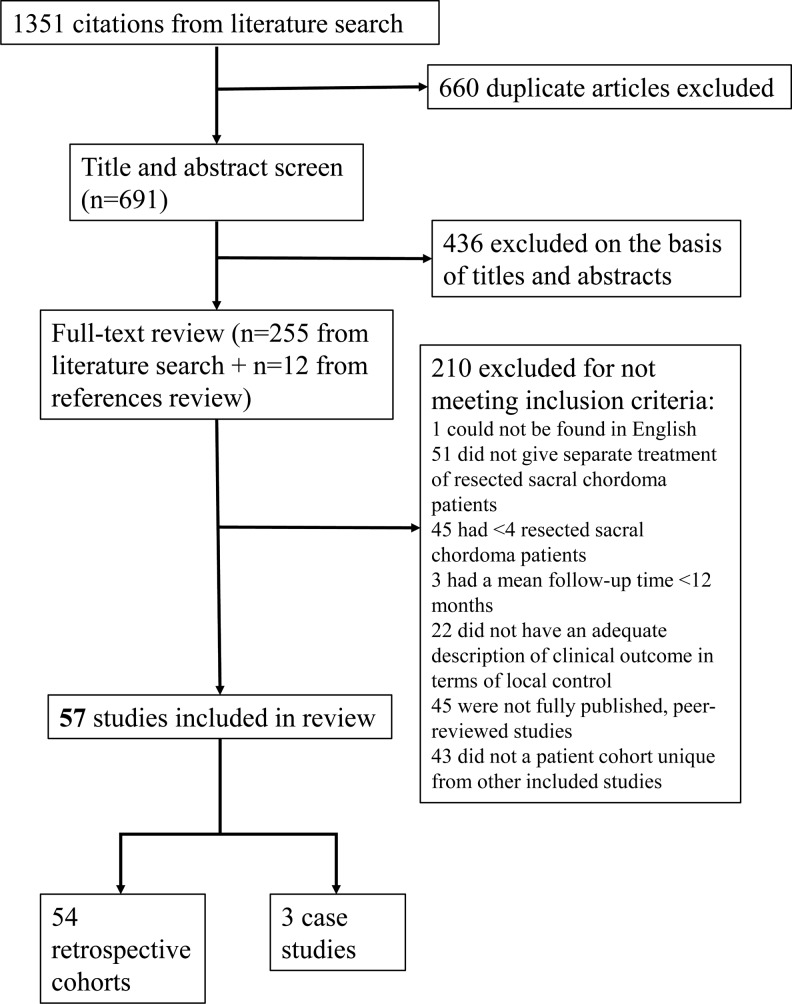
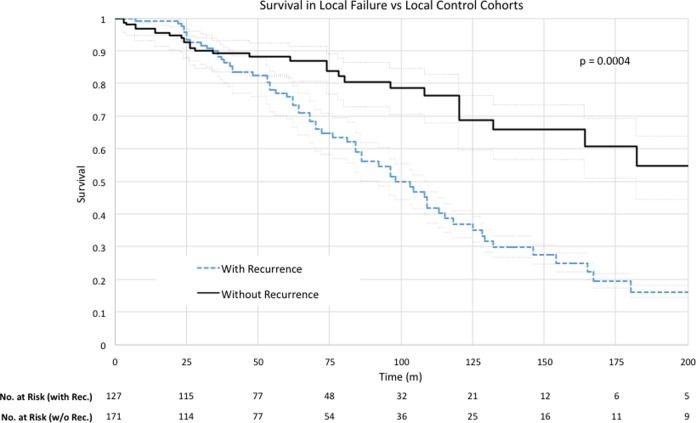
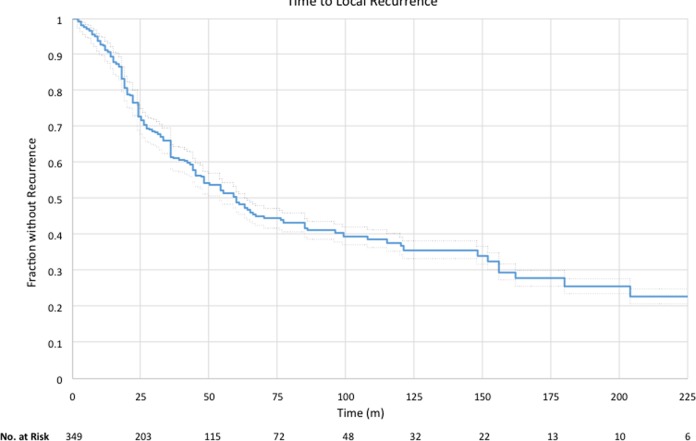
Fifty-seven studies, with 1235 unique sacral chordoma patients, were included in this review. Local and distant recurrence occurred in 42.6% and 22.4% of patients with adequate follow-up, respectively. Kaplan-Meier overall median survival for patients with and without recurrence were 98 and 209 months after surgery, respectively. Wide surgical margin was associated with a lower rate of local recurrence; and wide surgical margin, female sex, and patient age ≥65 years were associated with lower rates of distant recurrence.
While surgical margin remains the most significant prognostic factor for local and distant recurrence, combined surgical approach may be associated with local recurrence. Male sex and age <65 years may be associated with distant recurrence. Patients with risk factors for recurrence should undergo close monitoring to maximize survival.
系统评价。
骶骨脊索瘤是一种罕见的原发性脊柱肿瘤,最佳治疗方法是整块切除。本研究的目的是评估有关切除骶骨脊索瘤的文献,并量化其中局部和远处复发的发生率、危险因素及治疗结果。
我们检索了1980年1月至2016年5月的5个在线数据库,以查找报告切除骶骨脊索瘤患者群体的生存、复发结果和/或预后因素的文章。报告了汇总队列的特征和临床结果。采用Fisher精确检验、非配对检验和单因素方差分析来研究与患者和治疗相关的局部和远处复发的预后因素。对局部复发时间和死亡时间进行生存分析。该方案的PROSPERO编号为CRD42015024384。
本综述纳入了57项研究,共1235例独特的骶骨脊索瘤患者。在有充分随访的患者中,局部和远处复发分别发生在42.6%和22.4%的患者中。有复发和无复发患者的Kaplan-Meier总体中位生存期分别为术后98个月和209个月。手术切缘广泛与较低的局部复发率相关;手术切缘广泛、女性性别和患者年龄≥65岁与较低的远处复发率相关。
虽然手术切缘仍然是局部和远处复发最重要的预后因素,但联合手术方法可能与局部复发有关。男性性别和年龄<65岁可能与远处复发有关。有复发危险因素的患者应接受密切监测,以最大限度地提高生存率。