
交接班:免疫检查点抑制剂联合或不联合化疗作为转移性非小细胞肺癌一线治疗方案
A Changing of the Guard: Immune Checkpoint Inhibitors With and Without Chemotherapy as First Line Treatment for Metastatic Non-small Cell Lung Cancer.
作者信息
Pacheco Jose M, Camidge D Ross, Doebele Robert C, Schenk Erin
机构信息
Division of Medical Oncology, Department of Internal Medicine, University of Colorado Cancer Center, Aurora, CO, United States.
出版信息
Front Oncol. 2019 Mar 29;9:195. doi: 10.3389/fonc.2019.00195. eCollection 2019.
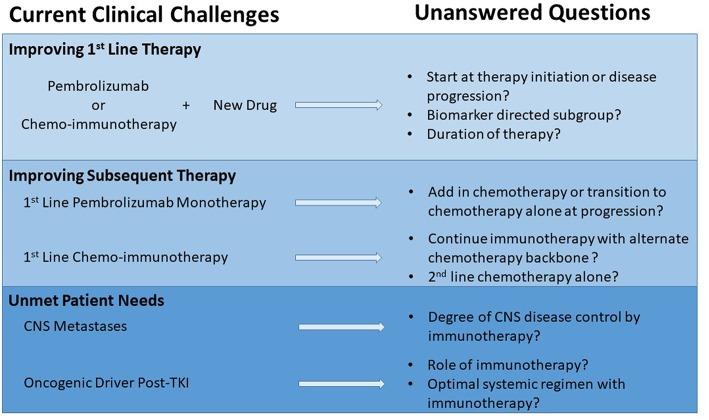
Inhibitory antibodies targeting programmed death protein 1 (PD-1) and programmed death ligand 1 (PD-L1) have resulted in improved outcomes for many patients with metastatic non-small cell lung cancer in (NSCLC) in the second-line setting due to their ability to lead to prolonged anti-tumor immune responses. Combining these immunotherapies with platinum-based chemotherapy as first-line treatment has resulted in improved response rates and increased survival when compared to platinum-based chemotherapy alone. Certain patient populations may even benefit from immune checkpoint inhibitors as monotherapy in the first-line setting. The PD-1 inhibitor pembrolizumab is approved as monotherapy or in combination with platinum + pemetrexed for most newly diagnosed patients with metastatic NSCLC, excluding those with a targetable oncogene such as ALK and EGFR. The PD-L1 inhibitor atezolizumab is also approved in combination with bevacizumab + carboplatin + paclitaxel for the same population, with some parts of the world also approving this regimen for patients with ALK rearrangements or EGFR activating mutations. However, there are many other chemo-immunotherapy regimens that have been evaluated as initial treatment in metastatic NSCLC. Additionally, combinations of PD-1 axis inhibitors with cytotoxic T lymphocyte antigen-4 inhibitors have been examined, although none are yet approved. Here we review the clinical data in support of the current first-line approaches across histologies and biomarker subtypes, as well as highlight future research directions revealed by the current data.
靶向程序性死亡蛋白1(PD-1)和程序性死亡配体1(PD-L1)的抑制性抗体已使许多转移性非小细胞肺癌(NSCLC)患者在二线治疗中取得了更好的疗效,这是因为它们能够引发持久的抗肿瘤免疫反应。与单纯铂类化疗相比,将这些免疫疗法与铂类化疗联合作为一线治疗可提高缓解率并延长生存期。某些患者群体甚至可能在一线治疗中从免疫检查点抑制剂单药治疗中获益。PD-1抑制剂帕博利珠单抗被批准用于大多数新诊断的转移性NSCLC患者的单药治疗或与铂类+培美曲塞联合使用,但不包括那些具有可靶向致癌基因(如ALK和EGFR)的患者。PD-L1抑制剂阿替利珠单抗也被批准与贝伐单抗+卡铂+紫杉醇联合用于同一患者群体,世界上一些地区也批准该方案用于ALK重排或EGFR激活突变的患者。然而,还有许多其他化疗免疫疗法已被评估用于转移性NSCLC的初始治疗。此外,尽管尚未有PD-1轴抑制剂与细胞毒性T淋巴细胞抗原4抑制剂的联合用药获得批准,但相关研究也已开展。在此,我们回顾支持当前跨组织学和生物标志物亚型一线治疗方法的临床数据,并突出当前数据揭示的未来研究方向。
 Zotero 插件