Tomazoni Shaiane Silva, Costa Leonardo Oliveira Pena, Joensen Jon, Stausholm Martin Bjørn, Naterstad Ingvill Fjell, Leal-Junior Ernesto Cesar Pinto, Bjordal Jan Magnus
Masters and Doctoral Programs in Physical Therapy, Universidade Cidade de São Paulo, São Paulo, Brazil.
Physiotherapy Research Group, Department of Global Public Health and Primary Care, University of Bergen, Bergen, Norway.
Medicine (Baltimore). 2019 Apr;98(15):e15177. doi: 10.1097/MD.0000000000015177.
Low back pain (LBP) is ranked as one of the most prevalent health conditions. It is likely that some inflammatory mediators could be associated with pain and disability in these patients. Photobiomodulation therapy (PBMT) is a non-pharmacological therapy often used in patients with LBP and one of the possible mechanisms of action of therapy is modulate inflammatory mediators. However, to date there are no studies that evaluated the effects of PBMT on the levels of inflammatory mediators in patients with LBP. The aim of this study is to evaluate the acute effects of PBMT on systemic levels of inflammatory mediators and pain intensity in patients with chronic non-specific low back pain.
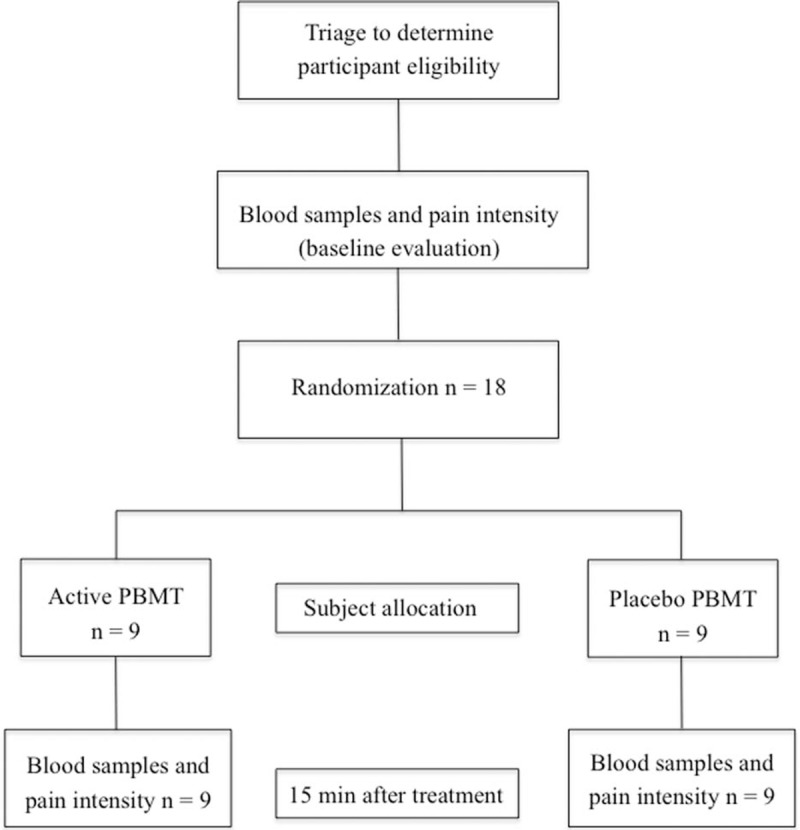
This is a prospectively registered, two-arm randomized placebo-controlled trial with blinded patients, assessors and therapists. Eighteen patients with chronic non-specific LBP will be randomized into 2 groups: placebo or active PBMT. The treatment will be provided in a single session. The primary outcome will be levels of prostaglandin E2 (PGE2). The secondary outcomes will be levels of necrosis factor alpha (TNF-α), interleukin 6 (IL-6) and pain intensity. Biochemical and clinical outcomes will be measured at baseline and 15 minutes after the single treatment session.
Despite PBMT be used in musculoskeletal disorders such as LBP, to the best of our knowledge this is the first study that will investigate a possible biological mechanism behind the positive clinical effects of PBMT on non-specific chronic low back pain.
The study was approved by the Regional Research Ethics Committee. The results will be disseminated through publication in peer-reviewed international journal and conferences.
NCT03859505.
腰痛(LBP)是最常见的健康问题之一。在这些患者中,某些炎症介质可能与疼痛和残疾有关。光生物调节疗法(PBMT)是一种常用于腰痛患者的非药物疗法,该疗法可能的作用机制之一是调节炎症介质。然而,迄今为止,尚无研究评估PBMT对腰痛患者炎症介质水平的影响。本研究的目的是评估PBMT对慢性非特异性腰痛患者炎症介质全身水平和疼痛强度的急性影响。
这是一项前瞻性注册、双臂随机安慰剂对照试验,患者、评估者和治疗师均为盲法。18例慢性非特异性腰痛患者将被随机分为两组:安慰剂组或活性PBMT组。治疗将在单次疗程中进行。主要结局将是前列腺素E2(PGE2)水平。次要结局将是肿瘤坏死因子α(TNF-α)、白细胞介素6(IL-6)水平和疼痛强度。生化和临床结局将在基线时以及单次治疗疗程后15分钟进行测量。
尽管PBMT已用于诸如腰痛等肌肉骨骼疾病,但据我们所知,这是第一项将研究PBMT对非特异性慢性腰痛产生积极临床效果背后可能的生物学机制的研究。
本研究已获得地区研究伦理委员会的批准。研究结果将通过在同行评审的国际期刊上发表以及在会议上进行传播。
NCT03859505。