School of Computer Science and Engineering, Northeastern University, Shenyang 110819, China.
College of Information Science and Engineering, Northeastern University, Shenyang 110819, China.
Molecules. 2019 Apr 2;24(7):1289. doi: 10.3390/molecules24071289.
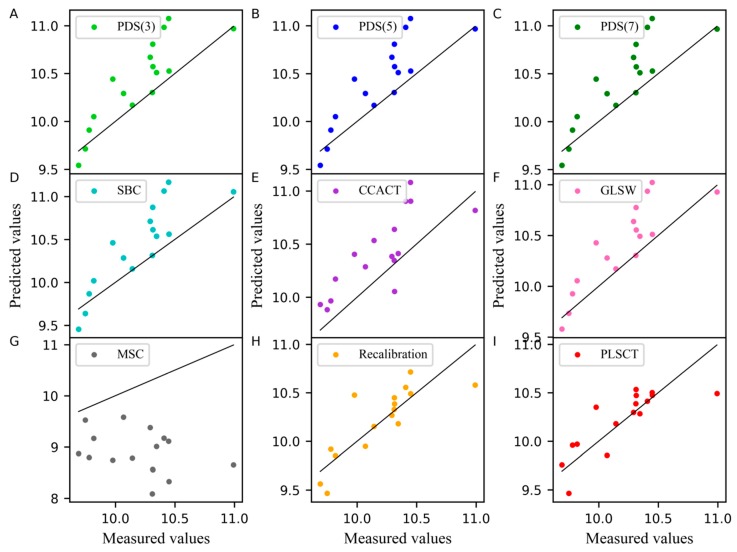
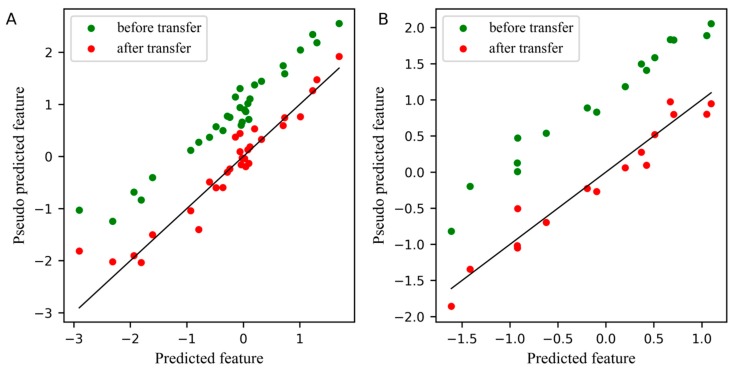
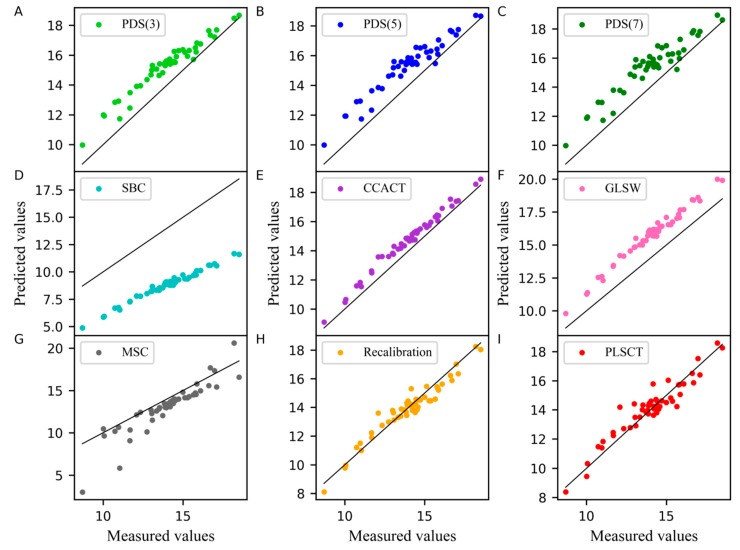
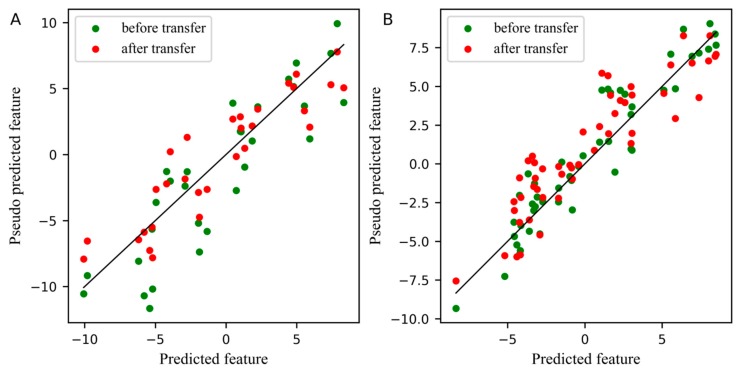
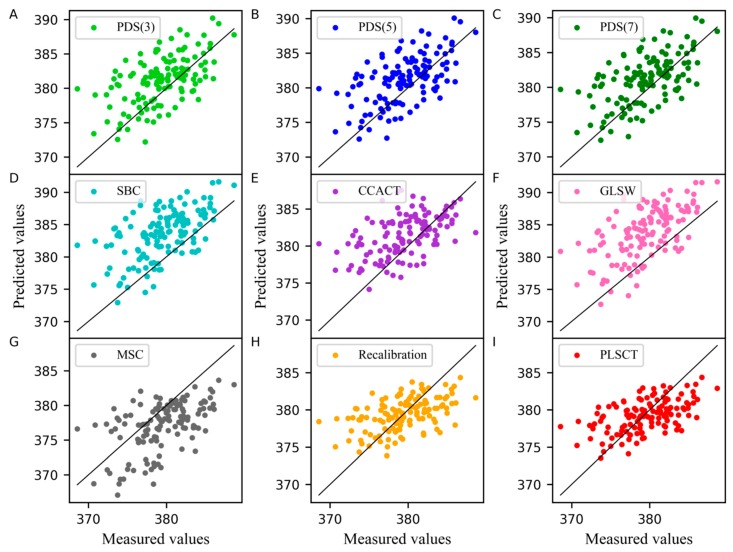
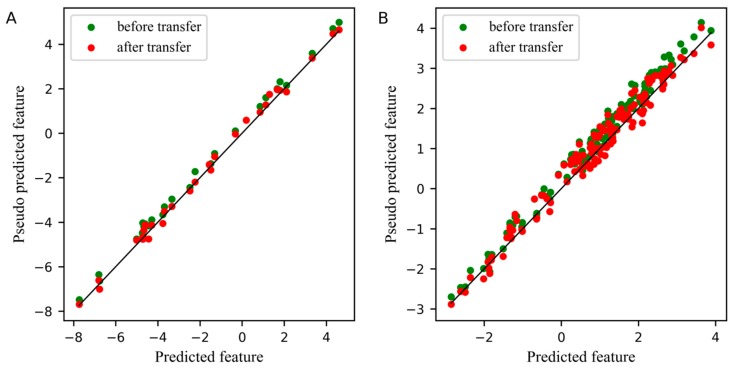
In order to enable the calibration model to be effectively transferred among multiple instruments and correct the differences between the spectra measured by different instruments, a new feature transfer model based on partial least squares regression (PLS) subspace (PLSCT) is proposed in this paper. Firstly, the PLS model of the master instrument is built, meanwhile a PLS subspace is constructed by the feature vectors. Then the master spectra and the slave spectra are projected into the PLS subspace, and the features of the spectra are also extracted at the same time. In the subspace, the pseudo predicted feature of the slave spectra is transferred by the ordinary least squares method so that it matches the predicted feature of the master spectra. Finally, a feature transfer relationship model is constructed through the feature transfer of the PLS subspace. This PLS-based subspace transfer provides an efficient method for performing calibration transfer with only a small number of standard samples. The performance of the PLSCT was compared and assessed with slope and bias correction (SBC), piecewise direct standardization (PDS), calibration transfer method based on canonical correlation analysis (CCACT), generalized least squares (GLSW), multiplicative signal correction (MSC) methods in three real datasets, statistically tested by the Wilcoxon signed rank test. The obtained experimental results indicate that PLSCT method based on the PLS subspace is more stable and can acquire more accurate prediction results.
为了使校准模型能够在多台仪器之间有效地进行转移,并纠正不同仪器测量的光谱之间的差异,本文提出了一种基于偏最小二乘回归(PLS)子空间(PLSCT)的新特征传递模型。首先,构建主仪器的 PLS 模型,同时通过特征向量构建 PLS 子空间。然后将主光谱和从光谱投影到 PLS 子空间,并同时提取光谱的特征。在子空间中,通过普通最小二乘法对从光谱的伪预测特征进行传递,使其与主光谱的预测特征相匹配。最后,通过 PLS 子空间的特征传递构建特征转移关系模型。这种基于 PLS 的子空间转移为仅使用少量标准样品进行校准转移提供了一种有效的方法。通过 Wilcoxon 符号秩检验,在三个真实数据集上对 PLSCT 与斜率和偏置校正(SBC)、分段直接标准化(PDS)、基于典型相关分析的校准转移方法(CCACT)、广义最小二乘法(GLSW)、乘法信号校正(MSC)方法进行了比较和评估。实验结果表明,基于 PLS 子空间的 PLSCT 方法更稳定,能够获得更准确的预测结果。