Nishioka Naoya, Uchino Junji, Hirai Soichi, Katayama Yuki, Yoshimura Akihiro, Okura Naoko, Tanimura Keiko, Harita Sachi, Imabayashi Tatsuya, Chihara Yusuke, Tamiya Nobuyo, Kaneko Yoshiko, Yamada Tadaaki, Takayama Koichi
Department of Pulmonary Medicine, Graduate School of Medical Science, Kyoto Prefectural University of Medicine, Kyoto 602-8566, Japan.
J Clin Med. 2019 Apr 3;8(4):450. doi: 10.3390/jcm8040450.
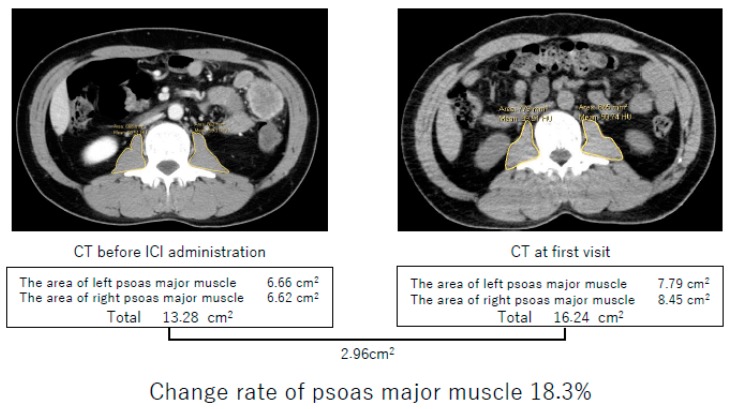
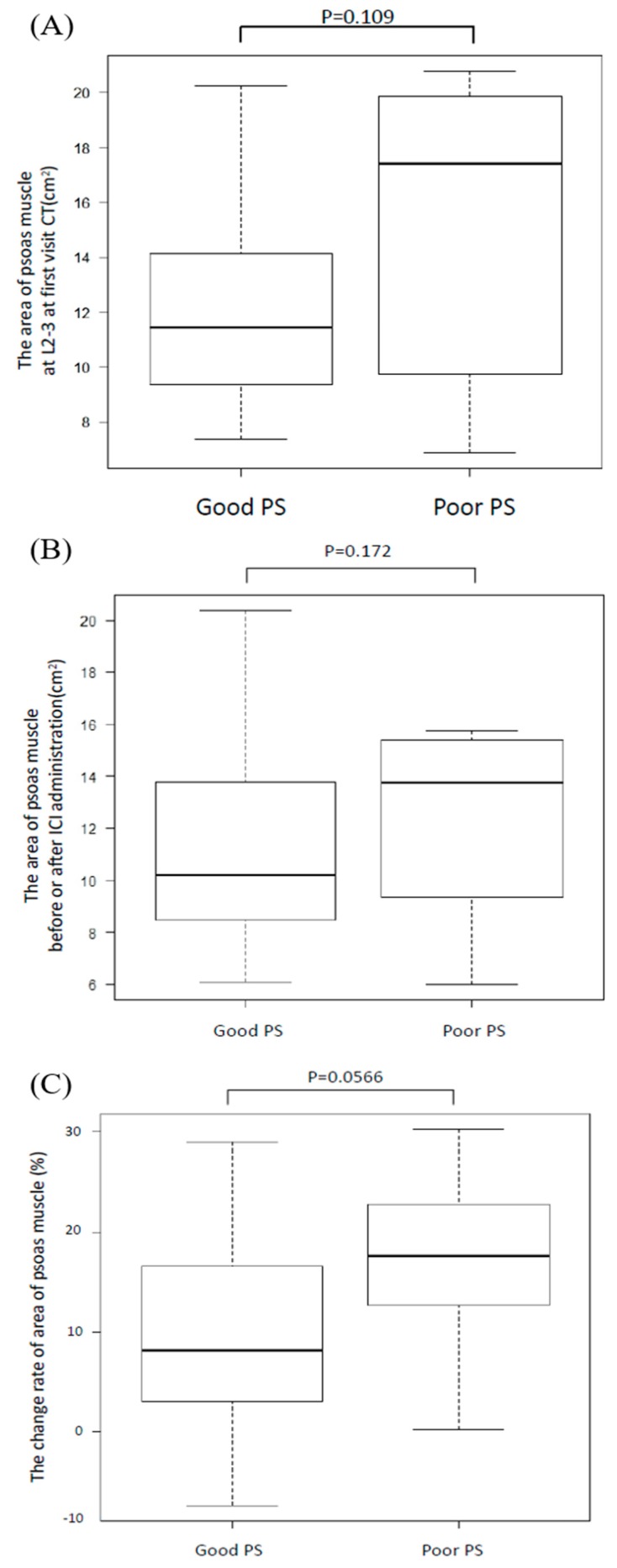
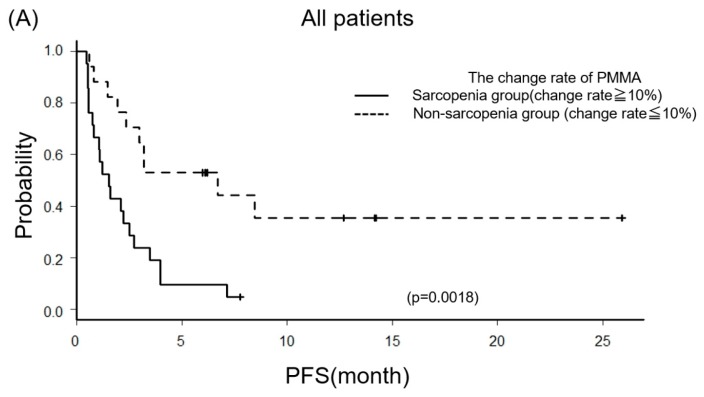
Secondary sarcopenia is defined as a decrease in muscle mass due to disease or malnutrition. Several studies have reported that secondary sarcopenia is an indicator of postoperative recurrence. We hypothesized that there is a correlation between the effect of immune checkpoint inhibitors (ICIs) and sarcopenia. We retrospectively analyzed 38 patients with advanced non-small cell lung cancer (NSCLC) who were treated with ICIs between February 2016 and April 2018. Patients were divided into two groups according to the change rate of the psoas major muscle area (PMMA) at the L2-L3 position and investigated the correlation between the change rate of the PMMA and the efficacy of ICIs was investigated. The objective response and disease control rates were lower in patients with sarcopenia than in those without sarcopenia. Patients with sarcopenia exhibited a significantly shorter median progression-free survival (PFS) than non-sarcopenia patients. Moreover, focusing on good Eastern Cooperative Oncology Group performance status patients, sarcopenia patients showed a shorter PFS than non-sarcopenia patients. Patients with sarcopenia are associated with poor outcomes for immunotherapy among those with advanced NSCLC, based on retrospective analysis. Further research is needed to validate the clinical biomarkers involved in ICI responders.
继发性肌肉减少症被定义为由于疾病或营养不良导致的肌肉量减少。多项研究报告称,继发性肌肉减少症是术后复发的一个指标。我们假设免疫检查点抑制剂(ICI)的疗效与肌肉减少症之间存在关联。我们回顾性分析了2016年2月至2018年4月期间接受ICI治疗的38例晚期非小细胞肺癌(NSCLC)患者。根据L2-L3位置腰大肌面积(PMMA)的变化率将患者分为两组,并研究了PMMA变化率与ICI疗效之间的相关性。肌肉减少症患者的客观缓解率和疾病控制率低于无肌肉减少症的患者。肌肉减少症患者的中位无进展生存期(PFS)明显短于非肌肉减少症患者。此外,聚焦于东部肿瘤协作组(ECOG)体能状态良好的患者,肌肉减少症患者的PFS短于非肌肉减少症患者。基于回顾性分析,晚期NSCLC患者中,肌肉减少症与免疫治疗的不良结局相关。需要进一步研究来验证ICI反应者中涉及的临床生物标志物。