James Theodore W, Baron Todd H
Division of Gastroenterology and Hepatology, Department of Medicine, University of North Carolina School of Medicine, Chapel Hill, North Carolina, United States.
Endosc Int Open. 2019 Apr;7(4):E600-E607. doi: 10.1055/a-0867-9599. Epub 2019 Apr 12.
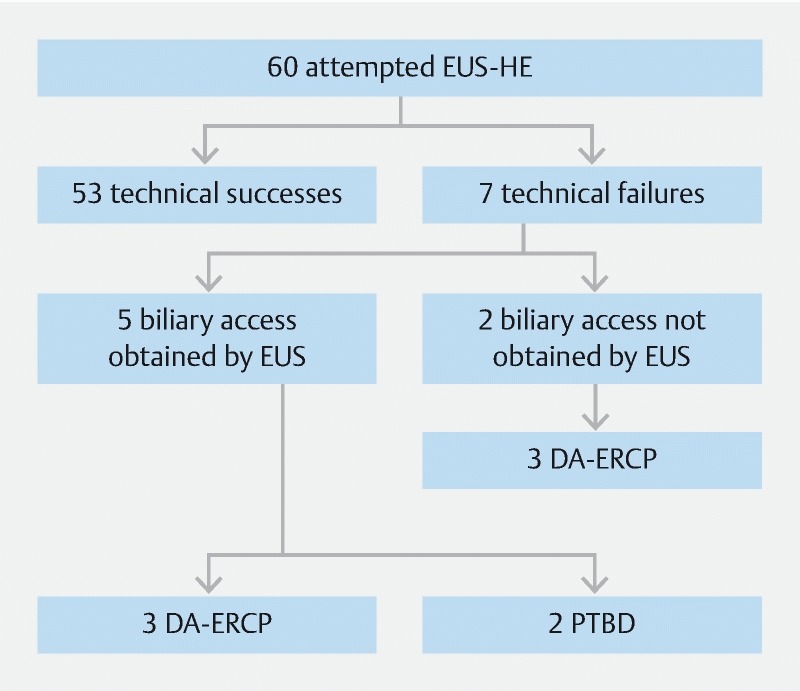
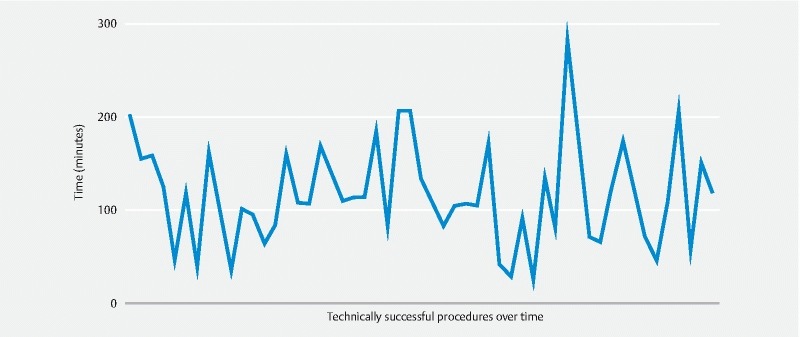
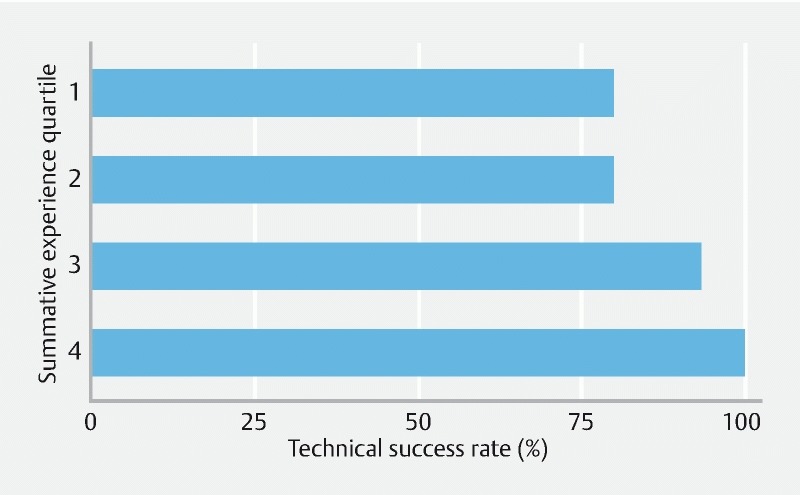
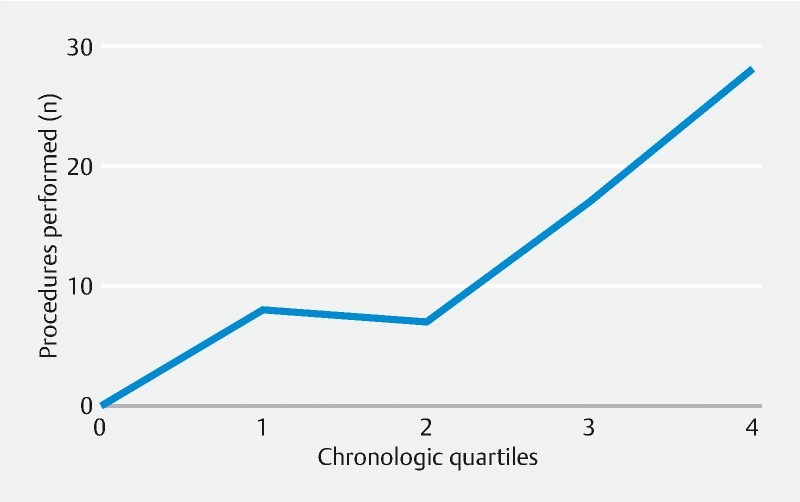
Endoscopic ultrasound-guided hepaticoenterostomy (EUS-HE) is an effective method of endoscopic biliary drainage in cases where endoscopic retrograde cholangiopancreatography has failed or is deemed impossible. Indications for EUS-HE have expanded, resulting in increased interest by endoscopists to learn the procedure; however, few data exist on breadth of application or experience needed to develop proficiency. We describe utilization of EUS-HE for biliary decompression at a large tertiary referral center along with procedural learning curve. Retrospective evaluation of 60 consecutive patients who underwent attempted EUS-HE by one endoscopist from February 2016 through June 2018. Procedures were divided into chronological and summative experience quartiles. We compared procedural success rate, procedural utilization, and procedure duration over time. Sixty patients underwent attempted EUS-HE during the study period: 35 with surgically altered anatomy, 23 with malignant biliary obstruction, 35 outpatients, 35 females; median age, 66 years. The procedure was technically successful in 53 patients. Success rates by summative experience quartile were 80 %, 80 %, 93.3 % and 100 % respectively. Beginning at patient number 40, the remaining cases had a success rate of 100 %. Utilization increased from eight cases in the first chronological quartile to 28 in the fourth. There was no significant reduction in procedure duration over time. For an experienced endoscopist, EUS-HE could be performed effectively and safely after the experience of 40 cases. Limitations of this study include a single endoscopist and heterogeneous patient population with variable anatomy that may affect procedural success. Future studies should include data from multiple centers and endoscopists.
内镜超声引导下肝肠吻合术(EUS - HE)是在内镜逆行胰胆管造影术失败或被认为不可行的情况下进行内镜胆道引流的一种有效方法。EUS - HE的适应证已经扩大,这使得内镜医师对学习该操作的兴趣增加;然而,关于其应用范围或熟练掌握该操作所需经验的数据却很少。我们描述了在一家大型三级转诊中心使用EUS - HE进行胆道减压的情况以及操作学习曲线。 对2016年2月至2018年6月期间由一名内镜医师尝试进行EUS - HE的60例连续患者进行回顾性评估。操作被分为按时间顺序和累积经验的四分位数。我们比较了随着时间推移的操作成功率、操作使用率和操作持续时间。 在研究期间,60例患者尝试进行了EUS - HE:35例患者存在手术改变的解剖结构,23例患者存在恶性胆道梗阻,35例为门诊患者,35例为女性;中位年龄为66岁。53例患者的操作在技术上取得成功。按累积经验四分位数划分的成功率分别为80%、80%、93.3%和100%。从第40例患者开始,其余病例的成功率为100%。使用率从第一个时间顺序四分位数的8例增加到第四个四分位数的28例。随着时间的推移,操作持续时间没有显著缩短。 对于经验丰富的内镜医师来说,在积累40例经验后可以有效且安全地进行EUS - HE。本研究的局限性包括仅一名内镜医师以及患者群体解剖结构各异,这可能会影响操作的成功。未来的研究应纳入来自多个中心和内镜医师的数据。