Maddock C L, Noor S, Kothari A, Bradley C S, Kelley S P
The Hospital for Sick Children, Toronto, Ontario, Canada.
Department of Rehabilitation Sciences, University of Toronto, Toronto, Ontario, Canada.
J Child Orthop. 2019 Apr 1;13(2):167-171. doi: 10.1302/1863-2548.13.190015.
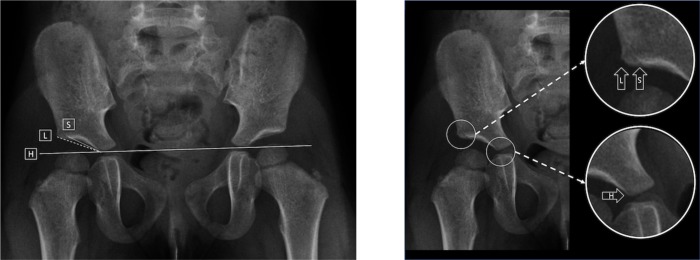
The ability to monitor and study developmental dysplasia of the hip (DDH) requires validated radiographic outcome measures. The sourcil method of acetabular index measurement (AI-S) has not yet been shown to be a reliable measure of acetabular dysplasia in a DDH population, despite its widespread use. The aims of this study were to test the reliability of the AI-S method in a DDH population, and to compare the reliability of the AI-S method with that of the classic lateral edge method (AI-L).
From an institutional database, standardized anteroposterior hip radiographs were obtained from a cohort of 35 female patients (70 hips) at two and five years of age who had been treated nonoperatively for DDH. Three observers independently measured the acetabular index using the AI-L and AI-S methods on all 70 hips at two time points, four weeks apart.
The inter-rater reliability intraclass correlation coefficient (ICC) for the AI-L and AI-S methods was between good and excellent at 0.94 (confidence interval (CI) 0.89 to 0.96) and 0.91 (CI 0.87 to 0.94), respectively. The ICCs for intra-rater reliability for the AI-L method were excellent at 0.93 (CI 0.90 to 0.95), 0.95 (CI 0.93 to 0.97) and 0.95 (CI 0.94 to 0.97) for raters 1, 2 and 3, respectively. The ICCs for intra-rater reliability for the AI-S method were between good and excellent at 0.91 (CI 0.87 to 0.93), 0.93 (CI 0.90 to 0.95) and 0.90 (CI 0.86 to 0.93) for raters 1, 2 and 3 respectively.
Both AI-S and AI-L methods are equally reliable radiographic measures of DDH.
Level III (diagnostic).
监测和研究发育性髋关节发育不良(DDH)需要经过验证的影像学结局指标。尽管髋臼指数测量的索西尔方法(AI-S)被广泛使用,但尚未证明其在DDH人群中是髋臼发育不良的可靠测量方法。本研究的目的是测试AI-S方法在DDH人群中的可靠性,并将AI-S方法的可靠性与经典外侧边缘方法(AI-L)的可靠性进行比较。
从机构数据库中,获取了35名女性患者(70个髋关节)在2岁和5岁时因DDH接受非手术治疗的标准化前后位髋关节X线片。三名观察者在两个时间点(相隔四周)分别使用AI-L和AI-S方法对所有70个髋关节独立测量髋臼指数。
AI-L和AI-S方法的组间可靠性组内相关系数(ICC)分别在良好至优秀之间,AI-L为0.94(置信区间(CI)0.89至0.96),AI-S为0.91(CI 0.87至0.94)。AI-L方法的观察者内可靠性ICC对于观察者1、2和3分别为优秀,分别为0.93(CI 0.90至0.95)、0.95(CI 0.93至0.97)和0.95(CI 0.94至0.97)。AI-S方法的观察者内可靠性ICC对于观察者1、2和3分别在良好至优秀之间,分别为0.91(CI 0.87至0.93)、0.93(CI 0.90至0.95)和0.90(CI 0.86至0.93)。
AI-S和AI-L方法都是DDH同样可靠的影像学测量方法。
III级(诊断性)。