Lee Patrick, Pham Linhchi, Oakley Stephen, Eng Kimberly, Freydin Elena, Rose Tayla, Ruiz Alyssa, Reen Joyce, Suleyman Deborah, Altman Vanna, Keating Bench Kara, Lee Alice, Mahaniah Kiame
Medicine, North Shore Medical Center, Salem, Massachusetts, USA.
Harvard Medical School, Boston, Massachusetts, USA.
BMJ Open Qual. 2019 Feb 8;8(1):e000373. doi: 10.1136/bmjoq-2018-000373. eCollection 2019.
Achieving better care at lower cost in the US healthcare safety net will require federally qualified health centres (FQHC) to implement new models of team-based population healthcare. Lean thinking may offer a way to reduce the financial risk of practice transformation while increasing the likelihood of sustained improvement.
To demonstrate system-level improvement in hypertension control in a large FQHC through the situational use of lean thinking and statistical process control.
Lynn Community Health Center, the third largest FQHC in Massachusetts, USA.
4762 adult patients with a diagnosis of hypertension.
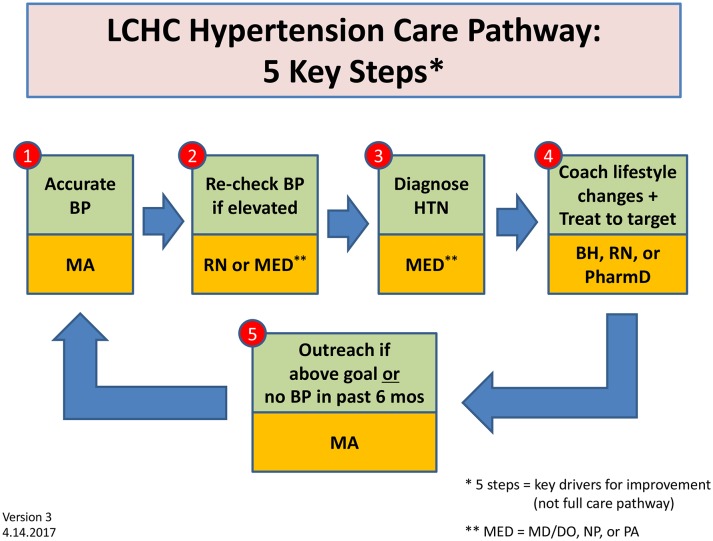
First, we created an organisation-wide focus on hypertension. Second, we implemented a multicomponent hypertension care pathway. The lean tools of strategy deployment, standardised work, job instruction, Plan-Do-Study-Adjust, 5S and visual control were used to overcome specific obstacles in the implementation.
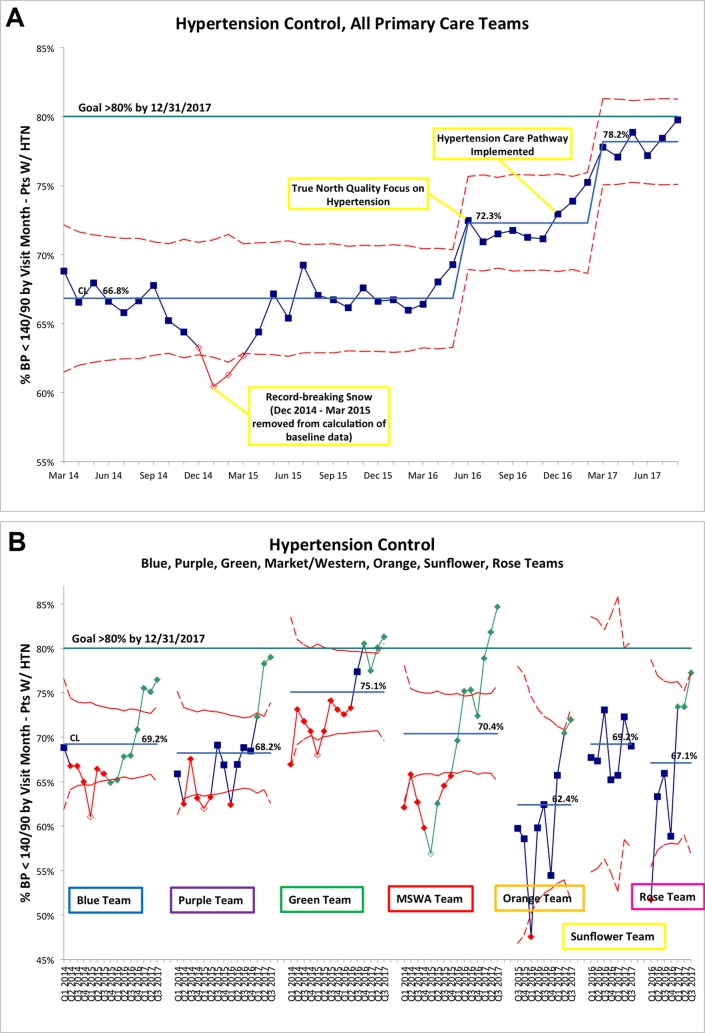
The primary outcome was hypertension control, defined as last measured blood pressure <140/90. Statistical process control was used to establish baseline performance and assess special cause variation resulting from the two-step intervention.
Hypertension control improved by 11.6% from a baseline of 66.8% to a 6 month average of 78.2%.
Durability of system changes has not been demonstrated beyond the 14-month period of the intervention. The observed improvement may underestimate the effect size of the full hypertension care pathway, as two of the five steps have only been partially implemented.
Success factors included experienced improvement leaders, a focus on engaging front-line staff, the situational use of lean principles to make the work easier, better, faster and cheaper (in that order of emphasis), and the use of statistical process control to learn from variation. The challenge of transforming care delivery in the safety net warrants a closer look at the principles, relevance and potential impact of lean thinking in FQHCs.
在美国医疗安全网中以更低成本实现更好的医疗服务,将要求联邦合格医疗中心(FQHC)实施基于团队的人群医疗新模式。精益思维可能提供一种降低实践转型财务风险的方法,同时增加持续改进的可能性。
通过情境化运用精益思维和统计过程控制,展示在大型FQHC中高血压控制的系统层面改善。
美国马萨诸塞州第三大FQHC——林恩社区健康中心。
4762名诊断为高血压的成年患者。
首先,我们在全组织范围内聚焦高血压。其次,我们实施了多组分高血压护理路径。运用战略部署、标准化工作、工作指导、计划-执行-研究-调整、5S和可视化控制等精益工具来克服实施过程中的特定障碍。
主要结局为高血压控制,定义为末次测量血压<140/90。使用统计过程控制来建立基线表现,并评估两步干预导致的特殊原因变异。
高血压控制率从基线的66.8%提高了11.6%,6个月平均达到78.2%。
干预的14个月之后,尚未证明系统变化的持久性。观察到的改善可能低估了完整高血压护理路径的效应大小,因为五个步骤中的两个仅部分实施。
成功因素包括经验丰富的改进领导者、注重让一线员工参与、情境化运用精益原则以使工作更轻松、更好、更快且更便宜(按此重点顺序),以及使用统计过程控制从变异中学习。在安全网中转变护理服务的挑战,值得更深入地审视精益思维在FQHC中的原则、相关性和潜在影响。