Universidad de Castilla-La Mancha, Social and Health Care Research Center, C/ Santa Teresa Jornet s/n, 16071, Cuenca, Spain.
Universidad de Castilla-La Mancha, Faculty of Education, C/ Ronda de Calatrava 3, 13071, Ciudad Real, Spain.
BMC Public Health. 2019 Apr 18;19(1):417. doi: 10.1186/s12889-019-6742-0.
Although physical activity (PA) integrated in schools' classrooms have shown a positive effect on children's behaviors, its effectiveness on cognitive functions, PA levels and other health variables remains unclear. This article outlines the rationale and methods of two classroom-based PA interventions (MOVI-da10!) on improving adiposity, executive function and motor competence in preschool children.
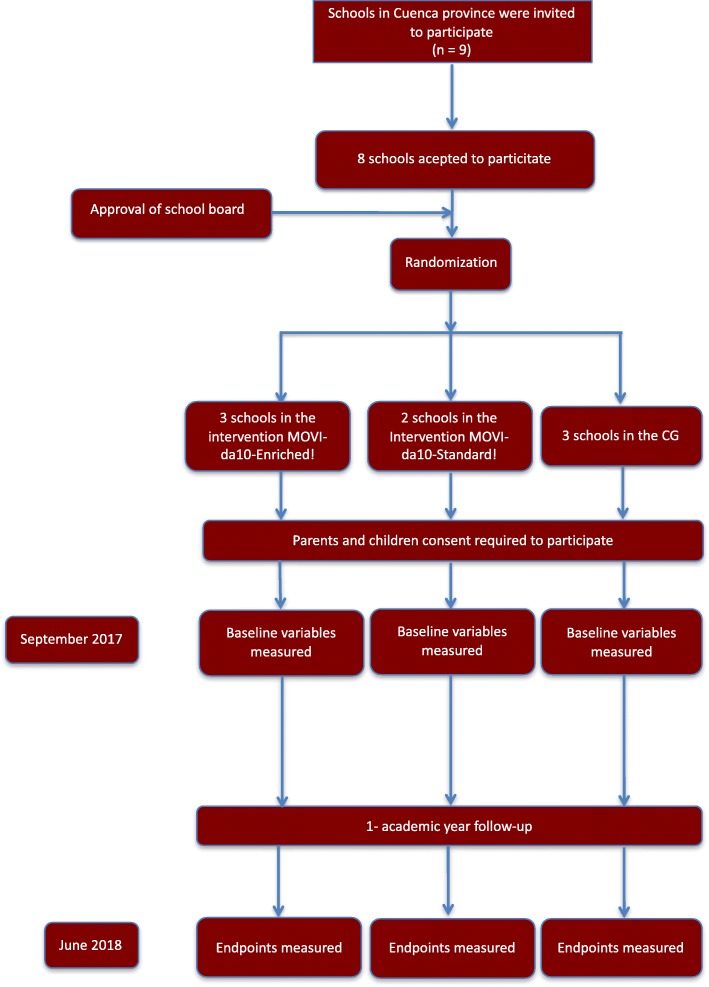
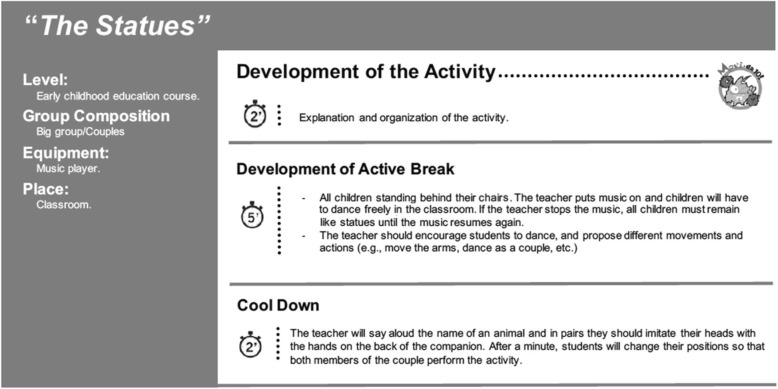
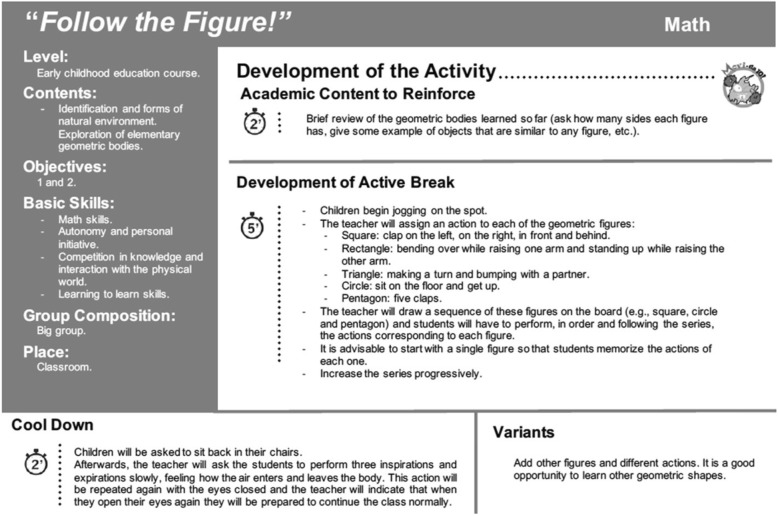
A three-arm cluster-randomized controlled trial (RCT) was carried out including eight schools (rural and urban areas) from Cuenca province, Spain. The schools were allocated to one of three groups: MOVI-da10-Enriched! intervention (n = 3), MOVI-da10-Standard! intervention, (n = 2), and the control group (n = 3). Around 900 children aged 4 to 6 years old were assesed at baseline (September 2017) and at the end (June 2018) of the intervention. The primary outcomes were changes in body fat by bioimpedance, executive function and motor competence. During a school year (from October 2017 to May 2018), children belonging to the MOVI-da10-Enriched! group performed enriched PA integrated into the academic curriculum including two active breaks lasting 10 min, 5 days/week. The children belonging to the MOVI-da10-Standard! group performed PA breaks (with low cognitive demand, where curricular contents were not reinforced) including two active breaks lasting 10 min, 5 days/week. In the control group, regular PA continued.
To our knowledge, MOVI-da10! is the first RCT to examine the effectiveness of two programs (enriched PA integrated into the academic curriculum and PA breaks only) versus a control group on improving adiposity, executive function and motor competence in preschool children.
NCT03236363 (clinicaltrials.gov), 31st July 2017.
尽管在学校课堂中融入体育活动(PA)已被证明对儿童行为有积极影响,但它对认知功能、PA 水平和其他健康变量的影响仍不清楚。本文概述了两项基于课堂的 PA 干预措施(MOVI-da10!)的基本原理和方法,以改善学龄前儿童的肥胖、执行功能和运动能力。
本研究采用三臂聚类随机对照试验(RCT),纳入西班牙昆卡省的 8 所学校(农村和城市地区)。这些学校被分配到三个组之一:MOVI-da10-Enriched!干预组(n=3)、MOVI-da10-Standard!干预组(n=2)和对照组(n=3)。大约 900 名年龄在 4 至 6 岁的儿童在基线(2017 年 9 月)和干预结束时(2018 年 6 月)进行评估。主要结局是通过生物阻抗法测量的体脂肪变化、执行功能和运动能力。在一个学年(2017 年 10 月至 2018 年 5 月)中,MOVI-da10-Enriched!组的儿童在学术课程中融入了强化 PA,包括 5 天/周、每次 10 分钟的两个活跃课间休息。MOVI-da10-Standard!组的儿童进行 PA 课间休息(认知需求较低,不强化课程内容),包括 5 天/周、每次 10 分钟的两个活跃课间休息。在对照组中,继续进行常规 PA。
据我们所知,MOVI-da10!是第一项检验两种方案(强化 PA 融入学术课程和仅 PA 课间休息)与对照组相比对改善学龄前儿童肥胖、执行功能和运动能力的有效性的 RCT。
NCT03236363(clinicaltrials.gov),2017 年 7 月 31 日。