Institute of Reproductive and Developmental Biology, Department of Surgery and Cancer, Faculty of Medicine, Imperial College London, London, W12 0NN, UK.
Beijing Advanced Innovation Center for Food Nutrition and Human Health, China Agricultural University, Beijing, 100193, China.
Stem Cell Res Ther. 2019 Apr 18;10(1):122. doi: 10.1186/s13287-019-1228-7.
Sox2 is a well-established pluripotent transcription factor that plays an essential role in establishing and maintaining pluripotent stem cells (PSCs). It is also thought to be a linage specifier that governs PSC neural lineage specification upon their exiting the pluripotent state. However, the exact role of SOX2 in human PSCs was still not fully understood. In this study, we studied the role of SOX2 in human embryonic stem cells (hESCs) by gain- and loss-of-function approaches and explored the possible underlying mechanisms.
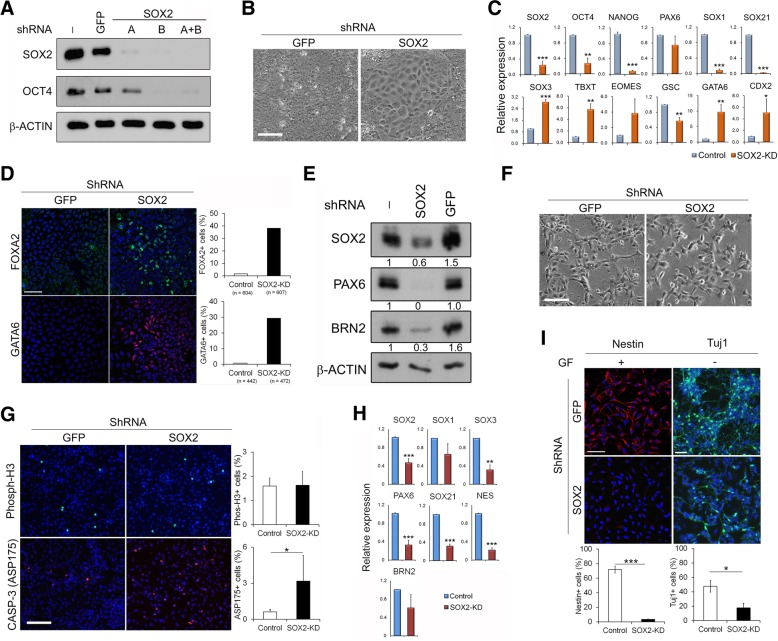
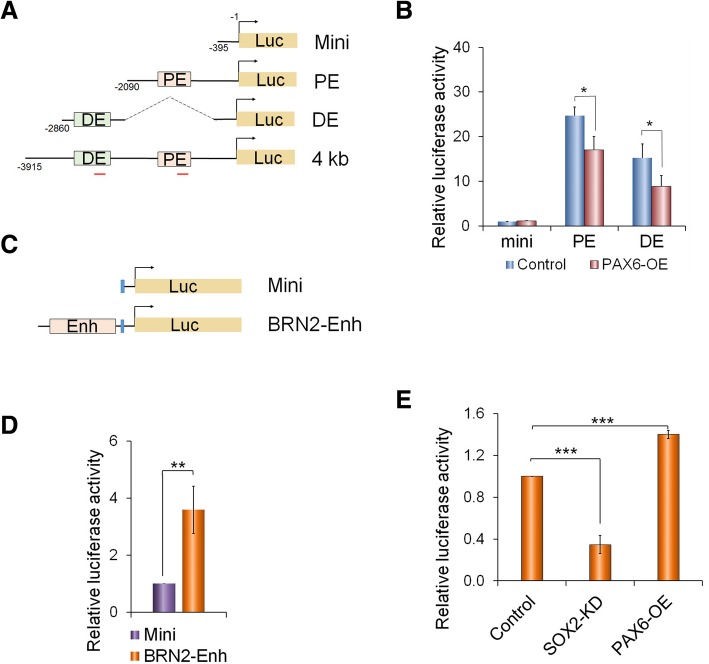
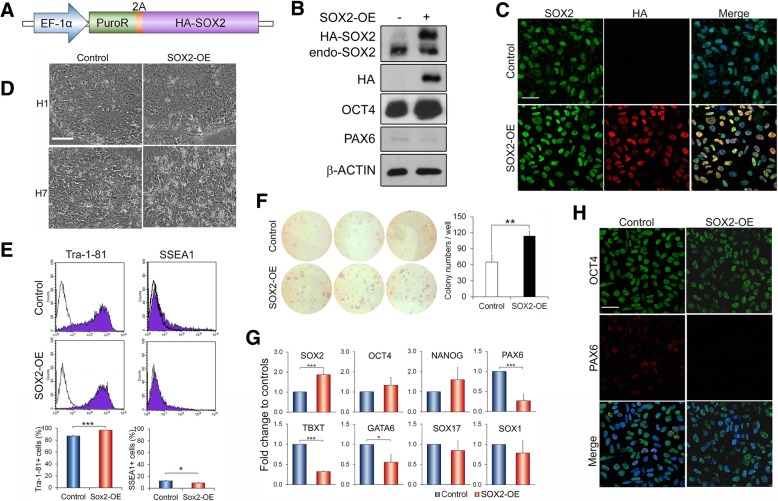
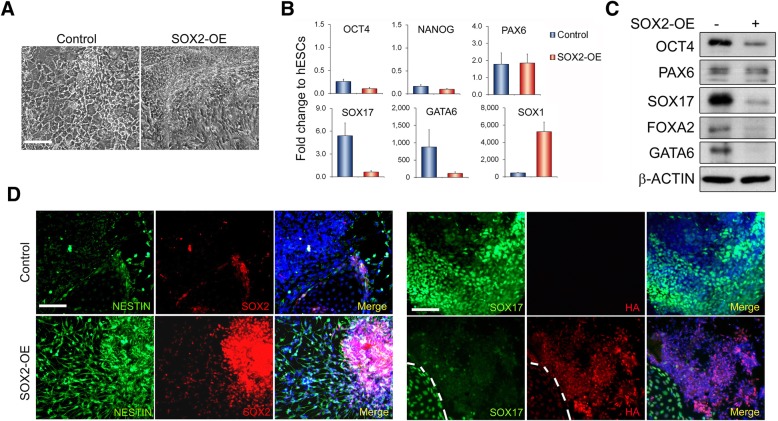
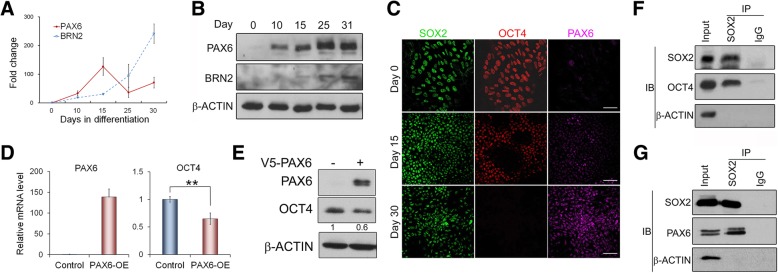
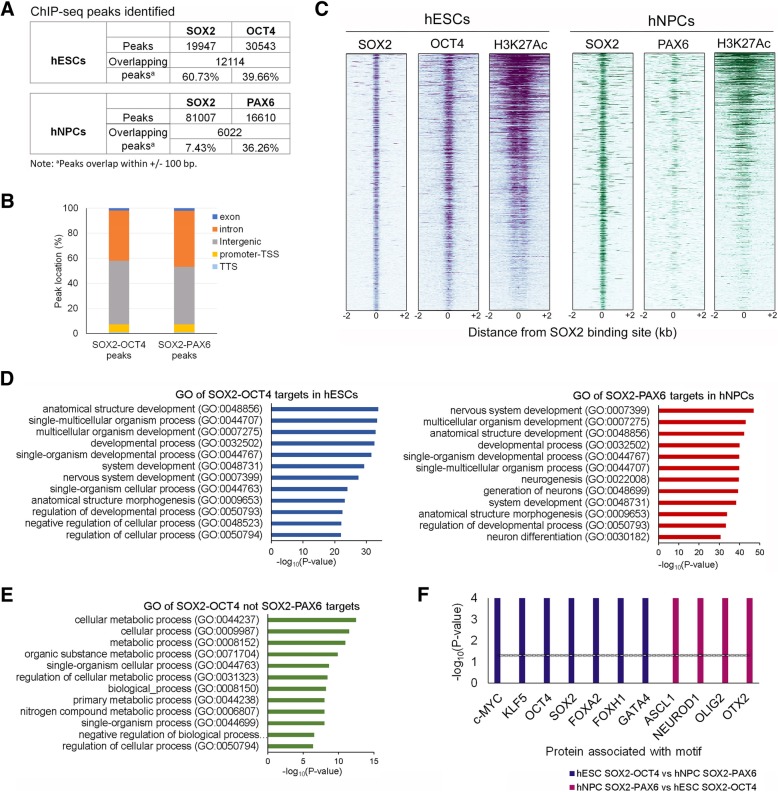
We demonstrate that knockdown of SOX2 induced hESC differentiation to endoderm-like cells, whereas overexpression of SOX2 in hESCs enhanced their pluripotency under self-renewing culture conditions but promoted their neural differentiation upon replacing the culture to non-self-renewal conditions. We show that this culture-dependent dual function of SOX2 was probably attributed to its interaction with different transcription factors predisposed by the culture environments. Whilst SOX2 interacts with OCT4 under self-renewal conditions, we found that, upon neural differentiation, PAX6, a key neural transcription factor, is upregulated and shows interaction with SOX2. The SOX2-PAX6 complex has different gene regulation pattern from that of SOX2-OCT4 complex.
Our work provides direct evidence that SOX2 is necessarily required for hESC pluripotency; however, it can also function as a neural factor, depending on the environmental input. OCT4 and PAX6 might function as key SOX2-interacting partners that determine the function of SOX2 in hESCs.
Sox2 是一种成熟的多能转录因子,在建立和维持多能干细胞(PSCs)方面发挥着重要作用。它也被认为是一种谱系指定因子,在 PSC 退出多能状态后,它可以控制 PSC 的神经谱系特化。然而,SOX2 在人类 PSCs 中的确切作用仍不完全清楚。在这项研究中,我们通过获得和丧失功能的方法研究了 SOX2 在人类胚胎干细胞(hESCs)中的作用,并探讨了可能的潜在机制。
我们证明了 SOX2 的敲低诱导 hESC 分化为内胚层样细胞,而 SOX2 在 hESCs 中的过表达增强了它们在自我更新培养条件下的多能性,但在替换培养为非自我更新条件时促进了它们的神经分化。我们表明,SOX2 的这种依赖于培养的双重功能可能归因于它与培养环境所倾向的不同转录因子的相互作用。虽然 SOX2 在自我更新条件下与 OCT4 相互作用,但我们发现,在神经分化时,PAX6,一种关键的神经转录因子,被上调,并显示与 SOX2 的相互作用。SOX2-PAX6 复合物的基因调控模式与 SOX2-OCT4 复合物不同。
我们的工作提供了直接证据,表明 SOX2 对于 hESC 的多能性是必需的;然而,它也可以作为一种神经因子发挥作用,这取决于环境输入。OCT4 和 PAX6 可能作为关键的 SOX2 相互作用伙伴,决定 SOX2 在 hESCs 中的功能。