Shinn Eileen H, Broderick Gordon, Fellman Bryan, Johnson Ainslee, Wieland Elizabeth, Moulder Stacy, Symmans William Fraser
University of Texas MD Anderson Cancer Center, Houston, TX.
Rochester Institute of Technology, Rochester, NY.
JCO Clin Cancer Inform. 2019 Apr;3:1-9. doi: 10.1200/CCI.18.00091.
Nearly 40% of patients with breast cancer discontinue their adjuvant oral endocrine treatment (ET). We measured discontinuation rates of ET at a comprehensive cancer center. We then used an iterative approach to model patterns of determinants associated with discontinuation of ET.
Patients with nonmetastatic breast cancer receiving active adjuvant ET were approached by nurse practitioners to complete an anonymous survey at one time point. We simulated a prospective model by iteratively regressing adverse effects onto adherence status across windowed time periods of 2 to 3 consecutive years, bootstrapping the smaller group of nonadherent patients and subsampling the larger adherent group.
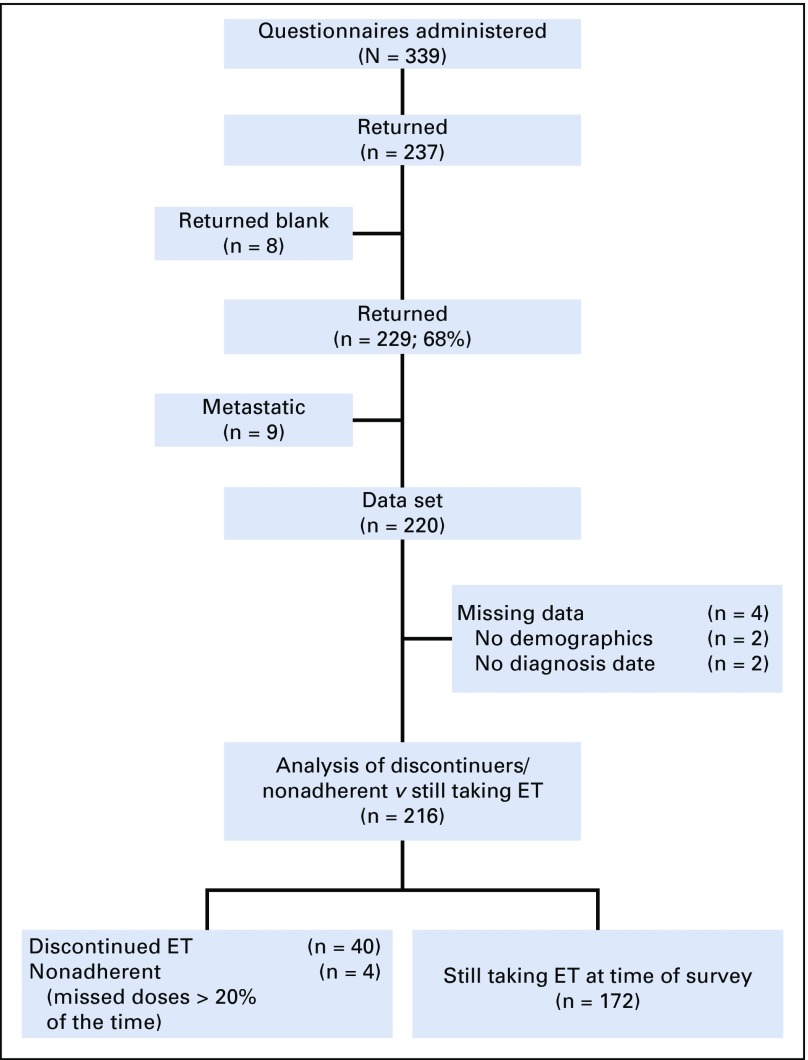
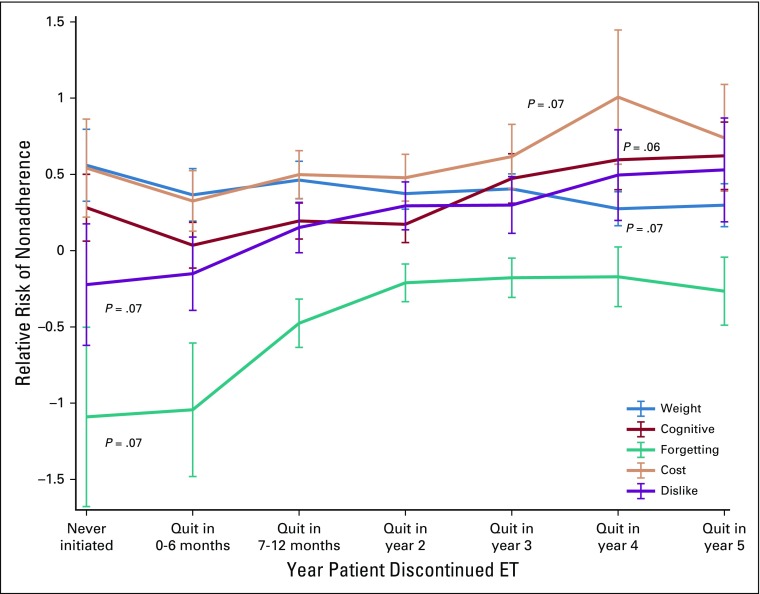
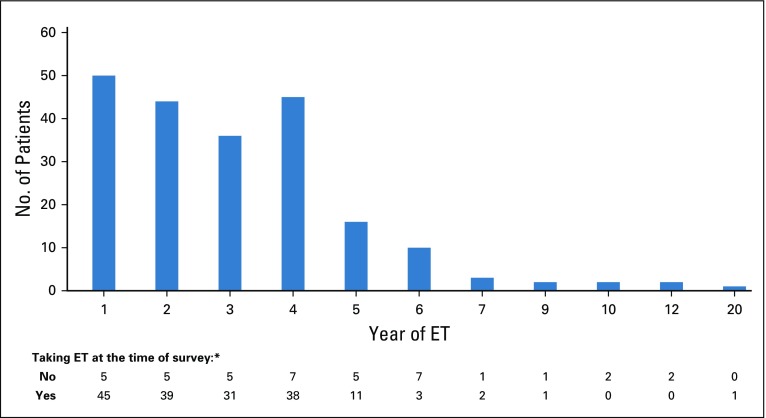
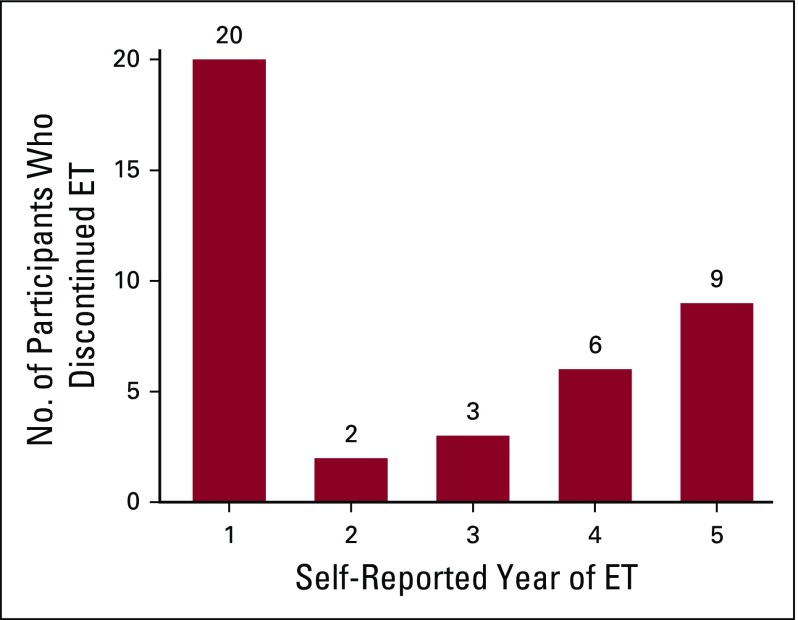
From February to April 2013, 216 participants were enrolled in the study. Forty patients (18.5%) reported that they had discontinued ET during the first 5 years of ET, and an additional four patients (1.9%) missed > 20% of their doses. Using two-sided significance tests, simulations showed that all 13 ET adverse effects and reasons for discontinuation were significantly related to discontinuation at some time point during ET. Worry about ET cost (odds ratio [OR], 1.79), emotional distress (OR, 1.72), and bone and joint pain (OR, 1.69) were the three most impactful reasons for discontinuation, with varying patterns of influence over time.
These analyses provide preliminary evidence that there are varying patterns of discontinuation of ET. Although some reasons for discontinuation exerted a steady influence over the 6-year ET trajectory (ie, bone and joint pain), other reasons, such as cost, cognitive complaints, and general dislike of pills, became more important in the later years of ET.
近40%的乳腺癌患者会中断其辅助性口服内分泌治疗(ET)。我们在一家综合癌症中心测量了ET的中断率。然后,我们采用迭代方法对与ET中断相关的决定因素模式进行建模。
接受积极辅助ET的非转移性乳腺癌患者由执业护士在一个时间点进行接触,以完成一项匿名调查。我们通过在连续2至3年的时间窗口内将不良反应迭代回归到依从状态,对较小的不依从患者组进行自抽样,对较大的依从患者组进行二次抽样,模拟了一个前瞻性模型。
2013年2月至4月,216名参与者纳入研究。40名患者(18.5%)报告称在ET的前5年中断了ET,另外4名患者(1.9%)漏服剂量超过20%。使用双侧显著性检验,模拟显示所有13种ET不良反应和中断原因在ET期间的某个时间点都与中断显著相关。对ET费用的担忧(比值比[OR],1.79).情绪困扰(OR,1.72)和骨与关节疼痛(OR,1.69)是中断的三个最具影响力的原因,随着时间推移影响模式各异。
这些分析提供了初步证据,表明ET中断存在不同模式。虽然一些中断原因在6年的ET过程中产生了稳定影响(如骨与关节疼痛),但其他原因,如费用、认知方面的不适以及对药片的普遍反感,在ET后期变得更为重要。