Thomas H J D, Myers-Smith I H, Bjorkman A D, Elmendorf S C, Blok D, Cornelissen J H C, Forbes B C, Hollister R D, Normand S, Prevéy J S, Rixen C, Schaepman-Strub G, Wilmking M, Wipf S, Cornwell W K, Kattge J, Goetz S J, Guay K C, Alatalo J M, Anadon-Rosell A, Angers-Blondin S, Berner L T, Björk R G, Buchwal A, Buras A, Carbognani M, Christie K, Siegwart Collier L, Cooper E J, Eskelinen A, Frei E R, Grau O, Grogan P, Hallinger M, Heijmans M M P D, Hermanutz L, Hudson J M G, Hülber K, Iturrate-Garcia M, Iversen C M, Jaroszynska F, Johnstone J F, Kaarlejärvi E, Kulonen A, Lamarque L J, Lévesque E, Little C J, Michelsen A, Milbau A, Nabe-Nielsen J, Nielsen S S, Ninot J M, Oberbauer S F, Olofsson J, Onipchenko V G, Petraglia A, Rumpf S B, Semenchuk P R, Soudzilovskaia N A, Spasojevic M J, Speed J D M, Tape K D, Te Beest M, Tomaselli M, Trant A, Treier U A, Venn S, Vowles T, Weijers S, Zamin T, Atkin O K, Bahn M, Blonder B, Campetella G, Cerabolini B E L, Chapin Iii F S, Dainese M, de Vries F T, Díaz S, Green W, Jackson R B, Manning P, Niinemets Ü, Ozinga W A, Peñuelas J, Reich P B, Schamp B, Sheremetev S, van Bodegom P M
School of Geosciences University of Edinburgh Edinburgh United Kingdom.
Ecoinformatics and Biodiversity, Department of Bioscience, Aarhus University Aarhus Denmark.
Glob Ecol Biogeogr. 2019 Jan;28(2):78-95. doi: 10.1111/geb.12783. Epub 2018 Nov 16.
Plant functional groups are widely used in community ecology and earth system modelling to describe trait variation within and across plant communities. However, this approach rests on the assumption that functional groups explain a large proportion of trait variation among species. We test whether four commonly used plant functional groups represent variation in six ecologically important plant traits.
Tundra biome.
Data collected between 1964 and 2016.
295 tundra vascular plant species.
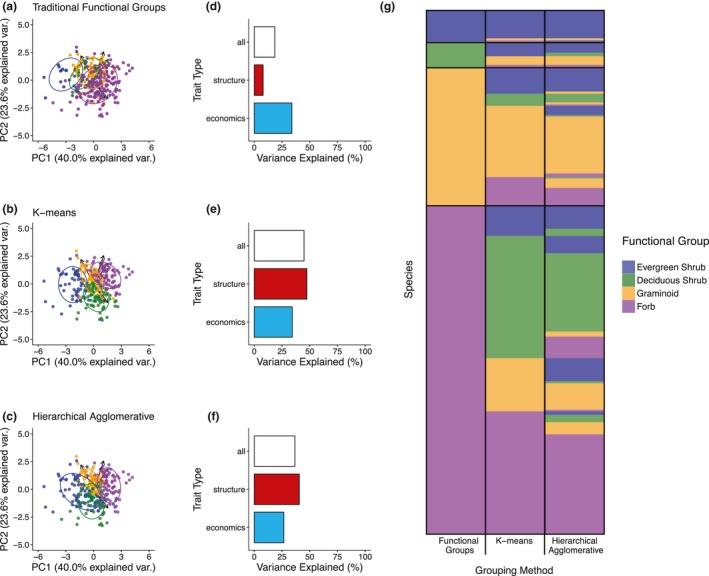
We compiled a database of six plant traits (plant height, leaf area, specific leaf area, leaf dry matter content, leaf nitrogen, seed mass) for tundra species. We examined the variation in species-level trait expression explained by four traditional functional groups (evergreen shrubs, deciduous shrubs, graminoids, forbs), and whether variation explained was dependent upon the traits included in analysis. We further compared the explanatory power and species composition of functional groups to alternative classifications generated using post hoc clustering of species-level traits.
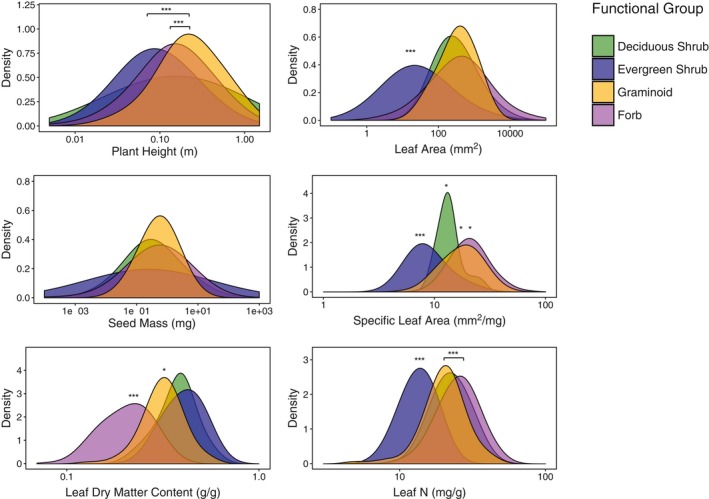
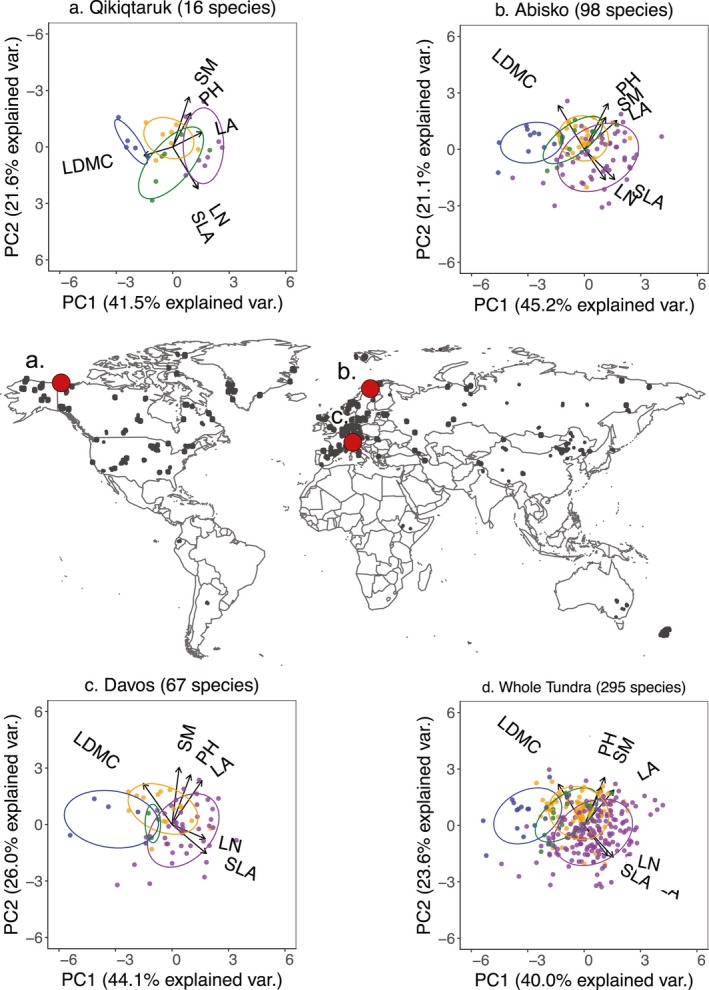
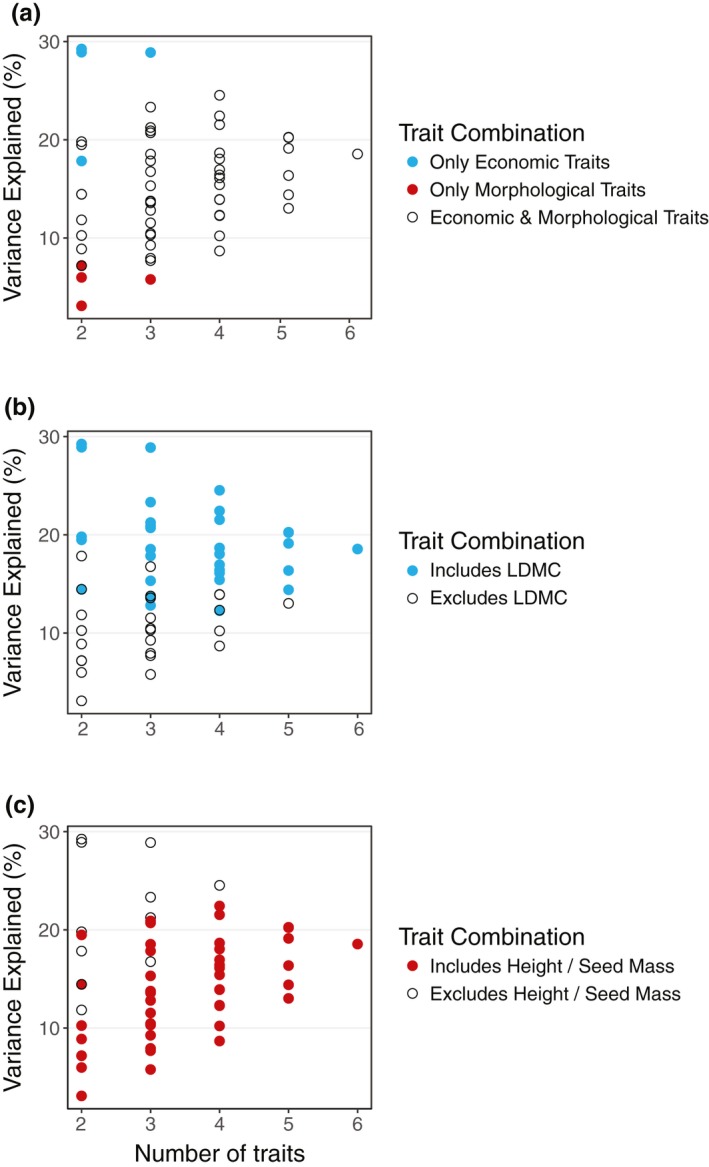
Traditional functional groups explained significant differences in trait expression, particularly amongst traits associated with resource economics, which were consistent across sites and at the biome scale. However, functional groups explained 19% of overall trait variation and poorly represented differences in traits associated with plant size. Post hoc classification of species did not correspond well with traditional functional groups, and explained twice as much variation in species-level trait expression.
Traditional functional groups only coarsely represent variation in well-measured traits within tundra plant communities, and better explain resource economic traits than size-related traits. We recommend caution when using functional group approaches to predict tundra vegetation change, or ecosystem functions relating to plant size, such as albedo or carbon storage. We argue that alternative classifications or direct use of specific plant traits could provide new insights for ecological prediction and modelling.
植物功能群在群落生态学和地球系统建模中被广泛用于描述植物群落内部和之间的性状变异。然而,这种方法基于功能群能解释物种间大部分性状变异这一假设。我们检验了四个常用的植物功能群是否代表六种生态上重要的植物性状的变异。
苔原生物群落。
1964年至2016年收集的数据。
295种苔原维管植物物种。
我们编制了一个关于苔原物种六种植物性状(株高、叶面积、比叶面积、叶干物质含量、叶氮含量、种子质量)的数据库。我们研究了由四个传统功能群(常绿灌木、落叶灌木、禾本科植物、草本植物)所解释的物种水平性状表达的变异,以及所解释的变异是否取决于分析中所包含的性状。我们还将功能群的解释力和物种组成与使用物种水平性状的事后聚类生成的替代分类进行了比较。
传统功能群解释了性状表达的显著差异,特别是在与资源经济学相关的性状中,这些差异在不同地点和生物群落尺度上都是一致的。然而,功能群解释了总体性状变异的19%,并且对与植物大小相关的性状差异的代表性较差。物种的事后分类与传统功能群不太相符,并且解释了物种水平性状表达变异的两倍。
传统功能群仅粗略地代表了苔原植物群落中测量良好的性状变异,并且对资源经济性状的解释比对与大小相关的性状的解释更好。我们建议在使用功能群方法预测苔原植被变化或与植物大小相关的生态系统功能(如反照率或碳储存)时要谨慎。我们认为替代分类或直接使用特定植物性状可为生态预测和建模提供新的见解。