School of Medical Science, Griffith University, Gold Coast, QLD, Australia.
The National Centre for Neuroimmunology and Emerging Diseases, Menzies Health Institute Queensland, Griffith University, Gold Coast, Southport, QLD, 4222, Australia.
Mol Med. 2019 Apr 23;25(1):14. doi: 10.1186/s10020-019-0083-4.
Chronic Fatigue Syndrome/ Myalgic Encephalomyelitis (CFS/ME) is a complex multifactorial disorder of unknown cause having multi-system manifestations. Although the aetiology of CFS/ME remains elusive, immunological dysfunction and more particularly reduced cytotoxic activity in natural killer (NK) cells is the most consistent laboratory finding. The Transient Receptor Potential (TRP) superfamily of cation channels play a pivotal role in the pathophysiology of immune diseases and are therefore potential therapeutic targets. We have previously identified single nucleotide polymorphisms in TRP genes in peripheral NK cells from CFS/ME patients. We have also described biochemical pathway changes and calcium signaling perturbations in NK cells from CFS/ME patients. Notably, we have previously reported a decrease of TRP cation channel subfamily melastatin member 3 (TRPM3) function in NK cells isolated from CFS/ME patients compared with healthy controls after modulation with pregnenolone sulfate and ononetin using a patch-clamp technique. In the present study, we aim to confirm the previous results describing an impaired TRPM3 activity in a new cohort of CFS/ME patients using a whole cell patch-clamp technique after modulation with reversible TRPM3 agonists, pregnenolone sulfate and nifedipine, and an effective TRPM3 antagonist, ononetin. Indeed, no formal research has commented on using pregnenolone sulfate or nifedipine to treat CFS/ME patients while there is evidence that clinicians prescribe calcium channel blockers to improve different symptoms.
Whole-cell patch-clamp technique was used to measure TRPM3 activity in isolated NK cells from twelve age- and sex-matched healthy controls and CFS/ME patients, after activation with pregnenolone sulfate and nifedipine and inhibition with ononetin.
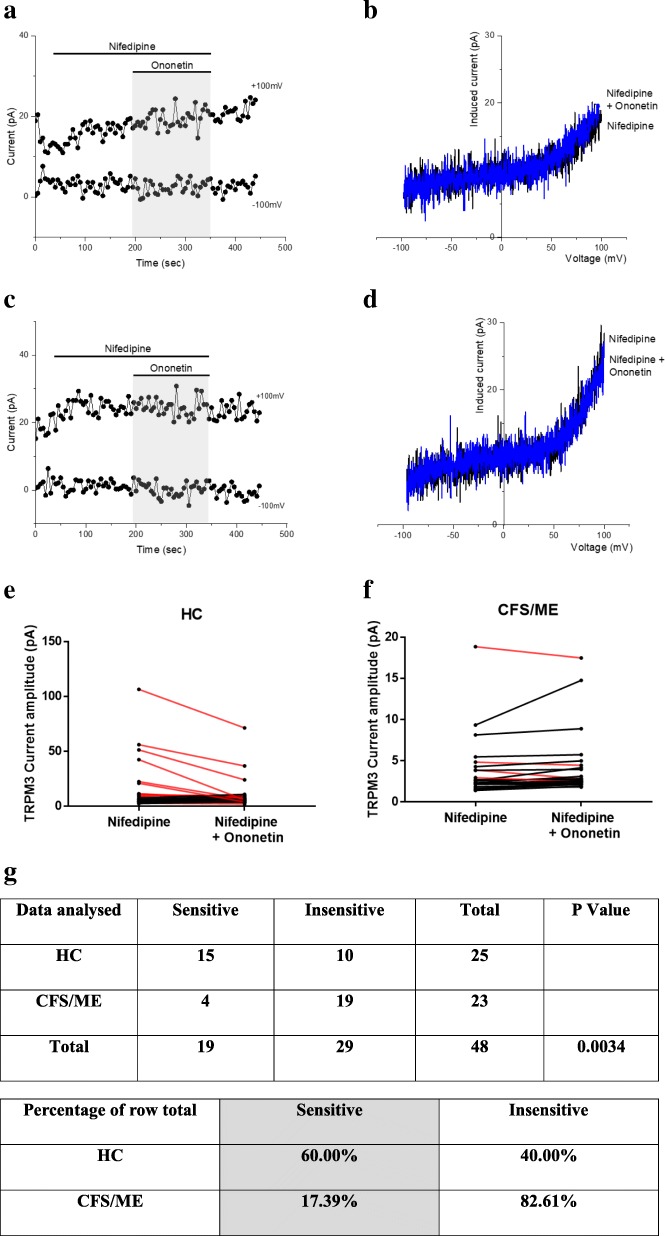
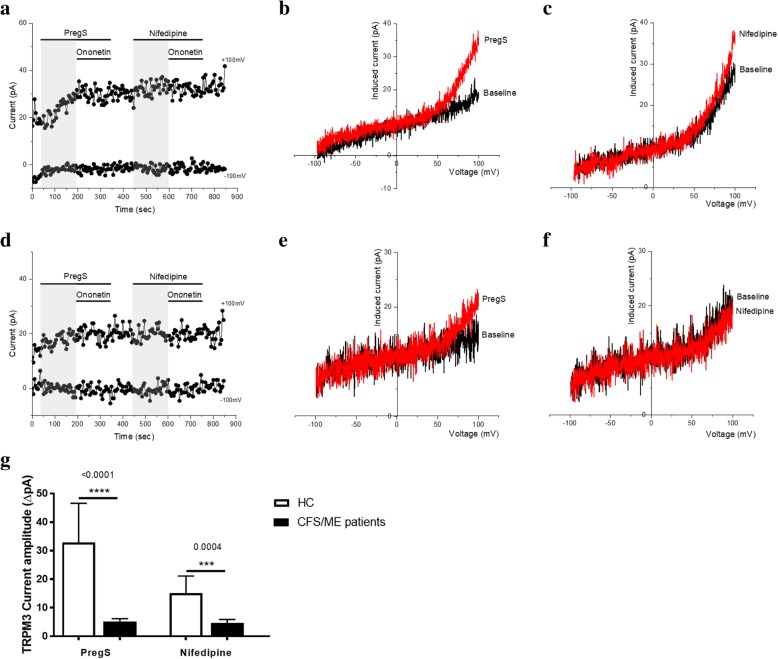
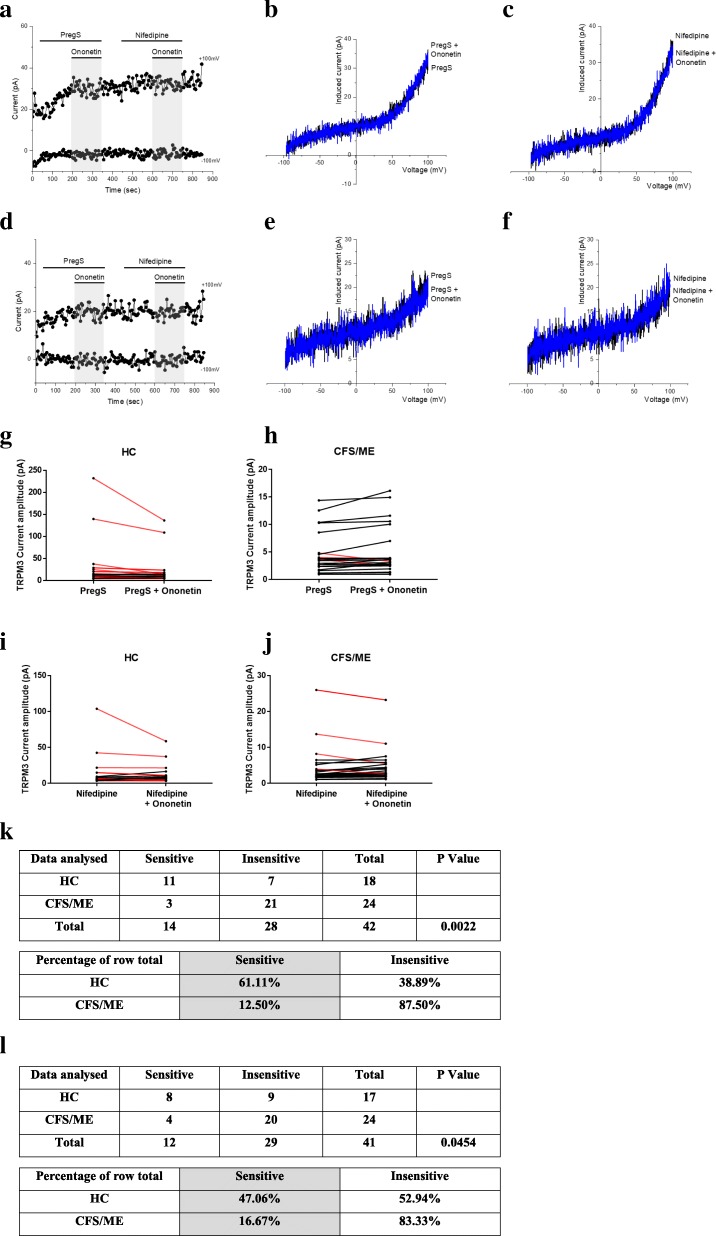
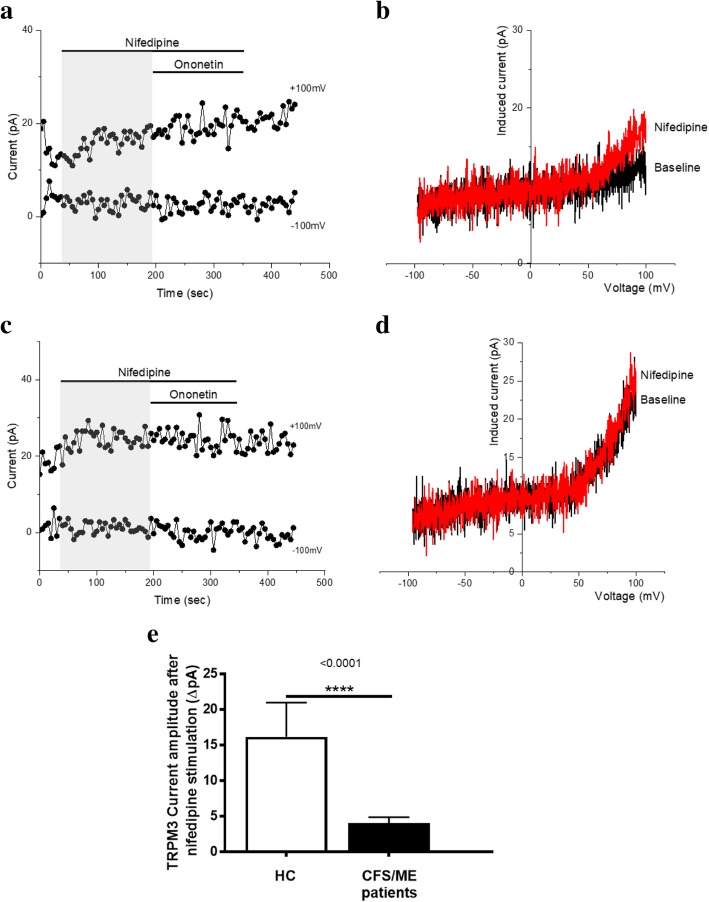
We confirmed a significant reduction in amplitude of TRPM3 currents after pregnenolone sulfate stimulation in isolated NK cells from another cohort of CFS/ME patients compared with healthy controls. The pregnenolone sulfate-evoked ionic currents through TRPM3 channels were again significantly modulated by ononetin in isolated NK cells from healthy controls compared with CFS/ME patients. In addition, we used nifedipine, another reversible TRPM3 agonist to support the previous findings and found similar results confirming a significant loss of the TRPM3 channel activity in CFS/ME patients.
Impaired TRPM3 activity was validated in NK cells isolated from CFS/ME patients using different pharmacological tools and whole-cell patch-clamp technique as the gold standard for ion channel research. This investigation further helps to establish TRPM3 channels as a prognostic marker and/ or a potential therapeutic target for CFS/ME.
慢性疲劳综合征/肌痛性脑脊髓炎(CFS/ME)是一种病因不明的复杂多因素疾病,具有多系统表现。尽管 CFS/ME 的病因仍然难以捉摸,但免疫功能障碍,特别是自然杀伤(NK)细胞的细胞毒性活性降低,是最一致的实验室发现。瞬时受体电位(TRP)阳离子通道超家族在免疫性疾病的病理生理学中起着关键作用,因此是潜在的治疗靶点。我们之前已经在 CFS/ME 患者的外周 NK 细胞中鉴定出 TRP 基因的单核苷酸多态性。我们还描述了 CFS/ME 患者 NK 细胞的生化途径变化和钙信号转导扰动。值得注意的是,我们之前曾报道过,与健康对照组相比,用孕烯醇酮硫酸盐和 ONONETIN 调制后,从 CFS/ME 患者中分离出的 NK 细胞中 TRP 阳离子通道亚家族黑色素 3(TRPM3)的功能降低,使用膜片钳技术。在本研究中,我们旨在使用全细胞膜片钳技术,在另一批 CFS/ME 患者中确认先前描述的 TRPM3 活性受损的结果,该技术使用可逆的 TRPM3 激动剂孕烯醇酮硫酸盐和硝苯地平以及有效的 TRPM3 拮抗剂 ONONETIN 进行调节。事实上,没有正式的研究评论过使用孕烯醇酮硫酸盐或硝苯地平来治疗 CFS/ME 患者,而有证据表明临床医生开钙通道阻滞剂来改善不同的症状。
使用全细胞膜片钳技术测量 12 名年龄和性别匹配的健康对照者和 CFS/ME 患者分离的 NK 细胞中的 TRPM3 活性,在激活后用孕烯醇酮硫酸盐和硝苯地平,并抑制 ONONETIN。
我们证实,与健康对照组相比,另一批 CFS/ME 患者分离的 NK 细胞在孕烯醇酮硫酸盐刺激后,TRPM3 电流的幅度明显降低。与 CFS/ME 患者相比,ONONETIN 再次显著调节了健康对照者 NK 细胞中孕烯醇酮硫酸盐诱导的 TRPM3 通道离子电流。此外,我们使用硝苯地平(另一种可逆的 TRPM3 激动剂)来支持先前的发现,并得到了类似的结果,证实了 CFS/ME 患者中 TRPM3 通道活性的显著丧失。
使用不同的药理学工具和全细胞膜片钳技术(离子通道研究的金标准),在 CFS/ME 患者分离的 NK 细胞中验证了 TRPM3 活性受损。这项研究进一步有助于将 TRPM3 通道确立为 CFS/ME 的预后标志物和/或潜在的治疗靶点。