Division of Nephrology, Tennessee Valley Healthcare System, Nashville, Tennessee.
Department of Medicine and.
Clin J Am Soc Nephrol. 2019 May 7;14(5):702-711. doi: 10.2215/CJN.04360418. Epub 2019 Apr 23.
Systemic inflammation modulates cardiovascular disease risk and functionality of HDL in the setting of CKD. Whether interventions that modify systemic inflammation can improve HDL function in CKD is unknown.
DESIGN, SETTING, PARTICIPANTS, & MEASUREMENTS: We conducted a analysis of two randomized, clinical trials, IL-1 trap in participants with GFR 15-59 ml/min per 1.73 m (study A) and IL-1 receptor antagonist in participants on maintenance hemodialysis (study B), to evaluate if IL-1 blockade had improved the anti-inflammatory activity (IL-6, TNF-, and Nod-like receptor protein 3), antioxidant function (superoxide production), and net cholesterol efflux capacity of HDL. HDL function was measured using LPS-stimulated THP-1 macrophages or peritoneal macrophages of apoE-deficient mice exposed to the apoB-depleted, HDL-containing fraction obtained from the plasma of the study participants, collected before and after the interventions to block IL-1 effects. Analysis of covariance was used for between group comparisons.
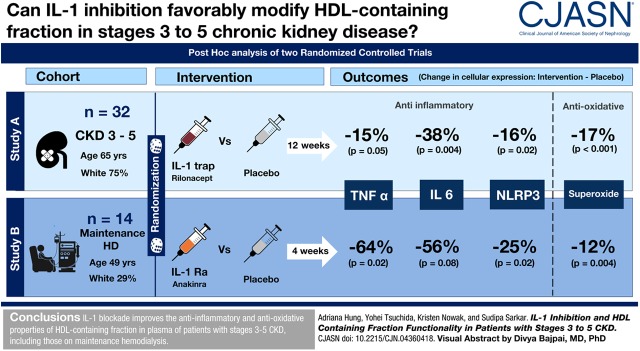
The mean age of the participants was 60±13 years, 72% (=33) were men, and 39% (=18) were black. There were 32 CKD (16 IL-1 trap and 16 placebo) and 14 maintenance hemodialysis (7 IL-1 receptor antagonist and 7 placebo) participants. Compared with placebo, IL-1 inhibition, in study A and B reduced cellular expression of TNF- by 15% (=0.05) and 64% (=0.02), IL-6 by 38% (=0.004) and 56% (=0.08), and Nod-like receptor protein 3 by 16% (=0.01) and 25% (=0.02), respectively. The intervention blunted superoxide production in the treated arm compared with placebo, with the values being higher by 17% in the placebo arm in study A (<0.001) and 12% in the placebo arm in study B (=0.004). Net cholesterol efflux capacity was not affected by either intervention.
IL-1 blockade improves the anti-inflammatory and antioxidative properties of the HDL-containing fraction of plasma in patients with stages 3-5 CKD, including those on maintenance hemodialysis.
系统性炎症可调节慢性肾脏病(CKD)患者的心血管疾病风险和高密度脂蛋白(HDL)功能。干预调节系统性炎症是否能改善 CKD 患者的 HDL 功能尚不清楚。
设计、地点、参与者和测量:我们对两项随机临床试验进行了 分析,一项是在肾小球滤过率为 15-59 ml/min/1.73 m2 的患者中使用白细胞介素-1 陷阱(研究 A),另一项是在维持性血液透析患者中使用白细胞介素-1 受体拮抗剂(研究 B),以评估白细胞介素-1 阻断是否改善了富含 HDL 的血浆中抗炎活性(白细胞介素-6、肿瘤坏死因子-α和 Nod 样受体蛋白 3)、抗氧化功能(超氧化物产生)和 HDL 的净胆固醇流出能力。使用脂多糖刺激的 THP-1 巨噬细胞或载脂蛋白 E 缺乏的小鼠腹膜巨噬细胞来测量 HDL 功能,这些细胞暴露于从研究参与者血浆中获得的载脂蛋白 B 耗尽、富含 HDL 的部分,在干预阻断白细胞介素-1 作用之前和之后收集。使用协方差分析进行组间比较。
参与者的平均年龄为 60±13 岁,72%(=33)为男性,39%(=18)为黑人。有 32 名 CKD(16 名白细胞介素-1 陷阱和 16 名安慰剂)和 14 名维持性血液透析(7 名白细胞介素-1 受体拮抗剂和 7 名安慰剂)参与者。与安慰剂相比,在研究 A 和 B 中,白细胞介素-1 抑制分别降低了细胞表达的 TNF-α 15%(=0.05)和 64%(=0.02),白细胞介素-6 38%(=0.004)和 56%(=0.08),Nod 样受体蛋白 3 16%(=0.01)和 25%(=0.02)。与安慰剂相比,干预措施抑制了治疗组中超氧化物的产生,在研究 A 中,安慰剂组的值高出 17%(<0.001),在研究 B 中,安慰剂组的值高出 12%(=0.004)。两种干预措施均未影响净胆固醇流出能力。
白细胞介素-1 阻断可改善 3-5 期 CKD 患者(包括维持性血液透析患者)富含 HDL 的血浆中抗炎和抗氧化特性。