He Xie, Burgess Kevin S, Yang Xue-Fei, Ahrends Antje, Gao Lian-Ming, Li De-Zhu
Germplasm Bank of Wild Species Kunming Institute of Botany, Chinese Academy of Sciences Kunming Yunnan China.
CAS Key Laboratory for Plant Diversity and Biogeography of East Asia, Kunming Institute of Botany Chinese Academy of Sciences Kunming Yunnan China.
Ecol Evol. 2019 Mar 11;9(7):4055-4064. doi: 10.1002/ece3.5034. eCollection 2019 Apr.
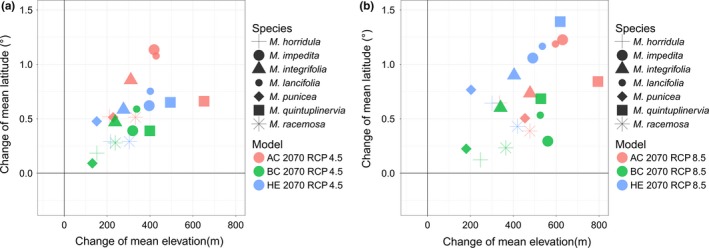
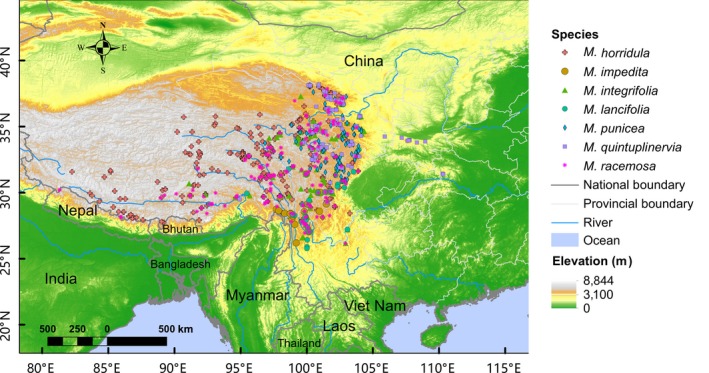
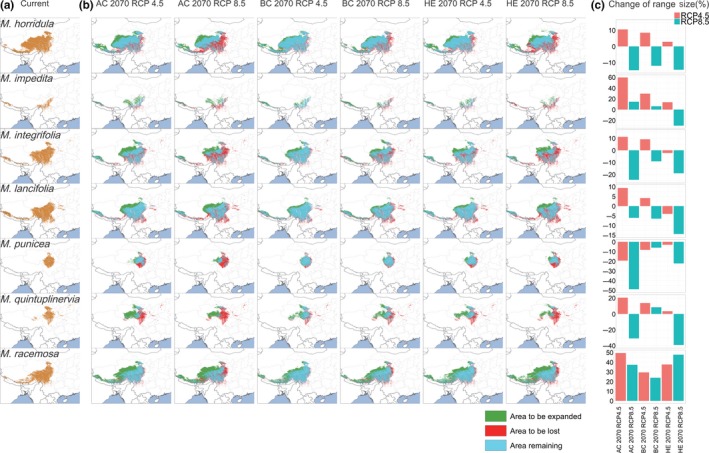
Climate change may impact the distribution of species by shifting their ranges to higher elevations or higher latitudes. The impacts on alpine plant species may be particularly profound due to a potential lack of availability of future suitable habitat. To identify how alpine species have responded to climate change during the past century as well as to predict how they may react to possible global climate change scenarios in the future, we investigate the climatic responses of seven species of , a representative genus endemic in the alpine meadow and subnival region of the Himalaya-Hengduan Mountains. We analyzed past elevational shifts, as well as projected shifts in longitude, latitude, elevation, and range size using historical specimen records and species distribution modeling under optimistic (RCP 4.5) and pessimistic (RCP 8.5) scenarios across three general circulation models for 2070. Our results indicate that across all seven species, there has been an upward shift in mean elevation of 302.3 m between the pre-1970s (1922-1969) and the post-1970s (1970-2016). The model predictions suggest that the future suitable climate space will continue to shift upwards in elevation (as well as northwards and westwards) by 2070. While for most of the analyzed species, the area of suitable climate space is predicted to expand under the optimistic emission scenario, the area contracts, or, at best, shows little change under the pessimistic scenario. Species such as , which already occupy high latitudes, are consistently predicted to experience a contraction of suitable climate space across all the models by 2070 and may consequently deserve particular attention by conservation strategies. Collectively, our results suggest that the alpine high-latitude species analyzed here have already been significantly impacted by climate change and that these trends may continue over the coming decades.
气候变化可能会通过将物种的分布范围转移到更高海拔或更高纬度来影响物种分布。由于未来可能缺乏适宜栖息地,对高山植物物种的影响可能尤为深远。为了确定高山物种在过去一个世纪中对气候变化的响应方式,以及预测它们未来对可能的全球气候变化情景的反应,我们研究了七种 的气候响应, 是喜马拉雅 - 横断山脉高山草甸和亚冰雪地区特有的一个代表性属。我们利用历史标本记录和物种分布模型,分析了过去的海拔变化以及在2070年三种通用环流模型下乐观(RCP 4.5)和悲观(RCP 8.5)情景下经度、纬度、海拔和分布范围大小的预测变化。我们的结果表明,在所有七个物种中,20世纪70年代前(1922 - 1969年)到20世纪70年代后(1970 - 2016年)平均海拔上升了302.3米。模型预测表明,到2070年,未来适宜气候空间将继续向海拔更高(以及向北和向西)的方向转移。虽然对于大多数分析的物种,在乐观排放情景下适宜气候空间面积预计会扩大,但在悲观情景下面积会缩小,或者最多变化不大。像 这样已经占据高纬度的物种,预计到2070年在所有模型中适宜气候空间都会缩小,因此可能值得保护策略给予特别关注。总体而言,我们的结果表明,这里分析的高山高纬度物种已经受到气候变化的显著影响,并且这些趋势在未来几十年可能会持续。