From the ‡Department of Cellular & Molecular Medicine.
§Department of Medicine, Division of Endocrinology.
Mol Cell Proteomics. 2019 Jul;18(7):1363-1381. doi: 10.1074/mcp.RA119.001450. Epub 2019 Apr 24.
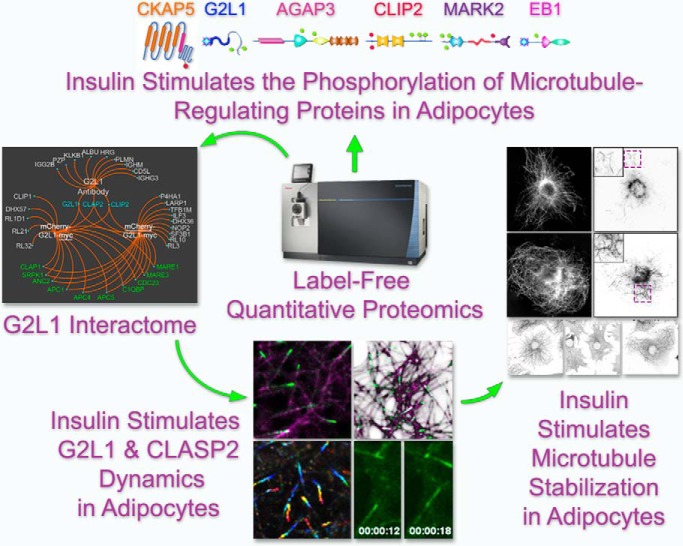
Insulin-stimulated glucose uptake is known to involve microtubules, although the function of microtubules and the microtubule-regulating proteins involved in insulin action are poorly understood. CLASP2, a plus-end tracking microtubule-associated protein (+TIP) that controls microtubule dynamics, was recently implicated as the first +TIP associated with insulin-regulated glucose uptake. Here, using protein-specific targeted quantitative phosphoproteomics within 3T3-L1 adipocytes, we discovered that insulin regulates phosphorylation of the CLASP2 network members G2L1, MARK2, CLIP2, AGAP3, and CKAP5 as well as EB1, revealing the existence of a previously unknown microtubule-associated protein system that responds to insulin. To further investigate, G2L1 interactome studies within 3T3-L1 adipocytes revealed that G2L1 coimmunoprecipitates CLASP2 and CLIP2 as well as the master integrators of +TIP assembly, the end binding (EB) proteins. Live-cell total internal reflection fluorescence microscopy in adipocytes revealed G2L1 and CLASP2 colocalize on microtubule plus-ends. We found that although insulin increases the number of CLASP2-containing plus-ends, insulin treatment simultaneously decreases CLASP2-containing plus-end velocity. In addition, we discovered that insulin stimulates redistribution of CLASP2 and G2L1 from exclusive plus-end tracking to "trailing" behind the growing tip of the microtubule. Insulin treatment increases α-tubulin Lysine 40 acetylation, a mechanism that was observed to be regulated by a counterbalance between GSK3 and mTOR, and led to microtubule stabilization. Our studies introduce insulin-stimulated microtubule stabilization and plus-end trailing of +TIPs as new modes of insulin action and reveal the likelihood that a network of microtubule-associated proteins synergize to coordinate insulin-regulated microtubule dynamics.
胰岛素刺激的葡萄糖摄取已知涉及微管,尽管微管的功能以及参与胰岛素作用的微管调节蛋白的功能仍知之甚少。CLASP2 是一种与微管结合的正端追踪蛋白 (+TIP),可控制微管动力学,最近被认为是与胰岛素调节的葡萄糖摄取有关的第一个 +TIP。在这里,我们使用 3T3-L1 脂肪细胞中的蛋白特异性靶向定量磷酸化蛋白质组学,发现胰岛素调节 CLASP2 网络成员 G2L1、MARK2、CLIP2、AGAP3 和 CKAP5 以及 EB1 的磷酸化,揭示了一个以前未知的微管相关蛋白系统对胰岛素的反应。为了进一步研究,我们在 3T3-L1 脂肪细胞中进行了 G2L1 相互作用组研究,发现 G2L1 与 CLASP2 和 CLIP2 以及 +TIP 组装的主要整合因子,末端结合 (EB) 蛋白共同免疫沉淀。在脂肪细胞中的活细胞全内反射荧光显微镜显示 G2L1 和 CLASP2 在微管正端共定位。我们发现,尽管胰岛素增加了包含 CLASP2 的正端的数量,但胰岛素处理同时降低了包含 CLASP2 的正端速度。此外,我们发现胰岛素刺激 CLASP2 和 G2L1 从独占的正端追踪重新分配到微管生长尖端的“尾随”。胰岛素处理增加了微管的 α-微管蛋白赖氨酸 40 乙酰化,这种机制被观察到受 GSK3 和 mTOR 之间的平衡调节,并导致微管稳定。我们的研究介绍了胰岛素刺激的微管稳定和 +TIP 的正端跟踪作为胰岛素作用的新模式,并揭示了微管相关蛋白网络协同协调胰岛素调节的微管动力学的可能性。