Department of Neurology and Centre for Clinical Neuroscience Daping Hospital Third Military Medical University Chongqing China.
Ann Clin Transl Neurol. 2019 Mar 12;6(4):788-794. doi: 10.1002/acn3.756. eCollection 2019 Apr.
Obstructive sleep apnea syndrome (OSAS) is characterized by nocturnal intermittent hypoxemia and can increase the risk of Parkinson's disease. This study aimed to investigate the association between plasma -synuclein levels and hypoxia in the patients with OSAS.
We recruited 42 OSAS patients and 46 controls with simple snoring matched for age and gender. OSAS was diagnosed on the basis of the clinical symptoms as well as the nighttime polysomnography. Plasma total -synuclein and phosphorylated -synuclein levels were measured by ELISA kits.
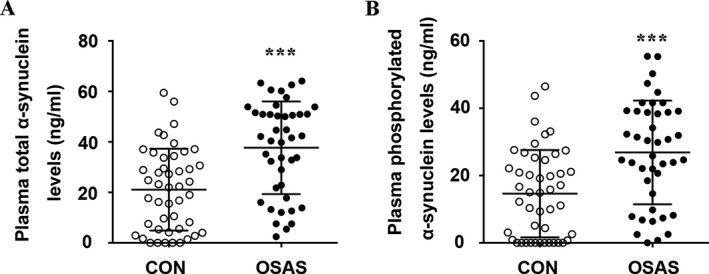
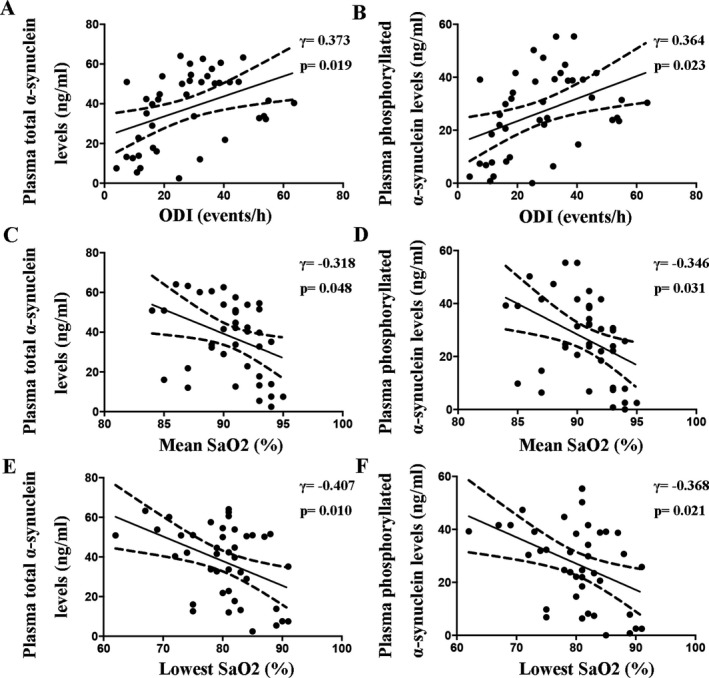
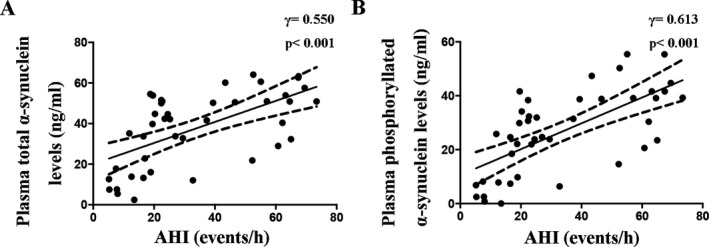
The OSAS patients had significant higher levels of plasma total -synuclein and phosphorylated -synuclein levels. Both of the above indexes were positively correlated with the apnea-hypopnea index and the oxygen desaturation index, while they were negatively correlated with the mean and lowest oxyhemoglobin saturations.
This study suggests that chronic intermittent hypoxia can increase the -synuclein levels, which may contribute to the pathogenesis of Parkinson's disease.
阻塞性睡眠呼吸暂停综合征(OSAS)的特征为夜间间歇性低氧血症,可增加帕金森病的发病风险。本研究旨在探讨 OSAS 患者血浆 -突触核蛋白水平与低氧血症的关系。
我们招募了 42 名 OSAS 患者和 46 名单纯打鼾的对照者,这些对照者按年龄和性别相匹配。根据临床症状和夜间多导睡眠图诊断 OSAS。采用 ELISA 试剂盒测定血浆总 -突触核蛋白和磷酸化 -突触核蛋白水平。
OSAS 患者的血浆总 -突触核蛋白和磷酸化 -突触核蛋白水平显著升高。上述两项指标均与呼吸暂停低通气指数和氧减指数呈正相关,与平均和最低血氧饱和度呈负相关。
本研究提示慢性间歇性低氧血症可增加 -突触核蛋白水平,这可能有助于帕金森病的发病机制。