Division of Pulmonary Medicine, Department of Medicine, School of Medicine, Keio University, Shinjuku, Tokyo, Japan.
Division of Infectious Diseases and Respiratory Medicine, Department of Internal Medicine, National Defense Medical College, Tokorozawa, Saitama, Japan.
PLoS One. 2019 Apr 25;14(4):e0216034. doi: 10.1371/journal.pone.0216034. eCollection 2019.
There is no proven management for mild cases of Mycobacterium avium complex (MAC) pulmonary disease, who do not immediately receive treatment and are managed with observation alone, because its long term-natural course, factors predictive of deterioration, and the effect of treating the disease remain unclear. Thus, we sought to investigate the natural course of mild cases of MAC pulmonary disease.
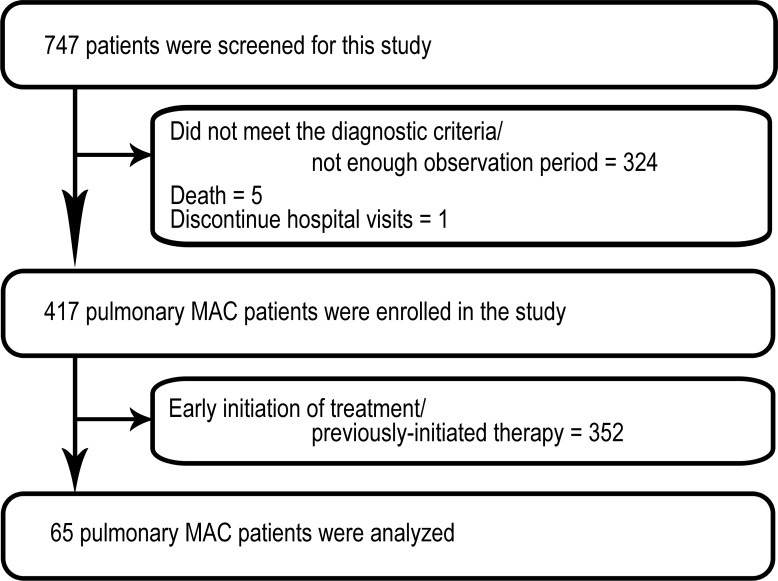
We conducted a multicenter retrospective study. Sixty-five patients with mild MAC pulmonary disease in whom treatment was withheld for at least 6 months after diagnosis were retrospectively recruited after a review of 747 medical records. Longitudinal changes in clinical features were evaluated by using a mixed effects model.
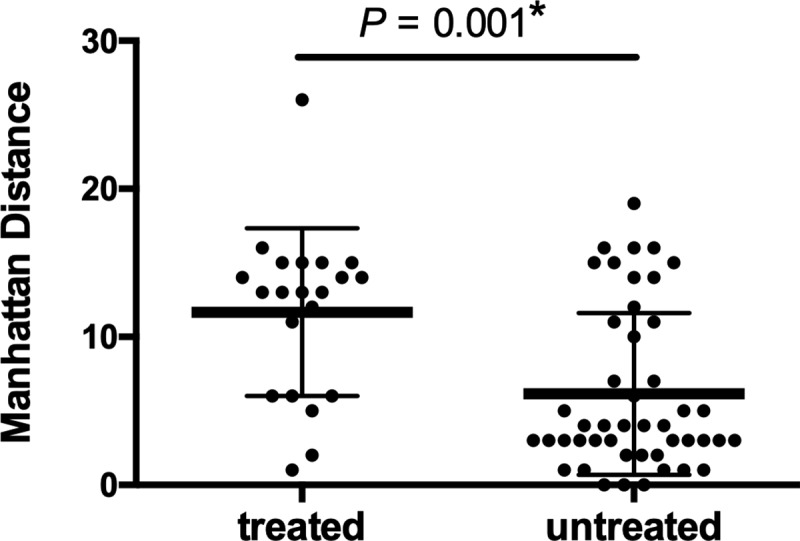
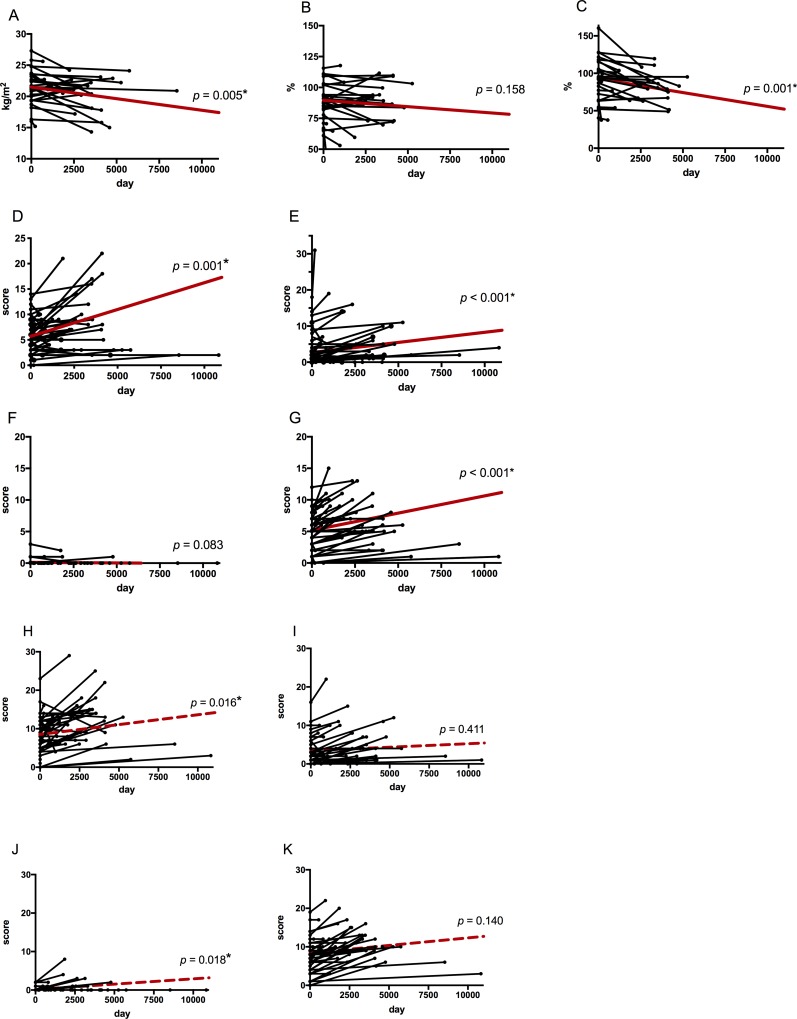
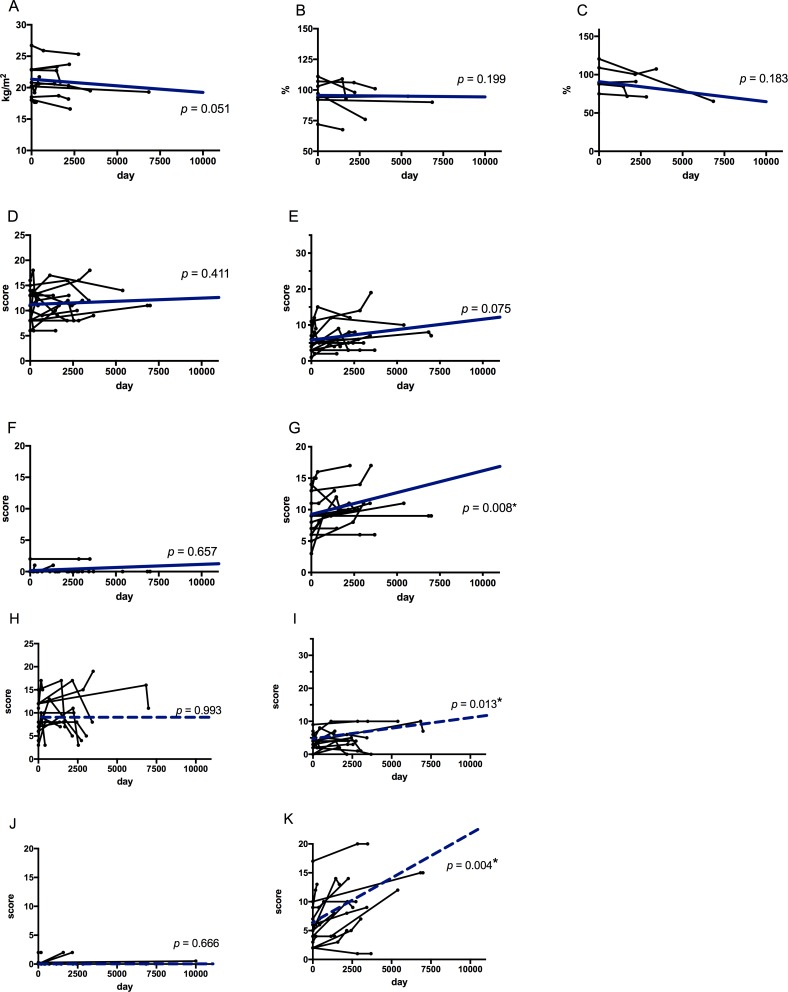
Mean follow-up was 6.9 ± 5.7 years. During the follow-up period, 15 patients (23%) required treatment and 50 (77%) were managed with observation alone. At diagnosis, 65 patients had nodular bronchiectatic disease without fibrocavitary lesions. Among clinical features, mean body mass index (BMI), forced expiratory volume in 1 second as percent of forced vital capacity (%FEV1), nodular lung lesions, and bronchiectasis worsened significantly in the observation group during follow-up. In the treatment group, BMI, and %FEV1 were stable, but bronchiectasis significantly worsened. At diagnosis, the polyclonal MAC infection rate in the treatment group was higher than that in the observation group. Other microbiological factors, such as insertion sequences, did not differ significantly between the groups.
Mild MAC pulmonary disease progresses slowly but substantially without treatment. Treatment prevents the deterioration of the disease but not the progression of bronchiectasis. Polyclonal MAC infection is a predictor of disease progression.
对于无即刻治疗且仅接受观察的轻度鸟分枝杆菌复合群(MAC)肺病患者,目前尚无明确的治疗方法,因为其长期自然病程、疾病恶化的预测因素以及治疗效果尚不清楚。因此,我们旨在研究轻度 MAC 肺病的自然病程。
我们开展了一项多中心回顾性研究。在回顾了 747 份病历后,我们回顾性地招募了 65 名在诊断后至少 6 个月未接受治疗的轻度 MAC 肺病患者。采用混合效应模型评估临床特征的纵向变化。
平均随访时间为 6.9±5.7 年。在随访期间,15 名患者(23%)需要治疗,50 名患者(77%)仅接受观察。在诊断时,65 名患者均存在无纤维空洞病变的结节性支气管扩张症。在临床特征中,观察组的平均体重指数(BMI)、用力肺活量占预计值的百分比(%FEV1)、结节性肺病变和支气管扩张在随访期间显著恶化。在治疗组中,BMI 和 %FEV1 保持稳定,但支气管扩张显著恶化。在诊断时,治疗组的多克隆 MAC 感染率高于观察组。其他微生物学因素,如插入序列,两组间无显著差异。
未经治疗的轻度 MAC 肺病会缓慢但实质性地进展。治疗可预防疾病恶化,但不能预防支气管扩张的进展。多克隆 MAC 感染是疾病进展的预测因素。