Malaria Research Unit, Centre Pasteur Cameroon, Yaounde, Cameroon.
Faculty of Sciences, University of Douala, Douala, Cameroon.
PLoS One. 2019 Apr 25;14(4):e0216133. doi: 10.1371/journal.pone.0216133. eCollection 2019.
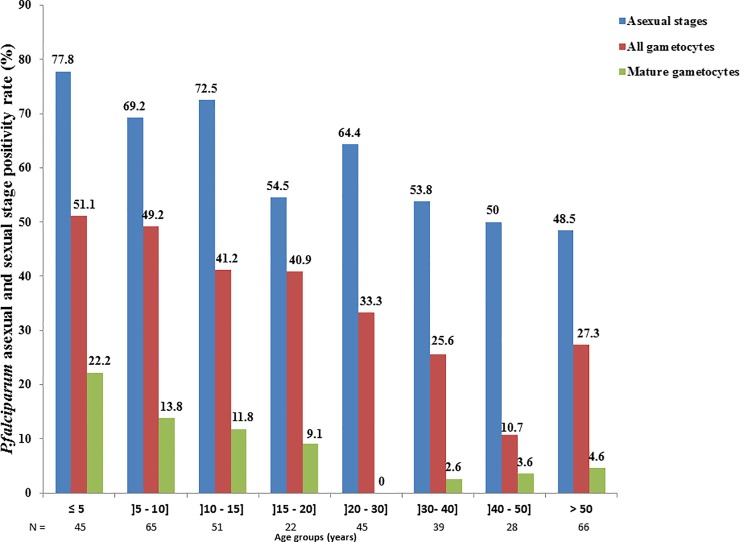
Presence of mature gametocyte forms of malaria parasites in peripheral blood is a key requirement for malaria transmission. Yet, studies conducted in most malaria transmission zones report the absence of gametocyte in the majority of patients. We therefore sought to determine the risk factors of both all-stage and mature gametocyte carriage in an area with high stable transmission of Plasmodium falciparum in Cameroon. Gametocyte positivity was determined using three complementary methods: thick blood smear microscopy, RT-PCR and RT-LAMP, whereas exposure to the infection was assessed by enzyme-linked immunosorbent assay. Of 361 malaria endemic residents randomly included in the study (mean age: 28±23 years, age range: 2-100 years, male/female sex ratio: 1.1), 87.8% were diagnosed with P. falciparum infection, of whom 45.7% presented with fever (axillary body temperature ≥37.5°C). Mature gametocyte positivity was 1.9% by thick blood smear microscopy and 8.9% by RT-PCR targeting the mature gametocyte transcript, Pfs25. The gametocyte positivity rate was 24.1% and 36.3% by RT-PCR or RT-LAMP, respectively, when targeting the sexual stage marker, Pfs16. Multivariate analyses revealed anemia as a common independent risk factor for both mature and all-stage gametocyte carriage, whereas fever and low anti-gametocyte antibody levels were independently associated with all-stage gametocyte carriage only. Taken together, the data suggest important differences in risk factors of gametocyte carriage depending on stage analyzed, with anemia, fever and low antiplasmodial plasma antibody levels representing the major contributing risk factors.
疟原虫成熟配子体在周围血液中的存在是疟疾传播的关键要求。然而,在大多数疟疾传播区进行的研究报告称,大多数患者中不存在配子体。因此,我们试图确定在喀麦隆一个高稳定传播地区携带所有阶段和成熟配子体的风险因素。采用三种互补方法确定配子体阳性:厚血涂片显微镜检查、RT-PCR 和 RT-LAMP,而通过酶联免疫吸附测定评估感染暴露情况。在随机纳入研究的 361 名疟疾流行地区居民(平均年龄:28±23 岁,年龄范围:2-100 岁,男女比例:1.1)中,87.8%被诊断为恶性疟原虫感染,其中 45.7%有发热(腋温≥37.5°C)。厚血涂片显微镜检查发现成熟配子体阳性率为 1.9%,RT-PCR 靶向成熟配子体转录本 Pfs25 的阳性率为 8.9%。RT-PCR 或 RT-LAMP 分别靶向性阶段标志物 Pfs16 的配子体阳性率分别为 24.1%和 36.3%。多变量分析显示贫血是成熟和所有阶段配子体携带的共同独立危险因素,而发热和低配子体抗体水平仅与所有阶段配子体携带独立相关。总之,数据表明,根据分析的阶段,配子体携带的风险因素存在重要差异,贫血、发热和低疟原虫血浆抗体水平是主要的危险因素。