Serizawa Kenichi, Tomizawa-Shinohara Haruna, Yasuno Hideyuki, Yogo Kenji, Matsumoto Yoshihiro
Product Research Department, Chugai Pharmaceutical Co., Ltd, Shizuoka, Japan.
Product Research Department, Chugai Pharmaceutical Co., Ltd, Kanagawa, Japan.
Front Neurol. 2019 Apr 9;10:341. doi: 10.3389/fneur.2019.00341. eCollection 2019.
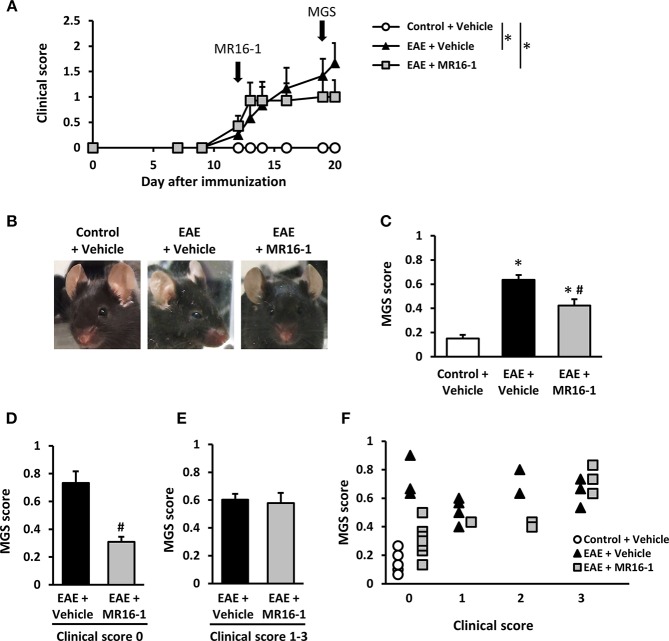
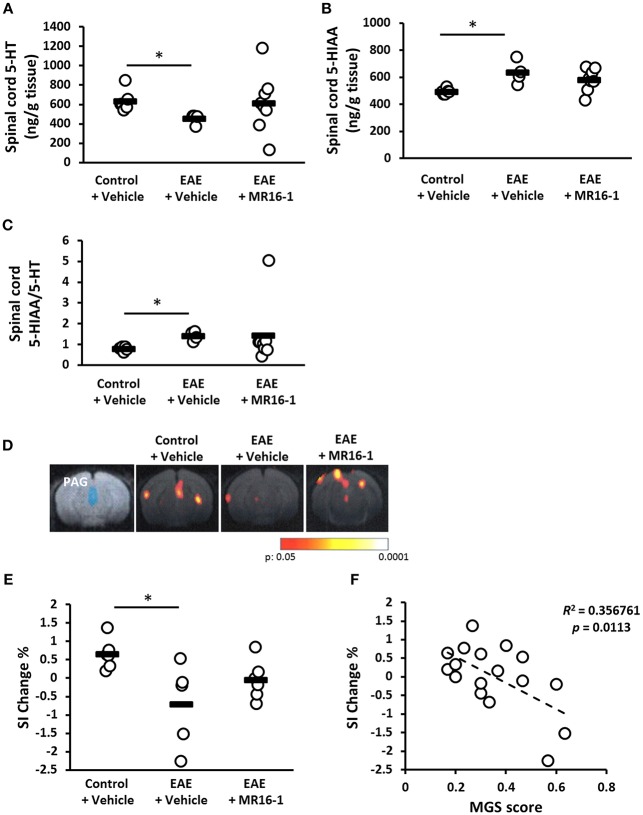
Chronic pain is a significant symptom in patients with autoimmune encephalomyelitis, such as multiple sclerosis and neuromyelitis optica. The most commonly used animal model of these diseases is experimental autoimmune encephalomyelitis (EAE). We previously reported that evoked pain, such as mechanical allodynia, was improved by an anti-IL-6 receptor antibody in EAE mice. However, few reports have evaluated spontaneous pain in EAE mice. Here, we assessed spontaneous pain in EAE mice by utilizing the Mouse Grimace Scale (MGS, a standardized murine facial expression-based coding system) and evaluated the influence of an anti-IL-6 receptor antibody (MR16-1). EAE was induced in female C57BL/6J mice by subcutaneous immunization with myelin oligodendrocyte glycoprotein 35-55 emulsified in adjuvant and administration of pertussis toxin. Mice were placed individually in cubicles and filmed for about 10 min. Ten clear head shots per mouse from the video recording were given a score of 0, 1, or 2 for each of three facial action units: orbital tightening, nose bulge, and ear position. Clinical symptoms of EAE were also scored. Measurement of 5-HT in the spinal cord and functional imaging of the periaqueductal gray (PAG) were also performed. Compared with control mice, MGS score was significantly higher in EAE mice. MR16-1 prevented this increase, especially in pre-onset EAE mice. Promotion of spinal 5-HT turnover and reduction of PAG activity were observed in pre-onset EAE mice. These results suggest that MR16-1 prevented spontaneous pain developed before EAE onset.
慢性疼痛是自身免疫性脑脊髓炎患者的一个重要症状,如多发性硬化症和视神经脊髓炎。这些疾病最常用的动物模型是实验性自身免疫性脑脊髓炎(EAE)。我们之前报道过,在EAE小鼠中,抗IL-6受体抗体可改善诱发性疼痛,如机械性异常性疼痛。然而,很少有报道评估EAE小鼠的自发性疼痛。在此,我们通过使用小鼠痛苦量表(MGS,一种基于标准化小鼠面部表情的编码系统)评估EAE小鼠的自发性疼痛,并评估抗IL-6受体抗体(MR16-1)的影响。通过皮下注射用佐剂乳化的髓鞘少突胶质细胞糖蛋白35-55并给予百日咳毒素,在雌性C57BL/6J小鼠中诱导EAE。将小鼠单独置于小隔间中并拍摄约10分钟。从视频记录中为每只小鼠的十张清晰头部照片在三个面部动作单元(眼眶收紧、鼻隆起和耳朵位置)中的每一个上给予0、1或2分。还对EAE的临床症状进行评分。还进行了脊髓中5-羟色胺的测量和导水管周围灰质(PAG)的功能成像。与对照小鼠相比,EAE小鼠的MGS评分显著更高。MR16-1可防止这种增加,尤其是在发病前的EAE小鼠中。在发病前的EAE小鼠中观察到脊髓5-羟色胺周转率的提高和PAG活性的降低。这些结果表明,MR16-1可预防EAE发病前出现的自发性疼痛。