Hazard Riley H, Kagina Peninah, Kitayimbwa Richard, Male Keneth, McShane Melissa, Mubiru Dennis, Welikhe Emma, Moore Christopher C, Abdallah Amir
University of Melbourne, School of Population and Global Health, Australia.
Mbarara University of Science and Technology, Department of Medicine, Uganda.
Open Forum Infect Dis. 2019 Mar 14;6(4):ofz140. doi: 10.1093/ofid/ofz140. eCollection 2019 Apr.
is the leading cause of bloodstream infection among human immunodeficiency virus (HIV)-infected patients with sepsis in sub-Saharan Africa and is associated with high mortality rates.
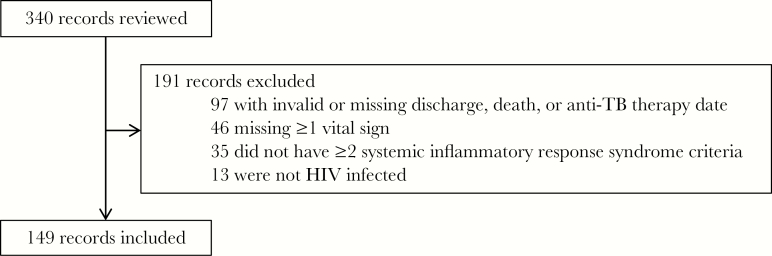
We conducted a retrospective study of HIV-infected adults with sepsis at the Mbarara Regional Referral Hospital in Uganda to measure the proportion who received antituberculosis therapy and to determine the relationship between antituberculosis therapy and 28-day survival.
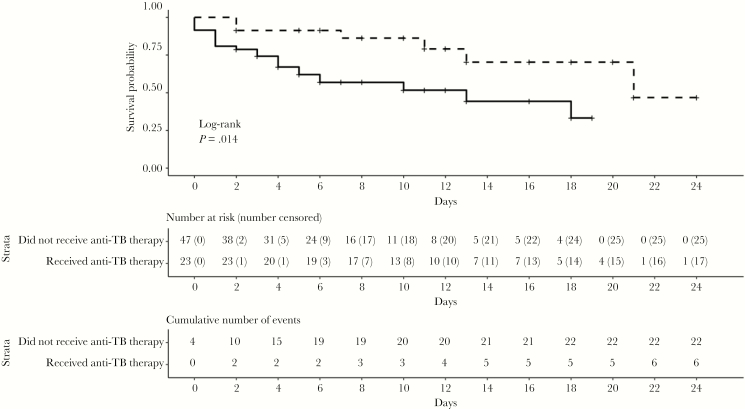
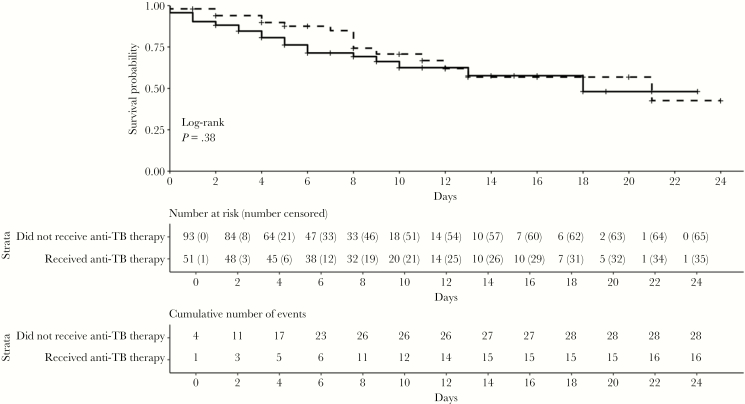
Of the 149 patients evaluated, 74 (50%) had severe sepsis and 48 (32%) died. Of the 55 patients (37%) who received antituberculosis therapy, 19 (35%) died, compared with 29 of 94 (31%) who did not receive such therapy (odds ratio, 1.34; 95% confidence interval [CI], .56-3.18; = .64). The 28-day survival rates did not differ significantly between these 2 groups (log-rank test, = .21). Among the 74 patients with severe sepsis, 9 of 26 (35%) who received antituberculosis therapy died, versus 23 of 48 (48%) who did not receive such therapy (odds ratio, 0.58; 95% CI, .21-1.52; = .27). In patients with severe sepsis, antituberculosis therapy was associated with an improved 28-day survival rate (log-rank test = .01), and with a reduced mortality rate in a Cox proportional hazards model (hazard ratio, 0.32; 95% CI, .13-.80; = .03).
Empiric antituberculosis therapy was associated with improved survival rates among patients with severe sepsis, but not among all patients with sepsis.
在撒哈拉以南非洲地区,是感染人类免疫缺陷病毒(HIV)并患有脓毒症的患者发生血流感染的主要原因,且与高死亡率相关。
我们对乌干达姆巴拉拉地区转诊医院的感染HIV的脓毒症成年患者进行了一项回顾性研究,以测量接受抗结核治疗的患者比例,并确定抗结核治疗与28天生存率之间的关系。
在评估的149例患者中,74例(50%)患有严重脓毒症,48例(32%)死亡。在接受抗结核治疗的55例患者(37%)中,19例(35%)死亡,而未接受此类治疗的94例患者中有29例(31%)死亡(比值比,1.34;95%置信区间[CI],0.56 - 3.18;P = 0.64)。这两组的28天生存率无显著差异(对数秩检验,P = 0.21)。在74例严重脓毒症患者中,接受抗结核治疗的26例中有9例(35%)死亡,未接受此类治疗的48例中有23例(48%)死亡(比值比,0.58;95% CI,0.21 - 1.52;P = 0.27)。在严重脓毒症患者中,抗结核治疗与28天生存率提高相关(对数秩检验P = 0.01),并且在Cox比例风险模型中与死亡率降低相关(风险比,0.32;95% CI,0.13 - 0.80;P = 0.03)。
经验性抗结核治疗与严重脓毒症患者生存率提高相关,但并非与所有脓毒症患者生存率提高相关。