Department of Veterinary Medicine, College of Veterinary Medicine, National Pingtung University of Science and Technology, Pingtung, Taiwan.
Department of Anatomy and Histology, College of Veterinary Medicine, Viet Nam National University of Agriculture, Hanoi, Vietnam.
Virol J. 2019 Apr 27;16(1):52. doi: 10.1186/s12985-019-1159-z.
Canine parvovirus type 2 (CPV-2) was first identified in the late 1970s; it causes intestinal hemorrhage with severe bloody diarrhea in kennels and dog shelters worldwide. Since its emergence, CPV-2 has been replaced with new genetic variants (CPV-2a, CPV-2b, and CPV-2c). Currently, information about the genotype prevalence of CPV-2 in Vietnam is limited. In the present study, we investigated the genotype prevalence and distribution of CPV-2 in the three regions of Vietnam.
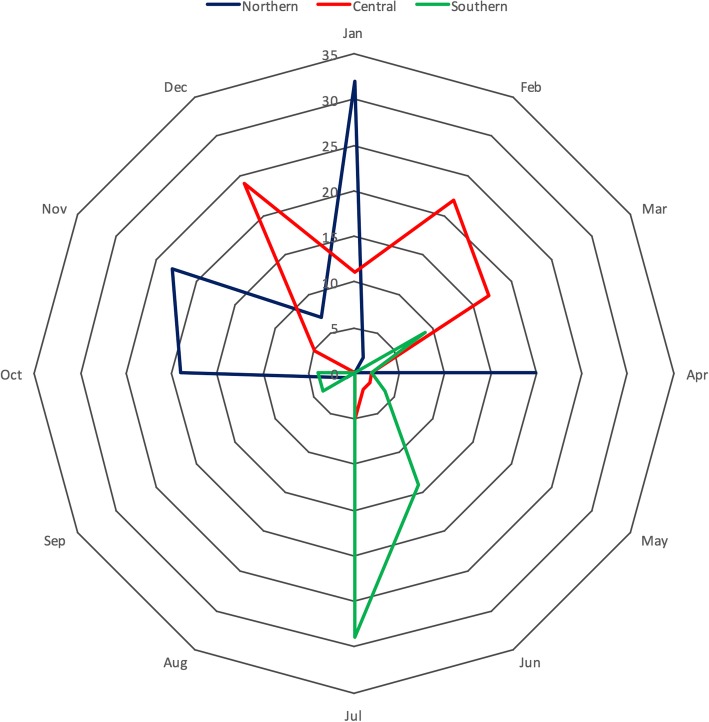
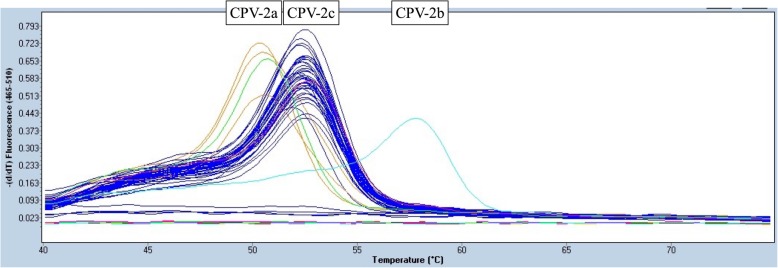
Rectal swabs were collected from 260 dogs with suspected CPV-2 infection from northern, central, and southern Vietnam from November 2016 to February 2018. All samples were identified as parvovirus positive by real-time PCR, and further genotyping was performed using a SimpleProbe® real-time PCR assay.
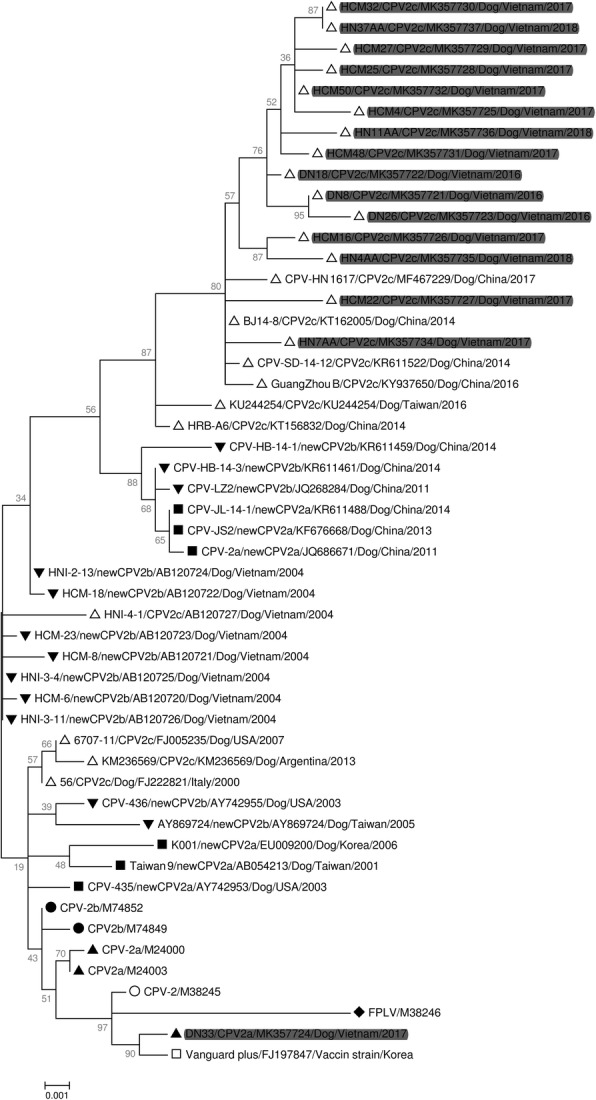
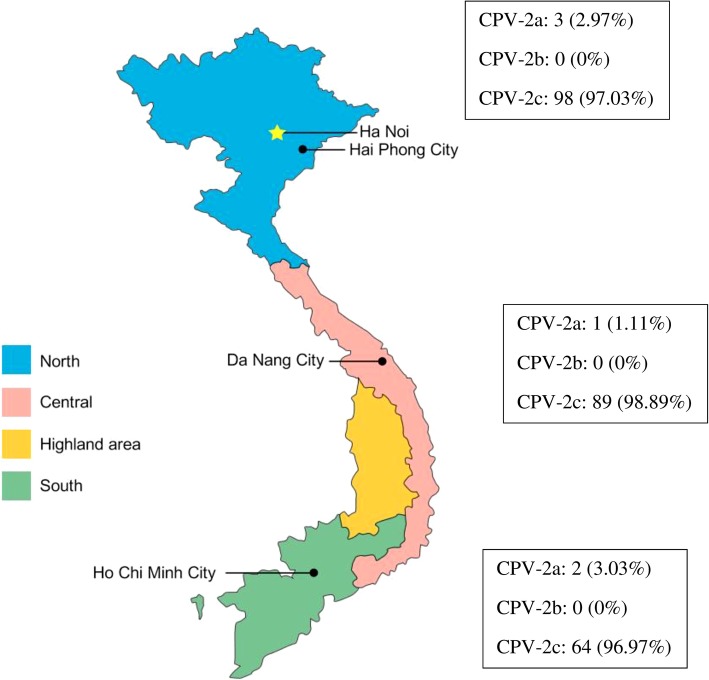
Of the 260 Vietnamese CPV-2 isolates, 6 isolates (2.31%) were identified as CPV-2a, 251 isolates (96.54%) were identified as CPV-2c and 3 isolates (1.15%) were untypable using the SimpleProbe® real-time PCR assay. In northern Vietnam, the percentages of CPV-2a and CPV-2c were 2.97% (3/101) and 97.3% (98/101), respectively. In central Vietnam, the percentages of CPV-2a and CPV-2c were 1.11% (1/90) and 98.89% (89/90), respectively. In southern Vietnam, the percentages of CPV-2a and CPV-2c were 3.03% (2/66) and 96.97% (64/66), respectively. CPV-2b was not observed in this study. The VP2 genes of CPV-2c in Vietnam are more genetically similar to those of CPV-2c strains in China and Taiwan than to those of prototype CPV-2c strains (FJ222821) or the first Vietnamese CPV-2c (AB120727).
The present study provides evidence that CPV-2c is the most prevalent variant in Vietnam. Phylogenetic analysis demonstrated that the recent Vietnamese CPV-2c isolates share a common evolutionary origin with Asian CPV-2c strains.
犬细小病毒 2 型(CPV-2)于 20 世纪 70 年代末首次被发现;它会引起世界各地犬舍和收容所中犬只的肠道出血和严重血性腹泻。自出现以来,CPV-2 已被新的遗传变异体(CPV-2a、CPV-2b 和 CPV-2c)所取代。目前,有关越南 CPV-2 基因型流行情况的信息有限。在本研究中,我们调查了越南三个地区 CPV-2 的基因型流行情况和分布情况。
2016 年 11 月至 2018 年 2 月,我们从越南北部、中部和南部疑似 CPV-2 感染的 260 只犬中采集直肠拭子。所有样本均通过实时 PCR 鉴定为细小病毒阳性,然后使用 SimpleProbe®实时 PCR 检测进行进一步的基因分型。
在 260 株越南 CPV-2 分离株中,有 6 株(2.31%)被鉴定为 CPV-2a,251 株(96.54%)被鉴定为 CPV-2c,3 株(1.15%)无法使用 SimpleProbe®实时 PCR 检测进行分型。在越南北部,CPV-2a 和 CPV-2c 的比例分别为 2.97%(3/101)和 97.3%(98/101)。在越南中部,CPV-2a 和 CPV-2c 的比例分别为 1.11%(1/90)和 98.89%(89/90)。在越南南部,CPV-2a 和 CPV-2c 的比例分别为 3.03%(2/66)和 96.97%(64/66)。本研究未观察到 CPV-2b。越南 CPV-2c 的 VP2 基因与中国和台湾的 CPV-2c 株系更为相似,与原型 CPV-2c 株系(FJ222821)或第一株越南 CPV-2c(AB120727)相比则不太相似。
本研究提供的证据表明 CPV-2c 是越南最流行的变异体。系统进化分析表明,最近的越南 CPV-2c 分离株与亚洲 CPV-2c 株系具有共同的进化起源。