Radboud Institute for Health Sciences, Department of Physiology, Radboud University Medical Center, Nijmegen, the NETHERLANDS.
Radboud Institute for Health Sciences, Department of Cardiology, Radboud University Medical Center, Nijmegen, the NETHERLANDS.
Med Sci Sports Exerc. 2019 Oct;51(10):1995-2002. doi: 10.1249/MSS.0000000000002015.
Hypertrophic cardiomyopathy (HCM) is characterized by inappropriate left ventricular (LV) wall thickness. Adaptations to exercise can occasionally mimic certain HCM characteristics. However, it is unclear whether physical activity affects HCM genotype expression and disease characteristics. Consequently, we compared lifelong physical activity volumes between HCM gene carriers with and without HCM phenotype, and compared disease characteristics among tertiles of physical activity in phenotypic HCM patients.
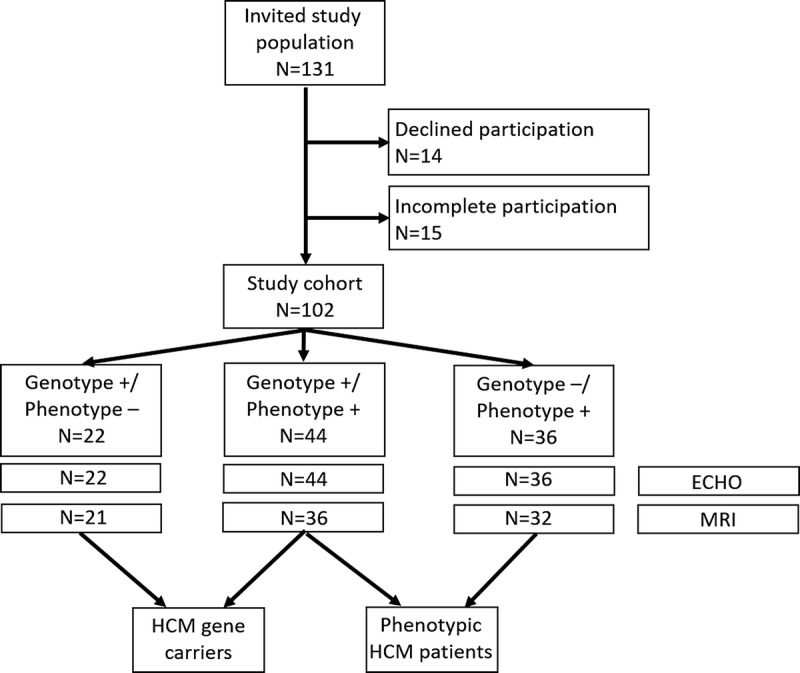
We enrolled n = 22 genotype positive/phenotype negative (G+/P-) HCM gene carriers, n = 44 genotype positive/phenotype positive (G+/P+) HCM patients, and n = 36 genotype negative/phenotype positive (G-/P+) HCM patients. Lifelong physical activity was recorded using a questionnaire and quantified as metabolic equivalent of task hours per week.
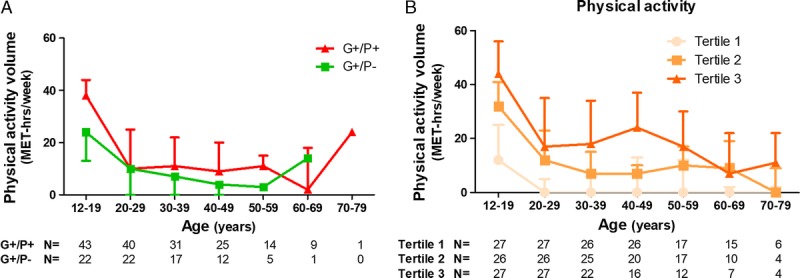
We included 102 participants (51 ± 16 yr, 49% male). Lifelong physical activity volumes were not different between G+/P+ and G+/P- subjects (16 [10-29] vs 14 [6-26] metabolic equivalent of task-hours per week, P = 0.33). Among phenotypic HCM patients, there was no difference in LV wall thickness, mass, and late gadolinium enhancement across physical activity tertiles. Patients with the highest reported physical activity volumes were younger at the time of diagnosis (tertile 1: 52 ± 14 yr, tertile 2: 49 ± 15 yr, tertile 3: 41 ± 18 yr; P = 0.03), and more often had a history of nonsustained ventricular tachycardia (4% vs 30% vs 30%, P = 0.03).
Lifelong physical activity volumes are not associated with genotype-to-phenotype transition in HCM gene carriers. We also found no difference in LV wall thickness across physical activity tertiles. However, the most active HCM patients were younger at the time of diagnosis and had a higher arrhythmic burden. These observations warrant further exploration of the role of exercise in HCM disease development.
肥厚型心肌病(HCM)的特征是左心室(LV)壁厚度异常。运动适应有时可以模仿某些 HCM 特征。然而,目前尚不清楚体力活动是否会影响 HCM 基因型的表达和疾病特征。因此,我们比较了 HCM 基因携带者中有无 HCM 表型的终生体力活动量,并比较了表型 HCM 患者体力活动三分位数之间的疾病特征。
我们纳入了 22 名基因型阳性/表型阴性(G+/P-)HCM 基因携带者、44 名基因型阳性/表型阳性(G+/P+)HCM 患者和 36 名基因型阴性/表型阳性(G-/P+)HCM 患者。使用问卷记录终生体力活动量,并以每周代谢当量任务小时数进行量化。
我们共纳入 102 名参与者(51 ± 16 岁,49%为男性)。G+/P+和 G+/P-受试者的终生体力活动量无差异(16 [10-29]与 14 [6-26]代谢当量任务小时/周,P = 0.33)。在表型 HCM 患者中,体力活动三分位组之间 LV 壁厚度、质量和晚期钆增强无差异。体力活动量最高的患者诊断时年龄较小(第 1 三分位:52 ± 14 岁,第 2 三分位:49 ± 15 岁,第 3 三分位:41 ± 18 岁;P = 0.03),且更常发生非持续性室性心动过速(4%比 30%比 30%,P = 0.03)。
HCM 基因携带者的终生体力活动量与基因型向表型的转变无关。我们还发现 LV 壁厚度在体力活动三分位组之间无差异。然而,最活跃的 HCM 患者在诊断时年龄较小,心律失常负担较高。这些观察结果提示需要进一步探讨运动在 HCM 疾病发展中的作用。