Altman Igor
Combustion Science and Propulsion Research Branch, Naval Air Warfare Center Weapons Division, 1 Administrative Circle, China Lake, CA 93555, USA.
Materials (Basel). 2019 Apr 26;12(9):1368. doi: 10.3390/ma12091368.
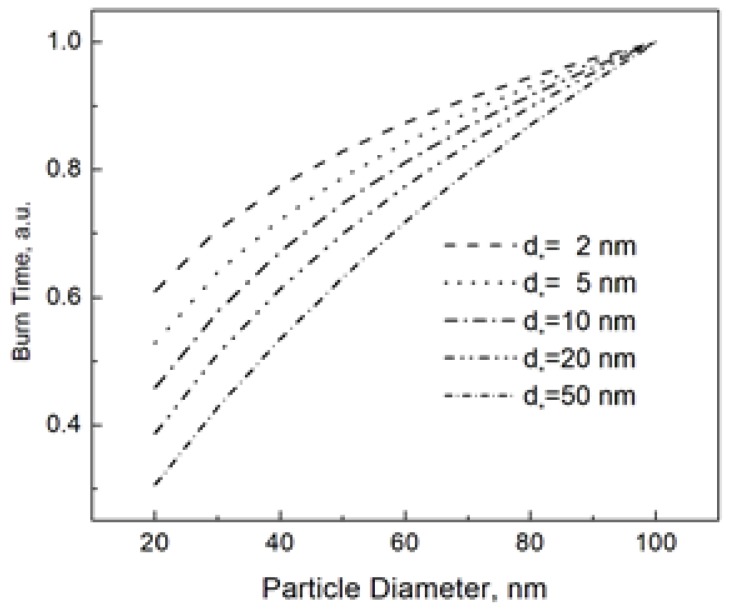
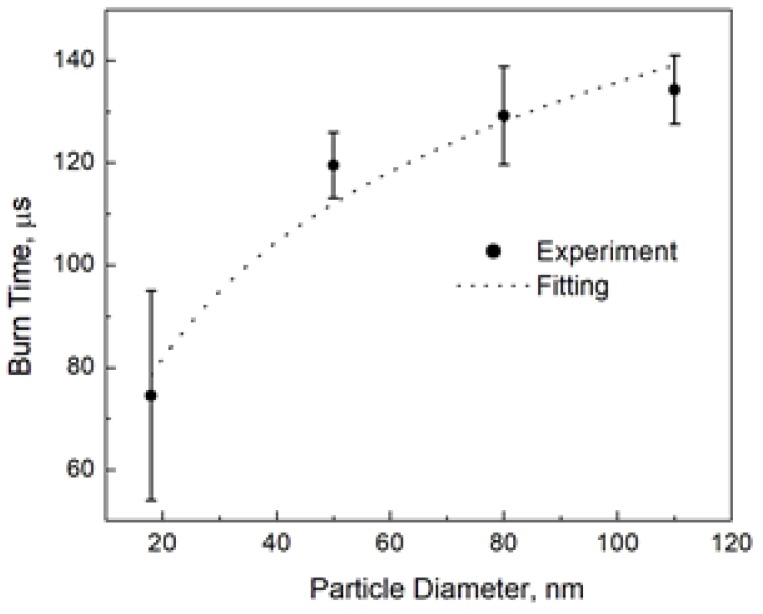
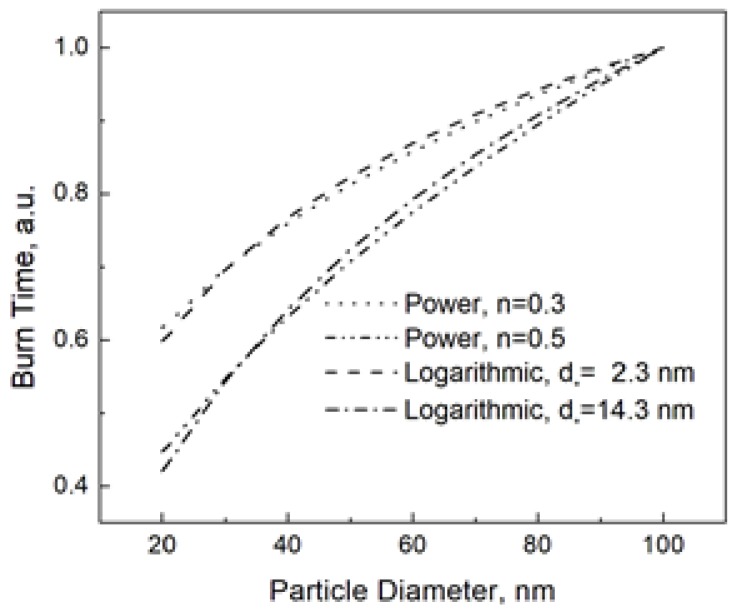
This article will discuss the combustion of metal nanoparticles and explain the burn time dependence on particle size. In contrary to common belief in the power law (~), which, in our knowledge, is simply an experimental fit to data, we propose the logarithmic law () that describes well the known results on nano-aluminum combustion. We derived the logarithmic dependence from a simple model taking into account the energy balance on the surface of a burning metal nanoparticle. The model in question is based on the small energy accommodation coefficient (EAC), which was recently utilized to solve experimental puzzles such as the significant temperature gap between the burning nanoparticle and the environment. A discussion on EAC, which value is important for the correct modeling of nanoparticle combustion, is also included. A way to generalize the considered combustion model is suggested.
本文将讨论金属纳米颗粒的燃烧,并解释燃烧时间对颗粒尺寸的依赖性。与我们所知的幂律(~)这一普遍观点相反,幂律只是对数据的一种实验拟合,我们提出了对数律(),它能很好地描述纳米铝燃烧的已知结果。我们从一个考虑燃烧金属纳米颗粒表面能量平衡的简单模型推导出了对数依赖性。所讨论的模型基于小能量容纳系数(EAC),该系数最近被用于解决诸如燃烧纳米颗粒与环境之间存在显著温度差等实验难题。文中还讨论了EAC,其值对于纳米颗粒燃烧的正确建模很重要。本文还提出了一种推广所考虑燃烧模型的方法。