Hsieh Ming H, Lin Yi-Ting, Chien Yi-Ling, Hwang Tzung-Jeng, Hwu Hai-Gwo, Liu Chih-Min, Liu Chen-Chung
Department of Psychiatry, National Taiwan University Hospital and College of Medicine, Taipei, Taiwan.
Department of Psychiatry, College of Medicine, National Taiwan University, Taipei, Taiwan.
Front Psychiatry. 2019 Apr 15;10:223. doi: 10.3389/fpsyt.2019.00223. eCollection 2019.
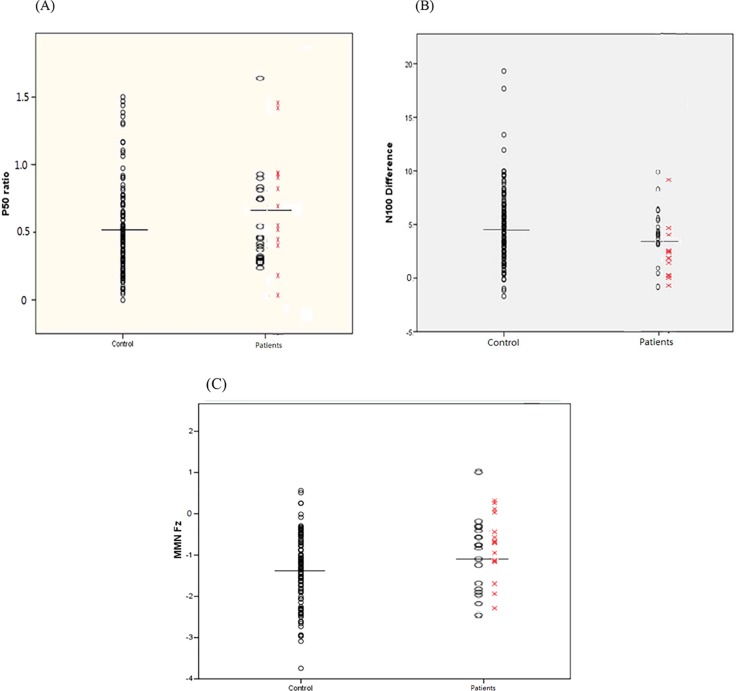
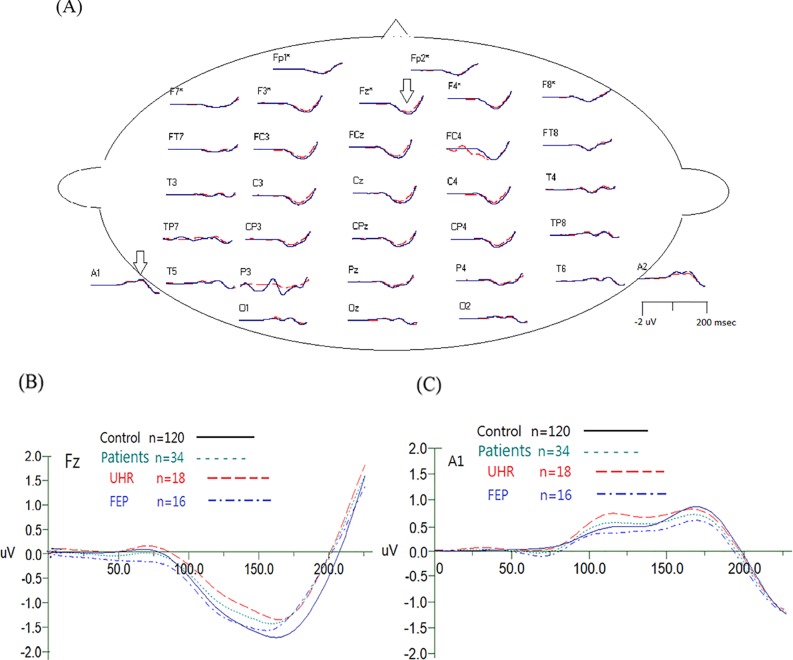
Auditory event-related potentials (ERPs) have been utilized to study defective information processing of patients with schizophrenia. To delineate the pathophysiological processes from pre-psychotic state to first-episode psychosis, a study on subjects from ultra-high-risk (UHR) state to first-episode psychosis, ideally in an antipsychotic-free condition, can add important information to our understanding. Patients with UHR state or at their first-episode psychosis (FEP) who were drug-naive or only have been temporarily treated with antipsychotics were assessed by auditory ERPs measurement, including P50/N100 (sensory gating) and duration mismatch negativity (MMN; deviance detection). A group of age-matched healthy subjects served as their controls. A total of 42 patients (23 UHR and 19 FEP) and 120 control subjects were recruited, including 21 pure drug-naive and 21 with very short exposure to antipsychotics. Collapsing FEP and UHR as a patient group, they exhibited significant sensory deficits manifested as larger P50 S2 amplitude, larger N100 ratio, and smaller N100 difference, and significantly less deviance detection response revealed by MMN. Such differences were less significant when treating FEP and UHR separately for comparisons. Comparisons of ERP results between drug-naive subjects and antipsychotic-short-exposure subjects revealed no significant difference in any P50/N100 and MMN parameter. Our study is one of the few studies focused on drug-naive or minimally treated patients at pre- or early-psychotic states. Our results exhibited impaired performance in sensory gating and deviance detection shown by certain parameters. A longitudinal study with larger sample sizes will be helpful to provide more evidence to elucidate the role of antipsychotics on an individual's neurophysiological performance at different stages of psychosis.
听觉事件相关电位(ERP)已被用于研究精神分裂症患者信息处理缺陷。为了描绘从精神病前期状态到首次发作精神病的病理生理过程,对处于超高风险(UHR)状态至首次发作精神病的受试者进行研究,理想情况下是在未使用抗精神病药物的条件下进行,这可以为我们的理解增添重要信息。对处于UHR状态或首次发作精神病(FEP)且未使用过药物或仅接受过短期抗精神病药物治疗的患者,通过听觉ERP测量进行评估,包括P50/N100(感觉门控)和持续时间失配负波(MMN;偏差检测)。一组年龄匹配的健康受试者作为对照。共招募了42名患者(23名UHR和19名FEP)和120名对照受试者,其中包括21名完全未使用过药物和21名抗精神病药物暴露时间极短的受试者。将FEP和UHR合并为患者组,他们表现出明显的感觉缺陷,表现为P50 S2波幅更大、N100比率更大、N100差异更小,并且MMN显示的偏差检测反应明显更少。分别对FEP和UHR进行比较时,这些差异不太显著。未使用过药物的受试者与抗精神病药物暴露时间短的受试者之间的ERP结果比较显示,在任何P50/N100和MMN参数上均无显著差异。我们的研究是少数关注处于精神病前期或早期且未使用过药物或接受过最少治疗的患者的研究之一。我们的结果显示某些参数在感觉门控和偏差检测方面表现受损。一项样本量更大的纵向研究将有助于提供更多证据,以阐明抗精神病药物在精神病不同阶段对个体神经生理表现的作用。